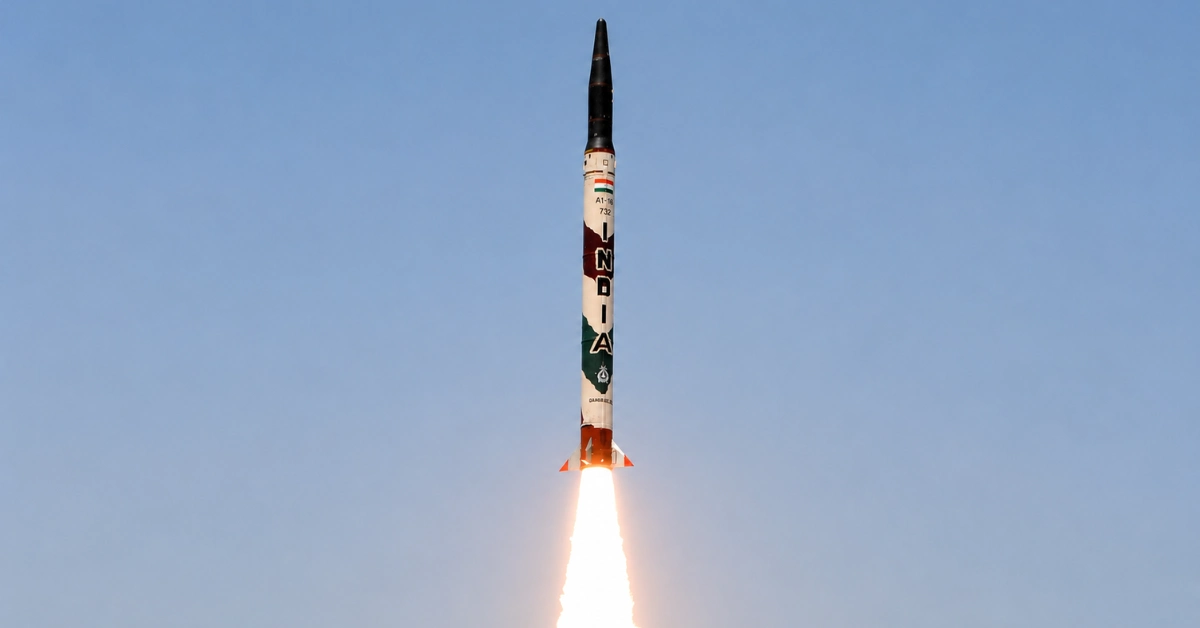
India on Friday, 22 May, successfully carried out the test-launch of the nuclear-capable Agni-1 ballistic missile from the Integrated Test Range (ITR) at Chandipur off the coast of Odisha, with the Ministry of Defence saying the launch validated all operational and technical parameters of the weapon system.
The Ministry of Defence, in a statement issued on 22 May 2026, said the launch was conducted under the aegis of the Strategic Forces Command (SFC), which manages India’s strategic nuclear missile arsenal.
Agni-1 is a short-range, road-mobile ballistic missile developed by the Defence Research and Development Organisation (DRDO) as part of India’s Agni missile programme.
The missile has a strike range of around 700 to 900 Km and is capable of carrying both conventional and nuclear warheads.
The single-stage missile uses solid-fuel propulsion and is designed for quick deployment from mobile launch platforms, giving the armed forces operational flexibility during strategic missions.
Agni-1 was originally developed to bridge the gap between the Prithvi missile series and longer-range Agni systems.
Read also : Rajnath Singh, South Korean Minister inaugurate Indian War Memorial in Seoul
The missile is equipped with an advanced guidance and navigation system designed to improve strike accuracy.
Over the years, India has carried out multiple user trials and operational validation launches of the Agni-1 system as part of efforts to maintain the readiness of the country’s strategic deterrence capability.
The latest launch took place from the Integrated Test Range facility at Chandipur, one of India’s primary missile testing centres.
The Odisha coast regularly hosts trials of strategic and tactical missile systems developed by DRDO for the Army, Navy and Air Force.
India’s Agni missile family includes Agni-1, Agni-2, Agni-3, Agni-4 and Agni-5 variants, with ranges extending from short-range battlefield deterrence to intercontinental strike capability. Agni-5, the longest-range missile in the series, is capable of striking targets at ranges beyond 5,000 Km.
Friday’s launch comes amid continued efforts by India to modernise and validate the operational readiness of its strategic missile forces through periodic testing and induction of upgraded systems.
Read also : India advances indigenous drone warfare capability with successful ULPGM-V3 missile trials