India has rejected recent international media portrayals of its textile recycling industry as environmentally negligent and exploitative, saying such a characterisation is selective and does not reflect the scale, circularity and regulatory transition underway in the sector.
The Ministry of Textiles, in a rebuttal issued on 14 May, said media coverage of textile recycling clusters such as Panipat in Haryana had drawn attention to environmental and occupational concerns, but added that isolated cases of non-compliance should not be used to define the country’s entire textile recycling ecosystem.
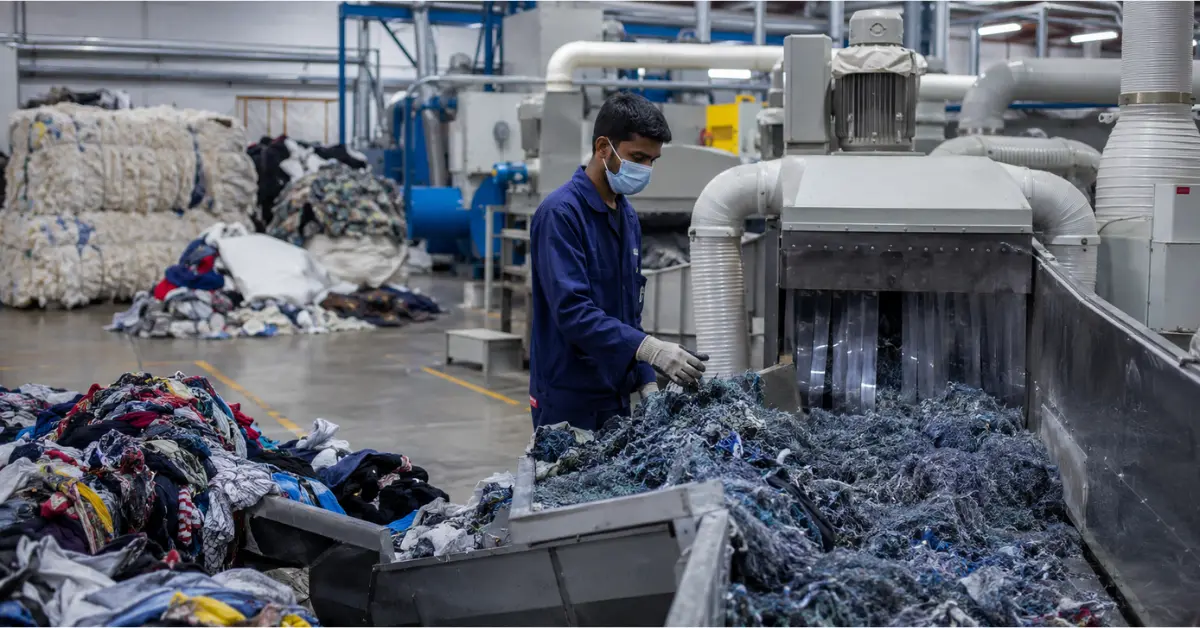
The statement comes at a time when India’s textile waste economy is attracting wider attention because of its scale, informal labour linkages, environmental risks and growing policy push towards circularity. Panipat, often described as one of the world’s major textile recycling hubs, has been central to this debate because of its large concentration of sorting, shredding and fibre-recovery units.
According to the ministry, India has one of the world’s largest textile recovery and recycling networks, built around long-standing systems of reuse, repair, recycling and repurposing. It said that, unlike countries where textile waste is largely sent to landfills, a substantial share of textile waste in India is recovered through formal and informal systems and channelised towards secondary use, fibre recovery, industrial reuse and allied applications.
Citing the 2026 “Mapping of Textile Waste Value Chain in India” study, the ministry said India generates around 7,073 kilo tonnes of textile waste annually, covering both pre-consumer and post-consumer streams. It added that nearly 97% of pre-consumer textile waste generated during manufacturing is recycled, showing a high level of material circularity within domestic manufacturing.
The ministry also disputed claims that India mainly functions as a dumping ground for Western fast-fashion waste. It said the Indian recycling industry is driven largely by domestic needs, with more than 90% of the roughly 7.8 million tonnes of textile waste managed annually sourced from domestic pre-consumer factory scrap and post-consumer waste.
Imported post-consumer waste, according to the ministry, accounts for around 7% of the total volume and is regulated under the Hazardous and Other Wastes (Management and Transboundary Movement) Rules, 2016. The ministry said this imported stream consists mainly of second-hand clothing and mutilated rags, largely traced through harmonised system codes, and flows primarily into the recycling and sorting ecosystem.
The economic significance of the sector is also substantial. Citing a FICCI report titled “Unlocking Value from India’s Textile Waste: A Roadmap for Circularity in the Textile Sector,” the ministry said India’s textile waste ecosystem currently generates an estimated economic value of around ₹22,000 crore annually, with further potential through improved sorting, segregation and higher-value recycling pathways.
Separate industry coverage of the FICCI-RECEIC report has also pointed to a much larger opportunity if India strengthens its collection, sorting and recycling systems. The report has estimated that textile waste recycling could unlock nearly $9.4 billion, or about ₹78,500 crore, in annual value through stronger circularity systems.
Read also : Centre to launch second tranche of limestone block auctions in Jammu and Kashmir
The ministry said India’s reuse and repair culture has traditionally helped keep per capita textile consumption and waste generation lower than in developed economies. It argued that textile recycling should therefore be seen not only as waste management, but also as a source of livelihoods, resource efficiency and secondary material value creation.
At the same time, the ministry acknowledged that concerns remain in parts of the value chain. It said challenges continue in post-consumer textile waste collection, management of blended and synthetic waste, fragmented feedstock aggregation, environmental compliance among smaller informal units, and worker safety in certain segments.
This acknowledgement is significant because criticism of India’s textile recycling industry has often focused on precisely these weak points – dust exposure, poor ventilation, wastewater management, informal work conditions and limited protection for workers in smaller units. The ministry’s position is that these concerns require regulatory and technological intervention, but do not represent the sector as a whole.
The government said textile recycling and processing units are regulated under the Water (Prevention and Control of Pollution) Act, 1974 and the Air (Prevention and Control of Pollution) Act, 1981, with mandatory consent requirements from State Pollution Control Boards. It said enforcement action by the National Green Tribunal and pollution control boards against non-compliant units shows that regulatory institutions are functional and active.
The ministry also pointed to India’s labour law framework, including the Occupational Safety, Health and Working Conditions Code, 2020, the Code on Social Security, 2020, the Code on Wages, 2019 and the Industrial Relations Code, 2020, as part of the statutory framework governing worker welfare, wages, working conditions and workplace safety.
On the environmental side, the ministry cited Life Cycle Assessment research by IIT Delhi using field data from the Panipat cluster. It said research published in the Journal of Cleaner Production in 2025 found that textile recycling reduces 30-40% of key environmental impacts, including greenhouse gas emissions, acid rain potential and fossil fuel depletion, compared with virgin fibre production pathways.
The government also highlighted technology adoption in organised and export-oriented parts of the sector. It said several textile units have invested in advanced recycling technologies, dust extraction systems, zero-liquid discharge wastewater treatment and renewable energy integration.
Tiruppur’s textile cluster was cited as an example of wider adoption of zero-liquid discharge systems in dyeing and processing units. The ministry said units in Tamil Nadu, Gujarat and Haryana are also adopting low-liquor dyeing technologies, advanced water recycling systems, digital process monitoring and energy-efficient processing infrastructure.
Beyond conventional apparel and household textiles, the ministry said India is also developing capabilities in technical textile recycling. It cited the Atal Centre of Textile Recycling and Sustainability at Panipat, established by IIT Delhi under the National Technical Textiles Mission, as having developed and transferred to industry a process for recycling high-performance aramid fibre waste used in bulletproof vests, protective gear, helmets and armoured vehicle components.
The rebuttal suggests that the government is trying to defend India’s textile recycling industry from sweeping criticism while also positioning the sector as a strategic circular-economy opportunity. But the same statement also makes clear that the next phase of growth will depend on better compliance among smaller units, improved worker protection, stronger waste segregation and higher-value recycling technologies.
For India, the policy challenge is to preserve the economic and environmental value of its large recycling network while addressing the occupational and pollution risks that have drawn scrutiny in clusters such as Panipat. The sector’s future credibility will likely depend less on denying the existence of problems and more on how quickly formalisation, enforcement and cleaner technology reach the weaker links in the value chain.