India is preparing a major expansion of its power transmission network to support over 900 GW of non-fossil fuel capacity by 2035-36, with investments of ₹7,93,300 crore aimed at ensuring reliable evacuation of renewable energy, according to a report by the Central Electricity Authority (CEA).
The plan marks a significant scale-up from the current 275 GW non-fossil capacity, which accounts for 52.5% of India’s total installed power base of 524 GW as of February 2026.
A key conclusion of the report is that transmission infrastructure, not generation capacity, is emerging as the primary bottleneck in India’s energy transition.
While solar and wind projects can be developed relatively quickly, transmission systems require longer gestation periods, creating a risk of congestion and renewable energy curtailment if grid expansion does not keep pace.
To address this, the transmission network has been planned for over 900 GW capacity, significantly higher than the projected 786 GW non-fossil requirement, creating a buffer against implementation delays and uneven renewable deployment.
India’s electricity demand is projected to reach a peak of 459 GW and an energy requirement of 3,365 MU by 2035-36.
Total installed capacity is expected to rise to 1,121 GW, with nearly 786 GW coming from non-fossil sources, according to the report.
Read also : India rules out fuel shortage, says petrol, diesel and LPG supplies fully secure amid misinformation surge
Solar and wind energy are expected to dominate this transition, contributing a combined 664 GW, including 509 GW from solar and 155 GW from wind.
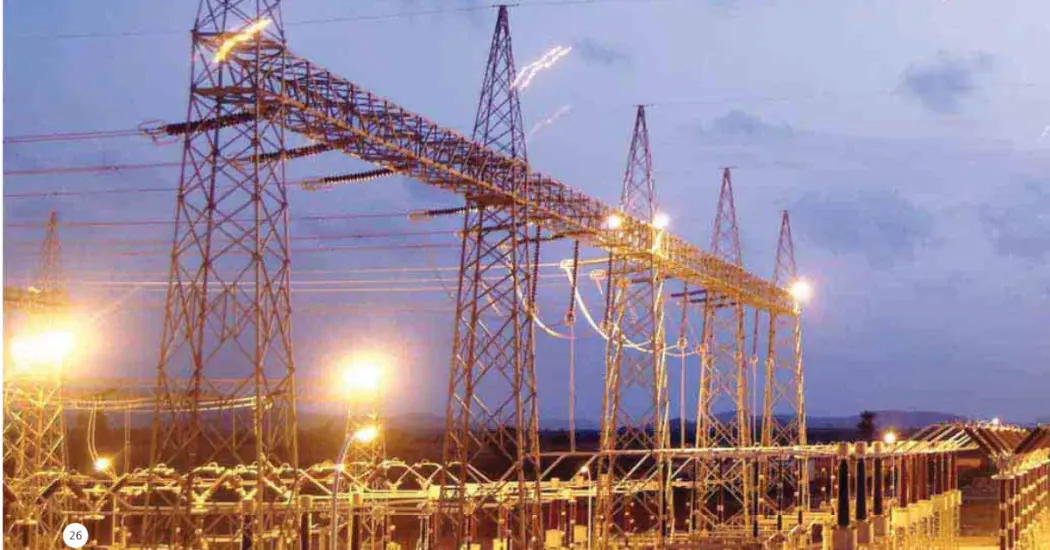
The transmission plan outlines a large-scale infrastructure expansion between 2026-27 and 2035-36, including 1,37,500 circuit Km of transmission lines and 8,27,600 MVA of substation capacity, at an estimated cost of ₹7,93,300 crore.
Transmission planning has been aligned with renewable-rich regions such as Rajasthan, Gujarat, Andhra Pradesh, Maharashtra, Madhya Pradesh, Karnataka, and Telangana, which together account for the bulk of future solar and wind capacity.
The plan also includes evacuation systems for 10 GW of offshore wind projects in Gujarat and Tamil Nadu, along with 9 GW of solar capacity in Ladakh integrated with storage.
Overall, the report maps a transmission-linked non-fossil capacity pipeline of 913.7 GW, including 275.5 GW already commissioned, 506.2 GW under implementation, and 334.5 GW in the planned stage, with an additional 60 GW under planning.
However, certain transmission schemes linked to around 19 GW capacity, including Ladakh and offshore wind projects, remain on hold due to high costs of RE.
The report also highlights the growing importance of energy storage for grid stability, noting that long-duration storage of around 6 hours will be required beyond 2030 to manage high renewable penetration.
Pumped storage projects are expected to play a key role, with a target of achieving 100 GW capacity by 2034-35 to support grid reliability through frequency regulation and voltage control.
The central takeaway from the plan is a strategic shift in India’s power sector approach, where transmission infrastructure is being built ahead of generation capacity to avoid future bottlenecks.
Read also : India absorbs oil shock with ₹10 per litre excise cut on fuel, brings in diesel export levy