India has been largely meeting its electricity demand over the past three financial years and the current year, with only a marginal gap between energy requirement and energy supplied, according to data presented by the Ministry of Power in Parliament.
In a written reply in the Rajya Sabha, the Ministry of Power stated that the country currently has adequate availability of electricity and that the small difference between demand and supply is generally due to constraints in state-level transmission or distribution networks.
“There is adequate availability of power in the country. Present installed generation capacity of the country is 520.51 GW (as on January, 2026). India has addressed the critical issue of power deficiency by adding 296.388 GW of fresh generation capacity since April, 2014 transforming the country from power deficit to power sufficient,” MoS Power Shripad Naik said in the written reply on Monday, 16 March.
“The ‘Energy Supplied’ has been commensurate to the ‘Energy Requirement’ with only a marginal gap which is generally on account of constraints in the State transmission / distribution network,” the ministry said.
According to the data provided by the ministry, in FY2022-23, the country’s energy requirement stood at 15,13,497 million units (MU), while energy supplied was 15,05,914 MU, leaving a shortfall of 7,583 MU or about 0.5% of total demand.
Read also : India installs over 5.97 crore smart meters nationwide as RDSS drives power distribution reforms
In FY2023-24, the gap narrowed further. Energy requirement was recorded at 16,26,132 MU while supply reached 16,22,020 MU, leaving only 4,112 MU unmet, equivalent to 0.3% of demand.
The situation improved significantly in FY2024-25. Energy requirement rose to 16,93,959 MU and energy supplied reached 16,92,369 MU, resulting in a shortfall of just 1,590 MU or around 0.1%.
For the current financial year 2025-26 (up to February 2026), the gap has become almost negligible.
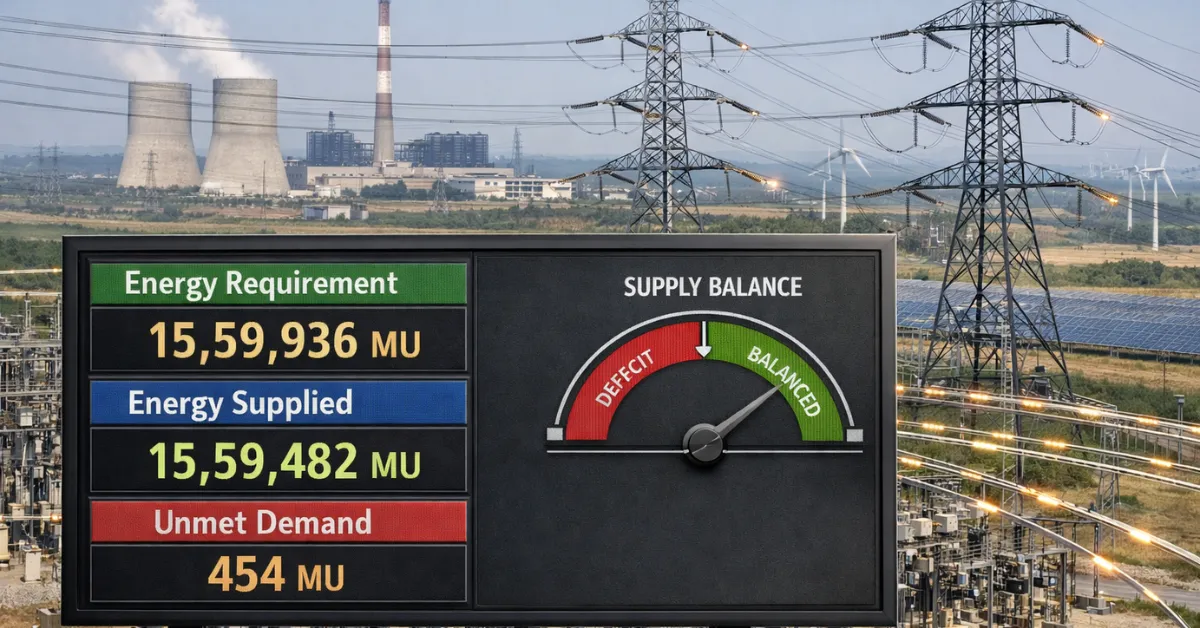
Energy requirement stood at 15,59,936 MU while supply was 15,59,482 MU, leaving an unmet demand of only 454 MU.
Peak power demand data also shows a similar trend of near-complete fulfillment.
In FY2022-23, peak demand reached 2,15,888 MW while peak supply met was 2,07,231 MW, leaving a gap of 8,657 MW or about 4.0%.
In FY2023-24, peak demand rose to 2,43,271 MW with 2,39,931 MW met, leaving 3,340 MW of demand unmet or roughly 1.4%.
In FY2024-25, peak demand touched 2,49,856 MW and almost the entire requirement was met, with only 2 MW of demand not served.
During FY2025-26 up to February, peak demand stood at 2,45,444 MW while peak met was 2,45,416 MW, leaving only 28 MW unmet.