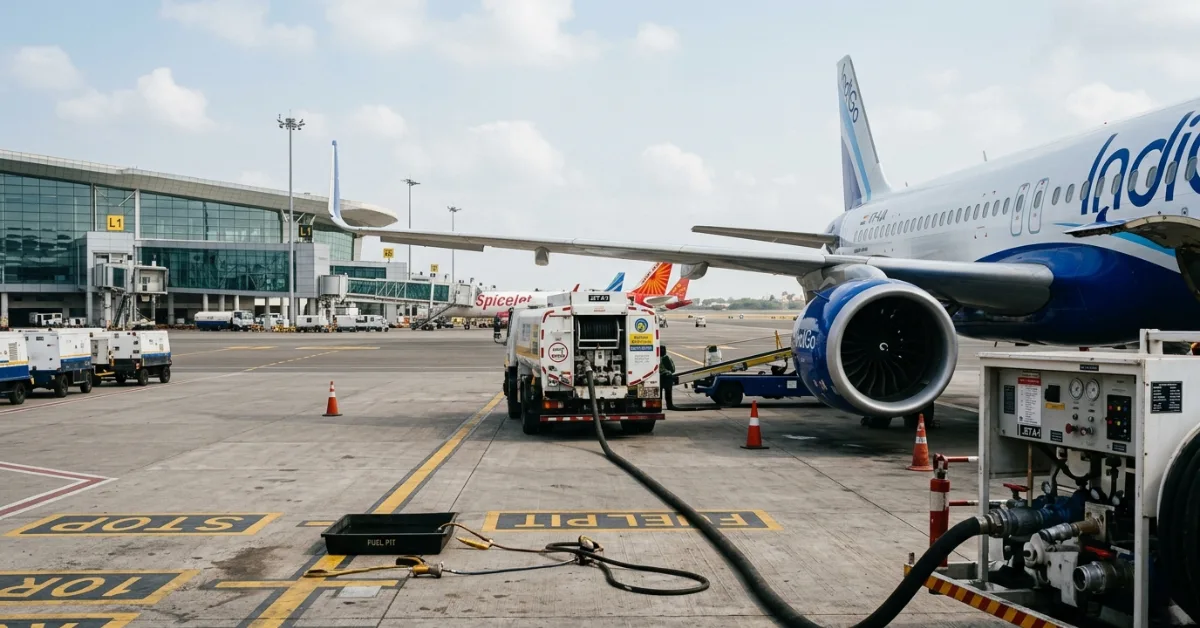
The Union Cabinet has approved a one-time budgetary support of up to ₹10,000 crore for Oil Marketing Companies (OMCs) to provide Aviation Turbine Fuel (ATF) price stabilisation support to scheduled Indian airlines for both domestic and international operations.
The decision was taken by the Cabinet chaired by Prime Minister Narendra Modi on Wednesday, 3 June, and is aimed at reducing the impact of exceptional fuel price volatility arising from the ongoing West Asia crisis.
Under the approved mechanism, the government will provide an interest-free advance to OMCs through the Ministry of Petroleum and Natural Gas.
The fund will compensate OMCs whenever international ATF prices exceed the benchmark price determined under the approved framework.
In a statement, the Cabinet said the support will help provide greater stability and predictability in fuel costs for airlines through a fixed-price ATF arrangement, reducing their exposure to sudden spikes in fuel prices.
The scheme will be available to all willing scheduled Indian carriers for both domestic and international operations.
Read also: India’s 100% green energy powered airports rise from zero in 2014 to 90+ in 2026
Participating airlines will procure ATF exclusively from OMCs under a memorandum of understanding involving the airlines, the Ministry of Civil Aviation and the Ministry of Petroleum and Natural Gas.
The arrangement will remain in force for up to 36 months, subject to annual review, or until the entire advance amount is recovered and settled, whichever is earlier.
According to the approved framework, when international ATF prices moderate, the differential amount will be recovered from OMCs and returned to the Consolidated Fund of India through a recovery and true-up mechanism.
A Monitoring Committee comprising representatives of the Ministry of Civil Aviation, Ministry of Petroleum and Natural Gas and the Department of Expenditure will oversee implementation, claim verification, reconciliation and settlement. All claims and recoveries will be subject to audit.
The government said the measure is expected to support domestic and international air connectivity, reduce the pass-through of fuel price shocks to passengers and moderate fare volatility.
It is also expected to help maintain connectivity to remote, regional, Tier-II and Tier-III cities and ensure continued utilisation of airport infrastructure, including airports developed under the UDAN scheme.
The Cabinet noted that global ATF prices have witnessed unprecedented volatility following the West Asia crisis.
International ATF prices rose from ₹60.50 per litre in March 2026 to ₹142 per litre in May 2026, an increase of nearly 2.5 times.
ATF accounts for around 40 per cent of airline operating costs and can rise to as much as 60 per cent of total operating expenditure during periods of extreme fuel price volatility.
The government also highlighted that the closure of Pakistan’s airspace for Indian carriers has resulted in longer flight paths to Europe, North America and Central Asia, increasing fuel consumption and operating costs.
The situation has contributed to higher long-haul passenger fares, weaker international demand and the reduction or suspension of services on several international routes.