India has become the 19th country in the world to deploy an advanced integrated aviation weather monitoring system, with the country’s first SkyCast System inaugurated at Indira Gandhi International Airport in New Delhi, the Ministry of Earth Sciences said in a statement on Friday, 29 May.
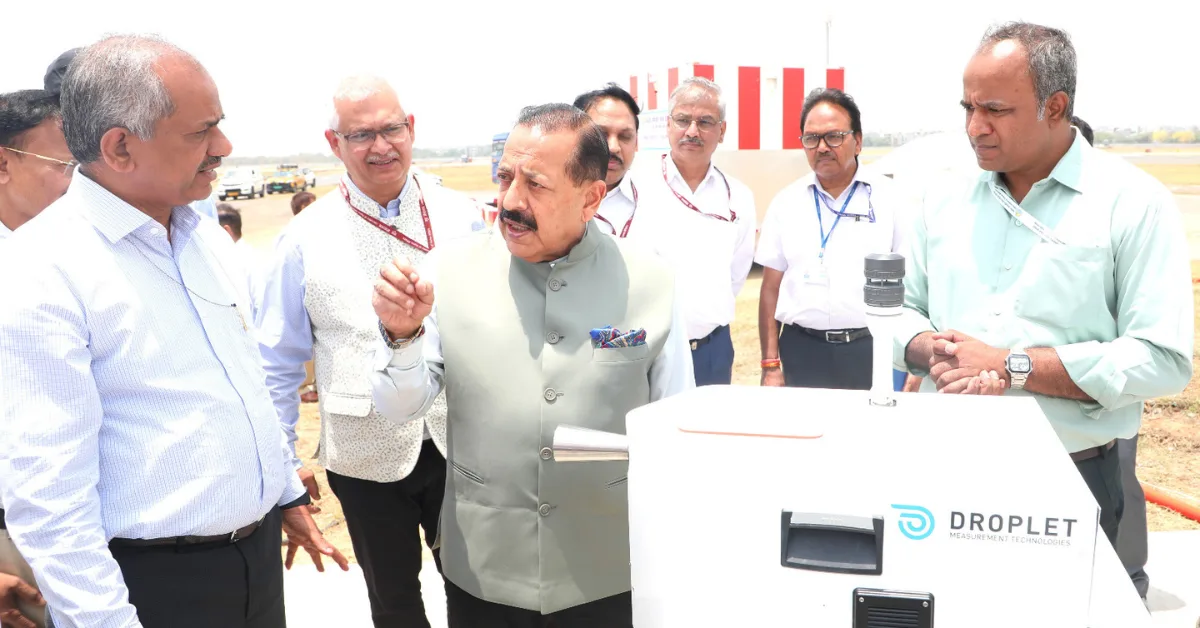
The system was inaugurated by Union Minister Dr Jitendra Singh at IGI Airport.
The ministry said the facility marks India’s entry into a new phase of weather-smart aviation, with real-time weather intelligence aimed at helping pilots, airlines, airport operators and air traffic management agencies.
The SkyCast System has been developed under Mission Mausam and is designed to improve aviation safety and operational efficiency by strengthening monitoring of fog, wind, turbulence, aerosols, moisture, visibility and other atmospheric conditions around airports.
The facility is particularly significant for Delhi airport, where winter fog often disrupts flight operations.
The ministry said the system will support advance alerts within short time windows of around three hours, helping aircrew and pilots take better decisions on landings and reducing avoidable delays, diversions and cancellations.
SkyCast brings together multiple atmospheric observation technologies, including a Radar Wind Profiler, SODAR, Microwave Radiometer, Ground-based Fog Aerosol Spectrometer and CL61 Lidar-based Ceilometer.
These instruments will provide continuous and high-resolution data on weather conditions around the airport.
A key component of the system is the advanced boundary layer Radar Wind Profiler. It can measure wind speed, wind direction, turbulence, vertical velocity and boundary-layer dynamics up to nearly 3 Km above the airport, a level that is critical for aircraft descent, approach and landing operations.
The Ground-based Fog Aerosol Spectrometer is expected to provide important data on fog droplets, aerosols and aerosol-fog interaction. This is relevant for Delhi because pollution particles and moisture often combine during winter, reducing visibility and affecting airport operations.
The new system is also linked to the scientific work carried out under the Winter Fog Experiment, which was jointly initiated by the Indian Institute of Tropical Meteorology and the India Meteorological Department at IGI Airport in 2015. The experiment helped improve understanding of fog formation, aerosol-cloud interaction, visibility reduction and urban boundary-layer processes.
Along with the SkyCast System, a Fog Observatory facility at Glide Path 10 was also inaugurated at Delhi airport.
The observatory is expected to strengthen runway-level monitoring and improve the quality of localised weather information available for airport operations.
The ministry said the next SkyCast facility will be set up at Jewar Airport in Uttar Pradesh, followed by expansion to other airports across the country. This planned rollout is aimed at bringing advanced aviation weather monitoring capabilities to more high-traffic and weather-sensitive airports.
Mission Mausam was approved by the Union Cabinet in September 2024 with an outlay of ₹2,000 crore over two years.
The programme aims to strengthen India’s weather and climate services through next-generation radars, advanced sensors, high-performance computing systems and improved observation networks.
The deployment of SkyCast also fits into a wider aviation modernisation push, where weather data, airport operations and flight planning are becoming increasingly integrated.
For airports affected by fog, turbulence and low visibility, such systems can help reduce uncertainty and improve coordination between meteorological teams and aviation operators.
Beyond aviation, the data generated by SkyCast is expected to support advanced forecasting models, artificial intelligence-enabled decision support systems, urban weather forecasting, pollution management, transport advisories and disaster preparedness.
With the launch of the system at IGI Airport, India has joined a small group of countries using integrated atmospheric remote sensing technology for aviation weather monitoring, while also creating a domestic model that can be expanded across major airports in the coming years.