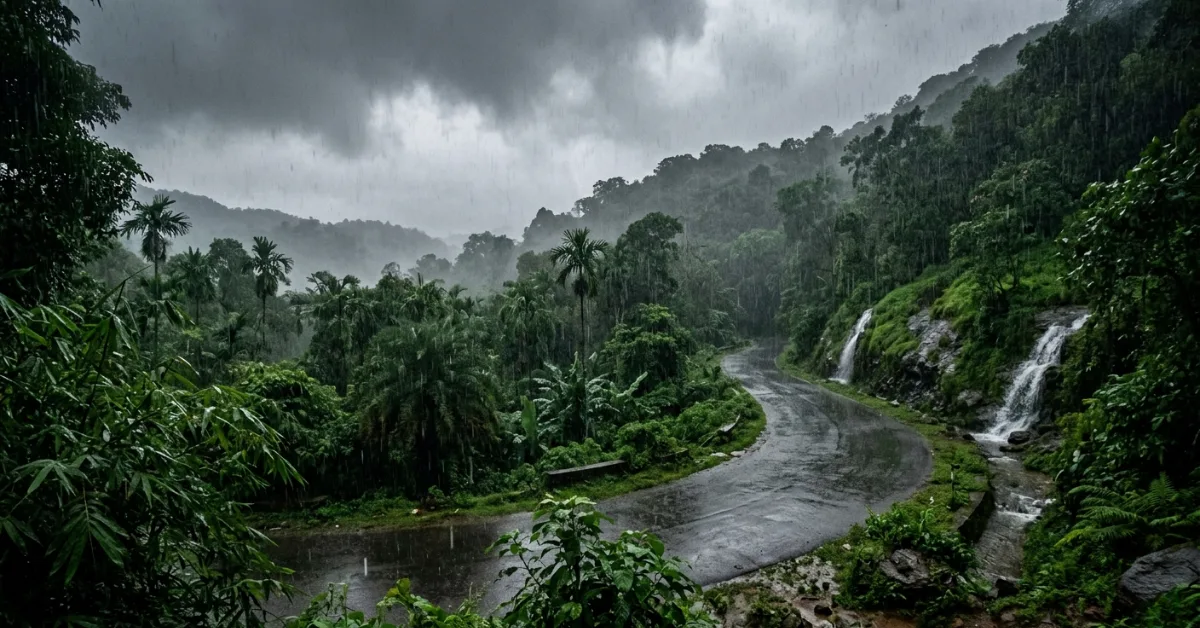
India is likely to receive below-normal rainfall during the 2026 southwest monsoon season, with the India Meteorological Department projecting seasonal rainfall at 90 per cent of the Long Period Average.
The updated long-range forecast, released by the Ministry of Earth Sciences on Friday, said monsoon rainfall during June-September 2026 is likely to remain below normal for the country as a whole, with a model error of ±4 per cent.
The Long Period Average for the southwest monsoon season, based on 1971-2020 data, is 87 cm.
The forecast marks a weak monsoon outlook at a time when large parts of the economy remain dependent on seasonal rainfall for agriculture, reservoirs, hydropower generation and rural demand.
According to IMD, there is an 84 per cent probability of below-normal or lower rainfall during the season.
The forecast gives a 60 per cent probability of deficient rainfall, 24 per cent probability of below-normal rainfall, 14 per cent probability of normal rainfall and only 2 per cent probability of above-normal rainfall.
The probability of excess rainfall has been placed at zero.
Spatially, below-normal seasonal rainfall is likely over most parts of the country. However, some areas over northwest and northeast India, eastern parts of peninsular India, adjoining areas of east-central India and isolated pockets of east India may receive normal to above-normal rainfall.
The outlook is significant for the monsoon core zone, which includes large rainfed agricultural areas.
IMD has forecast a 43 per cent probability of below-normal rainfall over the monsoon core zone, against 33 per cent probability of normal rainfall and 24 per cent probability of above-normal rainfall.
Among the four broad regions, northwest India has a 46 per cent probability of below-normal rainfall. Central India has a 43 per cent probability of below-normal rainfall, while the south peninsula has a 45 per cent probability of below-normal rainfall. Northeast India has a more balanced outlook, with 33 per cent probability of below-normal rainfall, 35 per cent probability of normal rainfall and 32 per cent probability of above-normal rainfall.
June is also expected to begin on a weak note. IMD said rainfall for the country as a whole during June 2026 is most likely to be below normal, at less than 92 per cent of the Long Period Average. The June rainfall LPA, based on 1971-2020 data, is 165.4 mm.
Below-normal monthly rainfall is likely over most parts of India in June, except some parts of northwest and northeast India, many parts of south peninsula and isolated areas of central India, where normal to above-normal rainfall is likely.
The weak rainfall forecast comes as the Pacific Ocean shows signs of shifting towards El Nino conditions. IMD said neutral El Nino-Southern Oscillation conditions are currently transitioning towards El Nino conditions over the equatorial Pacific region. The latest climate model forecasts indicate that El Nino conditions are likely to develop during the southwest monsoon season.
Neutral Indian Ocean Dipole conditions are currently seen over the Indian Ocean and are likely to continue during the monsoon season, according to IMD.
Alongside the rainfall outlook, IMD has also warned of hotter conditions in June. Above-normal maximum temperatures are likely over most parts of the country, except some parts of central, northwest and east India, where normal to below-normal maximum temperatures are likely.
Above-normal minimum temperatures are also likely across most parts of India, except some parts of northwest, central and adjoining south peninsular India.
Heatwave days are expected to be above normal in many parts of Uttar Pradesh, Haryana, Punjab, Bihar, Odisha, Chhattisgarh, Gujarat and Andhra Pradesh. Isolated regions of Maharashtra, Telangana, Himachal Pradesh and Tamil Nadu may also see above-normal heatwave days.
However, Rajasthan and Jharkhand are likely to record below-normal heatwave days in June.
IMD said below-normal rainfall can create challenges for agriculture, water availability, hydropower generation and ecosystem sustainability. It may also raise the risk of drought, heat stress and pressure on drinking water resources.
The department has advised water conservation, agriculture contingency planning, stronger drought monitoring, use of early warning services and preparedness in vulnerable sectors.
For heatwave preparedness, state governments and district administrations have been advised to ensure cooling shelters, safe drinking water, health surveillance and emergency response systems.
IMD said it will issue the forecast for July rainfall in the last week of June 2026.