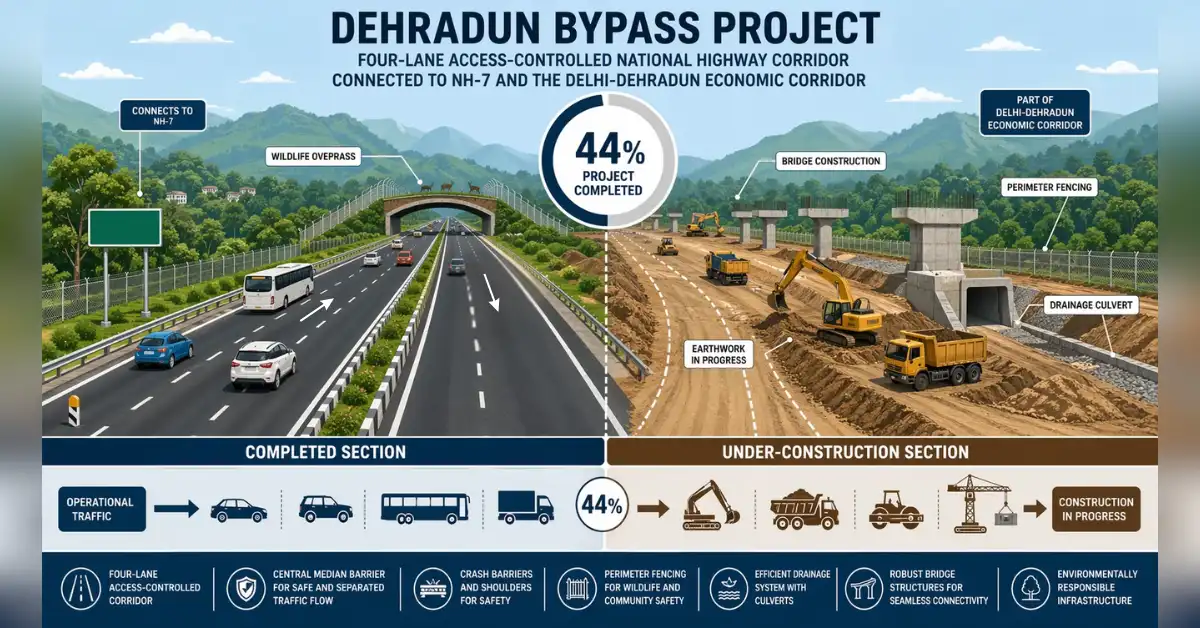
The 12 Km long Dehradun bypass project being developed by the National Highways Authority of India (NHAI) has reached around 44 per cent physical progress and is scheduled for completion by April 2027.
According to the Ministry of Road Transport and Highways, the project is being constructed at a capital cost of around ₹716 crore as a greenfield, four-lane access-controlled corridor aimed at decongesting traffic in Dehradun and improving regional connectivity.
The bypass originates from Jhajhra, connecting the Paonta Saheb-Ballupur section of NH-7, and extends up to the Delhi-Dehradun Economic Corridor near Asharori Check Post in Dehradun district.
Designed as an alternate south-western route, the corridor will divert non-destined traffic away from the city’s urban core, particularly traffic heading towards Selaqui industrial area, Vikasnagar, Herbertpur in Uttarakhand and Paonta Sahib in Himachal Pradesh.
The project is expected to significantly reduce congestion and vehicular pollution within Dehradun, while strengthening inter-state connectivity with Haryana, Punjab and Himachal Pradesh through the Delhi-Dehradun Economic Corridor.
Built with sustainability considerations, the bypass has a design speed of 100 Kmph, with certain forest stretches regulated at 80 Kmph to minimise environmental impact.
The right of way has been restricted to 30 metres, compared to the conventional 60 metres, to preserve forest cover.
To address wildlife movement, the project includes a 350 metre vehicular overpass for large animals, a dedicated cattle overpass, seven minor bridges, 21 box culverts, and five Hume Pipe culverts for smaller fauna.
Continuous fencing and wildlife signage are also being installed along the stretch.
Upon completion, the bypass will divert heavy and transit traffic away from Dehradun city, improving urban mobility and connectivity to key tourist destinations such as Mussoorie.