Chhattisgarh’s Raipur has created nearly 32,000 rainwater harvesting and groundwater recharge structures under the nationwide Jal Sanchay Jan Bhagidari initiative, positioning the city as a model for community-led urban water security, the Ministry of Jal Shakti said in a statement on Friday, 29 May.
The initiative has been taken up by the Raipur Municipal Corporation in collaboration with technical experts, builders, institutions and citizens to address declining groundwater levels and recurring waterlogging in the city.
Raipur receives nearly 1200-1400 mm of annual rainfall, but rapid urbanisation, increasing concretisation and excessive groundwater extraction had created serious water management challenges. A large share of rainwater was earlier lost as runoff through drains during the monsoon.
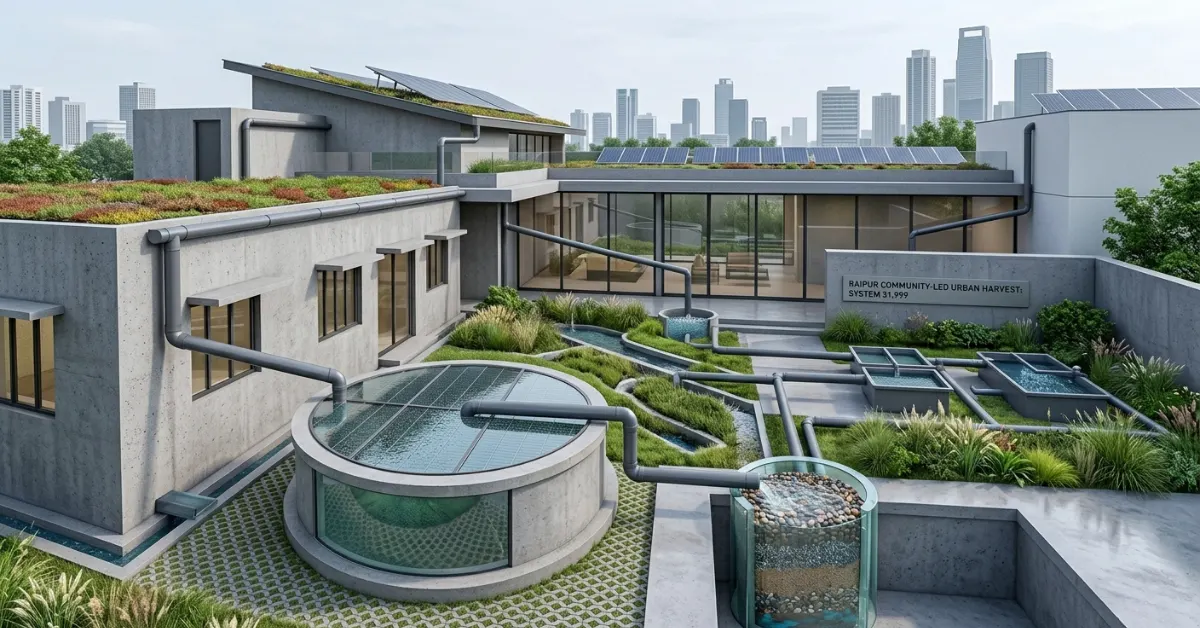
Under the campaign, several types of rainwater harvesting and recharge systems have been created across the city. These include recharge wells, percolation pits, injection wells, recharge shafts, rooftop harvesting systems and stormwater recharge structures.
A key part of Raipur’s model has been public-private participation. Builders and developers associated with CREDAI have integrated rainwater harvesting systems in residential colonies, commercial complexes, institutional campuses and public spaces.
The city has also adopted cost-effective technical solutions suited to local hydrogeological conditions. Permeable Eco Blocks are being promoted on footpaths, parking areas and open spaces to support natural groundwater recharge and reduce waterlogging.
Another intervention involves tractor-mounted auger drilling technology, multilayer filtration systems and slotted recharge pipes. This method has helped enable faster and cheaper construction of recharge structures at multiple locations.
The recharge potential from these systems is significant. Recharge wells can replenish up to three lakh litres of water annually, while injection well systems in groundwater-stressed areas can recharge up to fifteen lakh litres every year.
Raipur’s water conservation push is also being linked with long-term urban planning. Under town and country planning provisions, developers are being encouraged to reserve at least 1 per cent of planned areas for water harvesting and green spaces.
The city is also institutionalising regular maintenance and desilting mechanisms for recharge systems, ensuring that the created infrastructure remains functional beyond the initial campaign phase.
Alongside groundwater recharge, Raipur is advancing broader water resilience measures. An integrated Eco Bloc project across the Kharun River is being implemented with an outlay of ₹30 crore under a disaster management initiative to conserve rainwater at scale and support a “Sponge City” model.
The interconnection of ponds and lakes is also being undertaken to improve urban water storage and distribution. Parallel efforts are being made to promote treated wastewater reuse for industrial and infrastructure purposes, strengthening circular water management in the city.
Raipur’s experience highlights a shift in urban water governance, where groundwater conservation is being treated not only as an engineering challenge but also as a civic mission involving government agencies, communities and local stakeholders.
As Indian cities face growing groundwater stress, urban flooding and climate-related water challenges, Raipur’s model shows how policy support, technical innovation and community participation can turn rainwater from seasonal runoff into a long-term source of urban resilience.
Read also: GMDA to complete green makeover of key Gurugram junctions by 15 June