
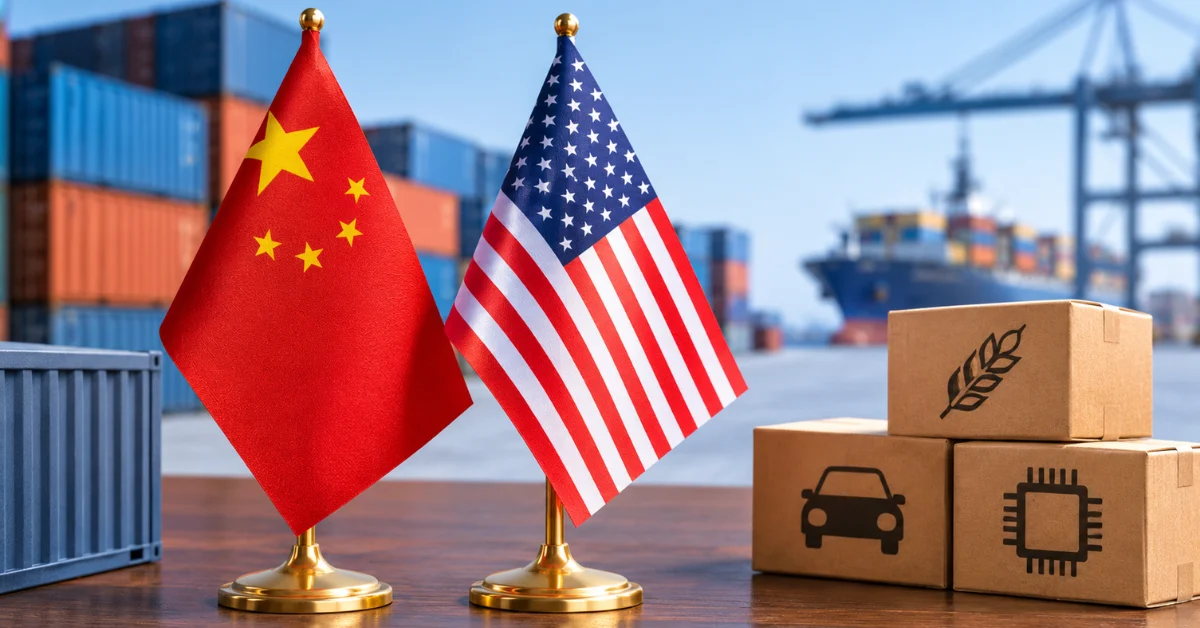
Beijing, November 15: China and the United States have held their first trade council meeting under a bilateral economic and trade consultation mechanism, discussing tariffs, agricultural trade and proposed reciprocal tariff reductions covering approximately $30 billion worth of imported goods on each side.
The meeting took place via video conference on November 13, China’s Ministry of Commerce confirmed in a statement on November 14.
According to the ministry, representatives from both countries discussed the implementation of outcomes from earlier economic and trade consultations, including a proposed reciprocal tariff-reduction arrangement involving approximately $60 billion worth of goods in total.
However, the ministry did not announce a new trade agreement or confirm that additional tariff reductions had taken effect following the meeting.
The discussions marked the first formal meeting of the bilateral trade council, known in US government documents as the U.S.-China Board of Trade.
The body was established to provide a dedicated channel for addressing trade concerns and exploring opportunities for cooperation between the world’s two largest economies.
China’s Commerce Ministry described the talks as candid, in-depth and constructive, covering tariffs, agricultural trade and other issues of mutual concern.
A major focus was the previously discussed reciprocal tariff-reduction framework, commonly known as the “$30 billion-for-$30 billion” arrangement.
Under the framework, the United States and China have identified lists of imported products worth approximately $30 billion on each side for potential reductions in customs duties.
The combined value of the goods covered by the proposed arrangement is therefore approximately $60 billion.
However, this figure represents the value of goods under consideration for lower tariffs, not the amount of tariff revenue that would be eliminated or savings already achieved.
The two governments agreed to establish the trade council in May 2026 as part of efforts to manage bilateral commercial disagreements and strengthen economic communication.
The reciprocal tariff-reduction framework was subsequently developed during consultations in September.
According to a White House document dated September 23, officials from both countries agreed on the terms of reference for the arrangement, and their respective principals approved two lists of products with comparable trade values.
The values assigned to the products were calculated using bilateral trade figures from 2024.
However, the document specifies that future tariff reductions must be determined and implemented in accordance with each country’s domestic legal procedures.
As a result, approval of the product lists does not mean that the proposed lower tariffs have already come into force.
Agricultural trade was another important subject during the November 13 discussions.
According to Reuters, the proposed reciprocal tariff package includes approximately $17 billion worth of American agricultural products imported by China in 2024.
This figure represents the historical value of agricultural products included in the proposed arrangement and should not be treated as a new purchase commitment made during the latest meeting.
Agricultural trade remains an important issue in relations between Washington and Beijing, particularly because American farmers depend on access to overseas markets, including China.
Reuters reported that China’s purchases of US agricultural products other than soybeans were on course to reach a seven-year low in 2026, despite an earlier commitment involving $17 billion in annual agricultural purchases through 2028.
Beijing has also urged Washington to implement the proposed reciprocal tariff reductions, linking progress on the arrangement to increased purchases of American agricultural products.
The trade council meeting took place ahead of an expected meeting between US President Donald Trump and Chinese President Xi Jinping on the sidelines of the Asia-Pacific Economic Cooperation forum in Shenzhen.
According to Reuters, the White House said the two leaders were expected to meet on November 19.
However, neither government announced that a new tariff agreement would be signed during the anticipated leaders’ meeting.
China’s Commerce Ministry said both sides had agreed to continue communicating through the trade council to address economic and trade concerns, expand cooperation and reduce outstanding disagreements.
The council provides a formal mechanism through which officials can discuss tariff arrangements, agricultural trade and other commercial issues.
For businesses involved in trade between the United States and China, progress on reciprocal tariff reductions could eventually affect import costs and market access.
However, the impact will depend on the final scope of any agreement, the tariff rates adopted and implementation by the respective governments.
The November 13 meeting represented the first operational step for the bilateral trade council rather than the conclusion of a new tariff agreement.
While the two countries have established a formal channel for continued negotiations, the latest announcement does not specify new tariff rates, an implementation date or additional binding commitments.
The discussions therefore signal continued engagement between Washington and Beijing, while the proposed reciprocal tariff reductions remain subject to further decisions and implementation.
Read also: Ola fined ₹10 lakh over misleading pre-ride tipping, CCPA orders practice to stop
Read also: India’s exports jump 29.9% to $89.99 billion in October, led by petroleum and electronics