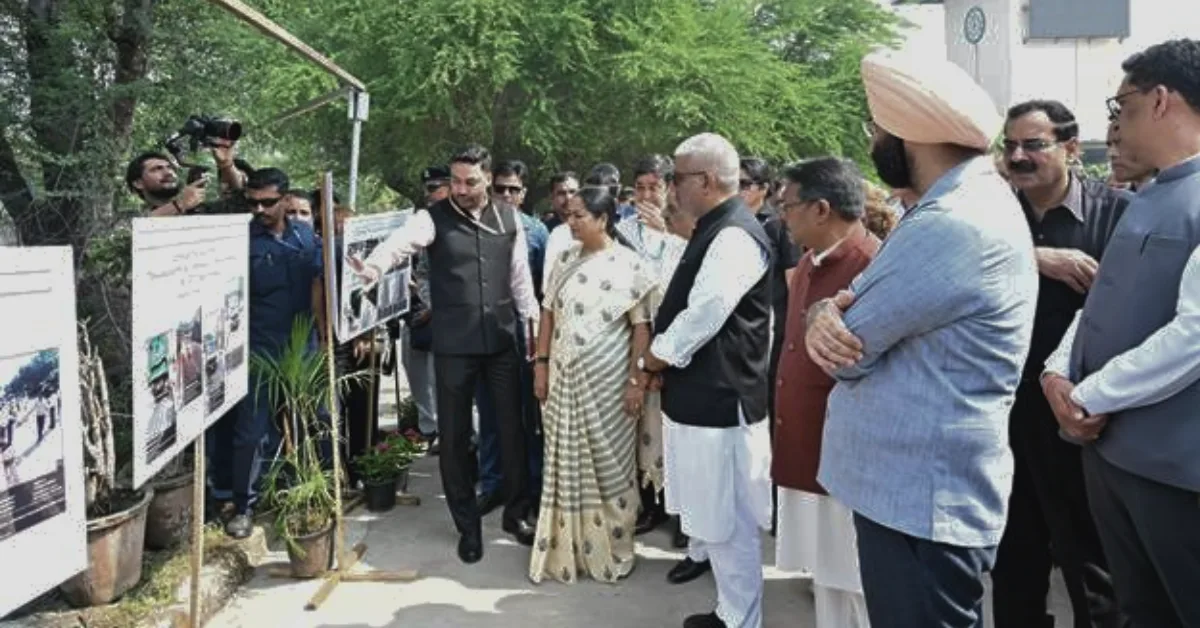
New Delhi, October 14, 2026: Delhi flagged off 150 new electric buses and expanded its air quality monitoring network from 47 to 60 stations on October 13 as part of efforts to strengthen public transport and tackle air pollution. Union Environment Minister Bhupender Yadav and Delhi Chief Minister Rekha Gupta inaugurated the new facilities while reviewing pollution-control measures at Anand Vihar, one of the capital’s major pollution hotspots.
The two leaders also virtually inaugurated public electric vehicle (EV) charging stations at five locations and visited an artificial intelligence (AI)-enabled control centre designed to monitor pollution sources and coordinate enforcement activities across Delhi.
The 150 electric buses were flagged off at Swami Vivekanand Inter-State Bus Terminal (ISBT), Anand Vihar. The new EV charging stations were inaugurated at Anand Vihar ISBT and the Nand Nagri, Rohini Sector-37, Nangloi and Keshopur depots.
During their visit to Anand Vihar, the ministers reviewed measures taken to address pollution caused by traffic congestion, road dust, construction activities, waste dumping and open burning. According to the Ministry of Environment, Forest and Climate Change, 11 agencies were assigned short- and long-term measures to tackle these problems.
The measures included paving internal roads, removing encroachments and illegally dumped construction waste, controlling dust at construction sites and easing traffic congestion. Greening activities are also under way as part of longer-term efforts.
Yadav said coordinated efforts by Delhi government departments had helped contain pollution at Anand Vihar. However, the ministry did not provide comparative air quality data to quantify the improvement.
The ministers also inaugurated 13 new Continuous Ambient Air Quality Monitoring Stations (CAAQMS) installed by the Delhi Pollution Control Committee (DPCC). The additions have increased Delhi’s monitoring network from 47 to 60 stations, providing continuous data on air pollution and weather conditions.
According to Yadav, the expanded network provides monitoring coverage based on a grid of one station per 25 square kilometres, alongside existing population-based norms. The government plans to extend this grid-based approach to other cities in the National Capital Region (NCR).
Air quality data from the stations will be available through the Central Pollution Control Board’s server and the SAMEER mobile application, allowing people to access updated Air Quality Index (AQI) information.
At Shastri Park, the ministers visited DPCC’s AI-enabled Integrated Command and Control Centre (ICCC), which is designed to bring together information on air quality, road dust, industrial emissions, stubble burning, noise levels and public complaints.
The centre is designed to integrate 15 external data systems, of which nine have already been connected. The remaining six are being integrated in phases. The system is intended to help authorities monitor pollution sources, identify problems and coordinate enforcement using real-time information.
Yadav welcomed Delhi’s efforts to expand electric public transport, strengthen pollution monitoring and address pollution sources at Anand Vihar. The initiatives combine additional electric buses, charging infrastructure and monitoring technology as part of the government’s efforts to improve air quality across the capital.
Read also: Nashik Kumbh Mela 2027: BSNL Plans 211 New Towers in ₹99-Crore Push to Improve Mobile Connectivity