New Delhi: Indian manufacturers, artisans and MSMEs can now access overseas markets through a newly operationalised inventory-based cross-border e-commerce export framework.
The government notified the framework under the Foreign Trade Policy 2023 on 5 August 2026 through Notification No. 27/2026-27 and the corresponding Public Notice No. 25/2026-27.
It provides a policy and procedural structure for the inventory-based cross-border e-commerce export of goods manufactured or produced in India.
The framework follows the amendment to India’s foreign direct investment policy through Press Note No. 3 of the 2026 Series, which permits inventory-based e-commerce operations exclusively for exports.
Under the new arrangement, eligible e-commerce entities can undertake export-only inventory operations through a registered Exporter-on-Record, or EOR.
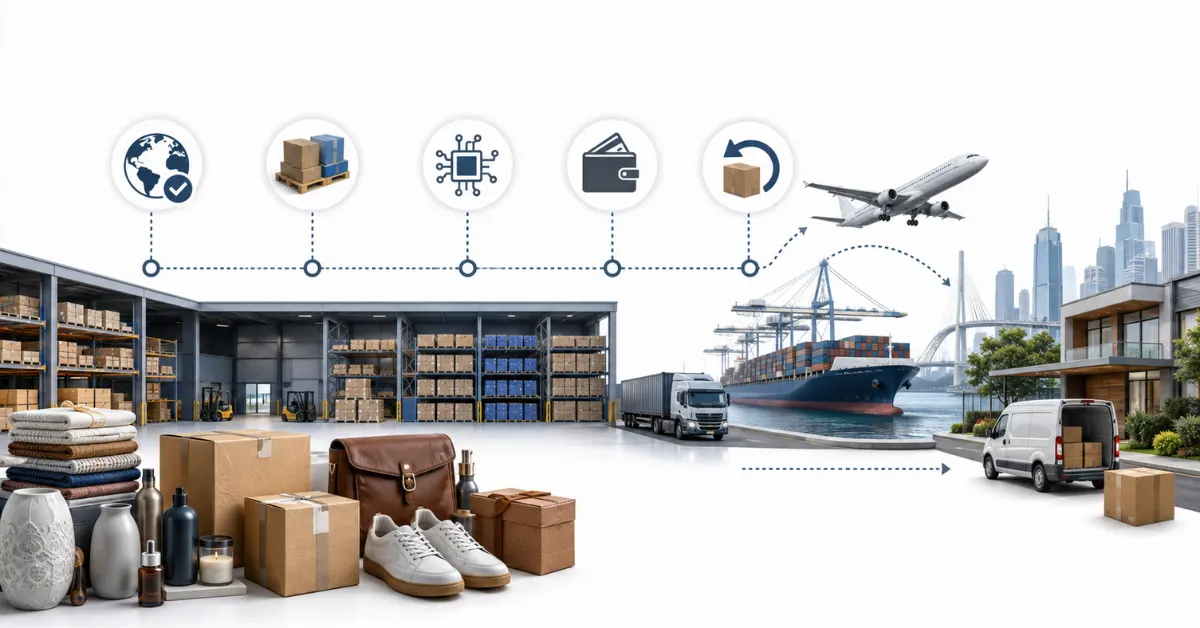
The EOR will procure goods from Indian Sellers-on-Record against confirmed orders received from overseas customers. It will export the products in its own name and assume responsibility for export operations and compliance with the requirements of the destination country.
Read also: India Achieves Near-Universal Banking Coverage; 99.92% of Inhabited Villages Now Have Banking Access
Indian sellers will therefore be able to access international markets while delegating export documentation, customs formalities, product testing and certification, regulatory compliance, packaging, labelling, fulfilment, logistics and reverse logistics to the EOR.
The framework is aimed at lowering compliance costs for Indian enterprises while providing timely payments, greater transparency in overseas sales and clearer accountability for export-related obligations.
Several safeguards have also been introduced to prevent the misuse of the export-only inventory model.
An EOR can procure goods from Indian sellers only after receiving a confirmed overseas order. The framework does not permit the speculative accumulation of inventory for possible future exports.
Goods procured for export must be distinctly identified and kept separately. Their movement and status must also be recorded in a digital repository to ensure traceability.
Inventory procured under the framework cannot subsequently be diverted for sale in the domestic market.
Indian sellers must be paid within the prescribed timeline, irrespective of whether the EOR has received payment from the overseas buyer.
Export-related rebates and refunds must be apportioned and passed on to the Sellers-on-Record in proportion to the free-on-board value attributable to their goods.
Sellers must also be provided information about the final overseas sale price of their products, along with order-status and shipment-tracking details.
Returned or rejected consignments cannot automatically be sold in India. They must be re-exported, returned to the original seller or disposed of according to the prescribed procedures.
Eligible entities will also be required to maintain digital records and obtain annual compliance certification to strengthen transparency and regulatory oversight.