
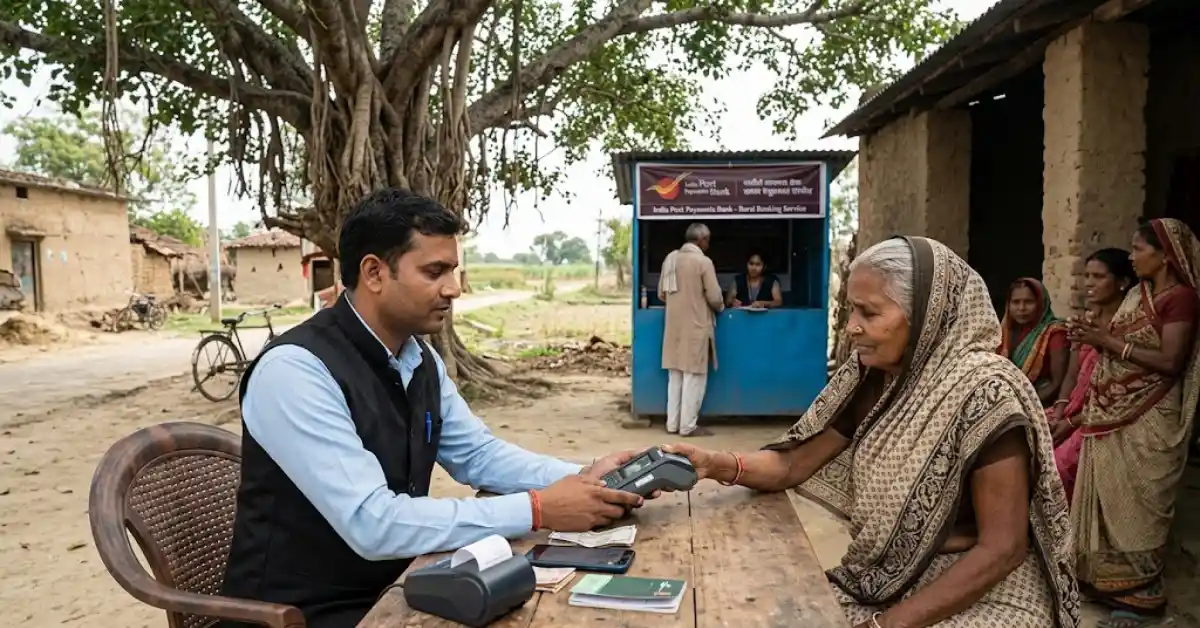
New Delhi: Banking services are now available within a five-kilometre radius of 99.92 per cent of India’s inhabited villages, the Union government told the Lok Sabha on August 3, 2026.
According to data uploaded by banks on the Jan Dhan Darshak application, 6,00,868 of the country’s 6,01,328 inhabited villages are covered by at least one banking outlet within the prescribed distance.
The government’s definition of a banking outlet includes a conventional bank branch, a Business Correspondent service point or an India Post Payments Bank centre. The coverage figure, therefore, does not mean that nearly every village has a physical bank branch.
As of July 17, 2026, the banking network supporting this coverage included more than 1.81 lakh bank branches, 17.36 lakh Business Correspondents and 1.65 lakh India Post Payments Bank centres.
The government said its objective is to provide access to a banking outlet within five kilometres of every inhabited village, including settlements in rural and remote parts of the country.
The Reserve Bank of India allows commercial banks, small finance banks, payments banks, local area banks and regional rural banks to open outlets without seeking prior approval for each location.
Under RBI’s branch-authorisation framework, banks are required to meet the norm of opening at least 25 per cent of their banking outlets in unbanked rural centres. A qualifying banking outlet can include a fixed Business Correspondent point that meets the central bank’s operational requirements.
The identification of uncovered villages and the establishment of new banking outlets is an ongoing process managed by State Level Bankers’ Committees and Union Territory Level Bankers’ Committees.
These committees work with state and Union Territory governments, banks and other stakeholders. Banks assess proposals for new outlets according to RBI guidelines, their business plans and the commercial viability of the proposed locations.
Jan Dhan accounts cross 58.77 crore
The government also said that 58.77 crore accounts had been opened under the Pradhan Mantri Jan Dhan Yojana as of July 17, 2026.
The accounts collectively held deposits of ₹3,12,414 crore. The scheme forms a central part of the government’s financial-inclusion programme, particularly for households that previously had limited access to formal banking services.
The Ministry of Finance also listed several digital initiatives introduced to improve the transparency and speed of agricultural-credit delivery.
The Jan Samarth Portal provides a common digital platform through which applicants can access government-supported loan and subsidy schemes. Applications can be evaluated digitally to support faster processing and sanctioning of loans.
Other initiatives include an e-KYC application developed by NABARD and KRISHIKA, a digital platform developed by the Department of Agriculture and Farmers Welfare. Banks have also introduced their own applications for beneficiary identification, outreach, loan processing and monitoring.
The Kisan Rin Portal, launched in September 2023, facilitates Aadhaar-based beneficiary verification and faster digital settlement of claims under the Modified Interest Subvention Scheme for loans provided through Kisan Credit Cards.
Government outlines steps against payment fraud
The government and RBI have also introduced measures aimed at strengthening the security of digital payments and preventing cyber-enabled financial fraud.
The Indian Digital Payment Intelligence Corporation, or IDPIC, was incorporated as a Section 8 company in October 2025. Its mandate includes detecting, preventing and analysing fraud in the digital-payments ecosystem through technologies such as artificial intelligence, machine learning and big-data analytics.
The RBI has also developed MuleHunter.AI, an artificial intelligence and machine-learning-based system designed to help banks identify accounts suspected of being used to receive or transfer proceeds of cyber fraud.
Separately, the RBI’s Digital Payment Security Controls require banks to maintain minimum security standards across internet banking, mobile banking and card-payment channels.
People can report cybercrime incidents, including complaints involving fake or illegal digital-lending applications, through the National Cybercrime Reporting Portal or by calling the national cybercrime helpline at 1930.
The information was provided in the Lok Sabha by Minister of State for Finance Pankaj Chaudhary.
Read also: Centre releases additional ₹1.09 lakh crore as tax devolution to strengthen state finances and accelerate capital expenditure