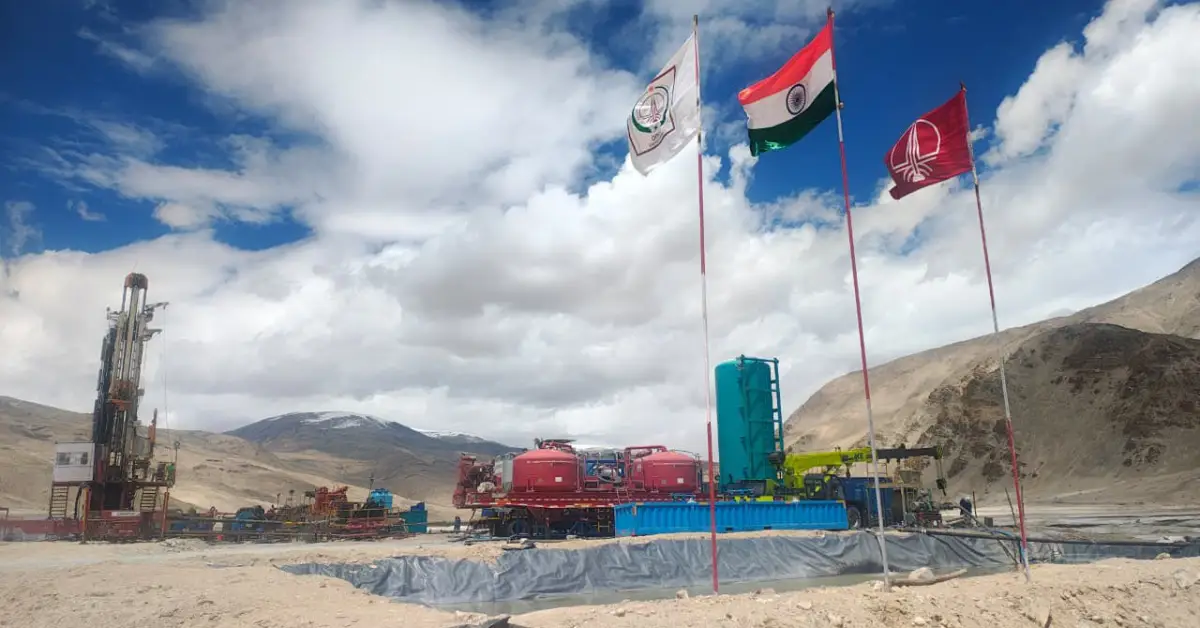
India’s first 1 MWe pilot geothermal power plant has moved a step closer to realisation after ONGC Energy Centre drilled the country’s second geothermal well to a target depth of 1,000 metres in Ladakh’s Puga Valley.
The well was drilled at an altitude of more than 14,000 feet in difficult Himalayan terrain.
ONGC said the drilling was completed in around one month.
The latest well builds on ONGC Energy Centre’s first geothermal drilling campaign in Puga, where the first well had earlier produced steam above boiling point.
According to ONGC, the earlier result established the viability of Puga’s geothermal resources for sustainable power generation.
The second well is important because it strengthens the technical base needed for the planned 1 MWe pilot geothermal power plant.
ONGC said the latest drilling campaign showed improved technical capability, better understanding of Puga’s complex geology and lower drilling costs through optimised operations.
The company said the milestone opens new possibilities for commercial development of geothermal energy in India.
Puga Valley in eastern Ladakh is among India’s key geothermal prospects. The project is being developed by ONGC Energy Centre as a pilot to test whether geothermal energy can be used for reliable power generation in the region.
Earlier, the Ladakh administration had said ONGC Energy Centre would deepen an existing geothermal well to 1,000 metres and drill another geothermal well of the same depth under the project.
The same project framework also envisaged testing, evaluation and commissioning of the pilot geothermal power plant during FY 2026-27.
Geothermal power uses heat from beneath the earth’s surface to generate electricity.
Unlike solar and wind power, it can provide round-the-clock baseload power if the resource is commercially viable.
For Ladakh, the project is significant because the region has difficult terrain, high energy logistics costs and long winter conditions.
ONGC said the breakthrough holds the promise of clean and reliable baseload power, stronger energy security and sustainable regional development for Ladakh.
The success of the second 1,000-metre well now gives the Puga project a stronger foundation for moving towards pilot-scale geothermal power generation.
If the pilot plant progresses as planned, it could mark India’s first operational step towards using geothermal energy as part of the country’s clean energy mix.
Read also : E20 rollout backed by rigorous testing, no cause for concern, say auto industry experts