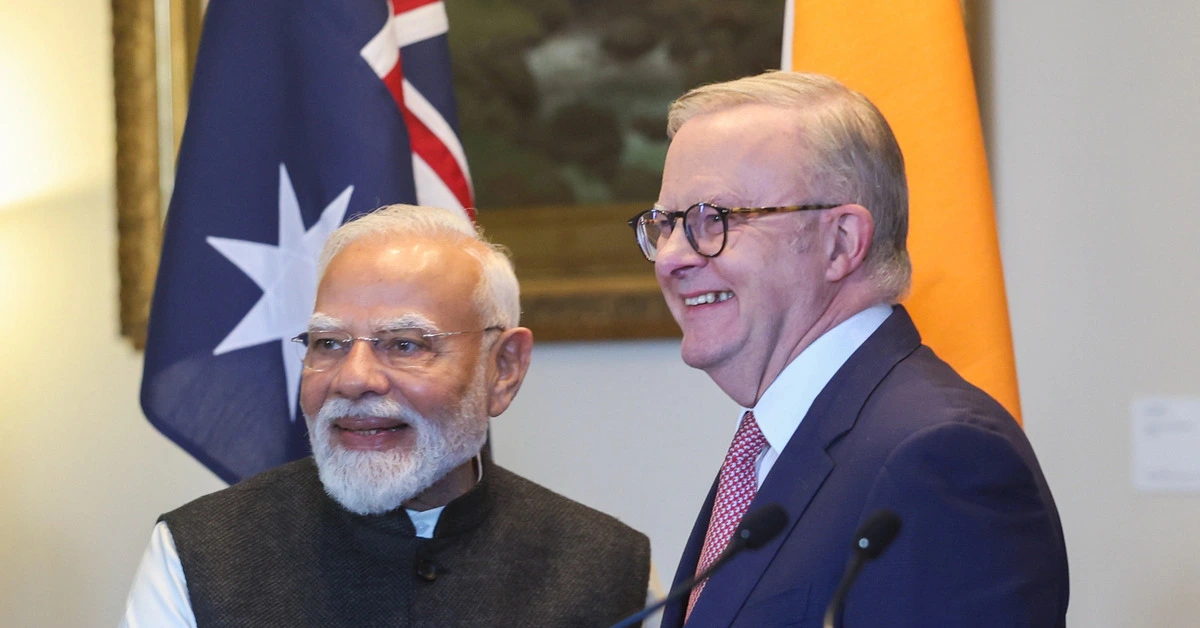
New Delhi, July 9, 2026 — Prime Minister Narendra Modi’s visit to Australia has yielded 18 outcomes across defence, energy, education and culture, according to a list released by the Prime Minister’s Office on Thursday.
Among the most significant is the finalisation of the administrative arrangement under the India-Australia Civil Nuclear Agreement, originally signed in 2014. The arrangement operationalises the pact and enables the supply of uranium from Australia to India. This was accompanied by an India-Australia Joint Statement on Energy Security, reaffirming both countries’ commitment to energy security amid geopolitical tensions.
On defence, the two countries renewed their 2009 Joint Declaration on Security through a new Joint Declaration on Defense and Security Cooperation (JDDSC), which identifies interoperability of forces, capacity building, the maritime domain, defence industrial collaboration, cyber security and technology, counter-terrorism, humanitarian assistance and disaster relief, and a unified approach within UNCLOS, ASEAN, the Pacific Islands Forum and IORA as areas of cooperation.
This was paired with a Maritime Security Collaboration Roadmap (MSCR) to enhance cooperation through information sharing, capability development and operational coordination, and a memorandum of understanding between the Indian Coast Guard and Australia’s Maritime Border Command covering maritime law enforcement, domain awareness and maritime border protection. Australia also extended an invitation for an Indian military instructor to be deployed at the Australian Defence College for the 2028-29 term.
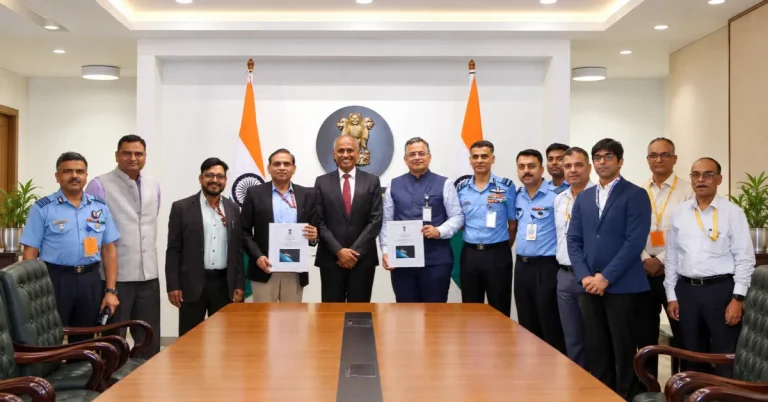
On technology, the countries signed the Australia-India Partnership for Cyber, Critical Technologies and Supply Chains (PACTS), building on a 2020 framework arrangement, aimed at supporting national and regional security, making critical supply chains more resilient, and strengthening collaboration in critical technologies, cyber security and digital resilience.
A separate MoU was signed under the Australia-Canada-India Technology and Innovation (ACITI) Partnership to advance trilateral cooperation in emerging technologies and innovation.
Read also : India’s indigenous Pinaka long-range guided rocket hits target with precision in flight test
Several outcomes covered education and skills. The Ministry of Skill Development and Entrepreneurship signed an MoU with Technical and Further Education (TAFE), Government of Western Australia, to set up a Centre of Excellence in Mining Equipment, Technology and Services at the National Skill Training Institute in Bhubaneswar, enabling exchange of students and trainees between the two institutions.
The National Council for Vocational Education and Training (NCVET) and the Australian Skills Quality Authority (ASQA) signed a letter of intent to strengthen regulatory frameworks in vocational training, co-develop occupational standards, and enable capacity building, staff exchanges and joint research.
Two Australian universities received clearances to establish campuses in India. Flinders University was handed a letter of intent to set up its campus in Bengaluru, while Victoria University received a formal letter of approval to set up and operate its campus in Gurugram.
Australia repatriated three Indian antiquities: an 11th-to-12th-century granite sculpture of the sacred bull Nandi, vehicle of Shiva, from Tamil Nadu; an 11th-century bronze trident with Auspicious Kali (Bhadrakali), also from Tamil Nadu; and a 12th-century basalt sculpture of the six-headed Skanda (Karttikeya), from Tamil Nadu.
In the energy and resources space, the Rooftop Solar Training Academy was operationalised at the Pandit Deendayal Energy University in Gandhinagar, in collaboration with Australia’s Department of Climate Change, Environment and Water, India’s Sector Skills Council for Green Jobs, and ReNEW.
It aims to train 2,000 women and youth as solar technicians, installers and helpers, supporting the PM Surya Ghar Yojana launched in January 2024. Geoscience Australia and the Geological Survey of India signed an MoU, building on a 2015 pact, aimed at adopting advanced exploration methodologies, capacity building, and modernising GSI infrastructure.
Other agreements included a Traditional Knowledge Digital Library access arrangement between India’s Council of Scientific & Industrial Research (CSIR) and IP Australia; an MoU between CSIR and the University of Melbourne covering collaborative research on drug target identification, trainee programs and faculty exchange; and an MoU between the Satyajit Ray Film and Television Institute in Kolkata and the Griffith Film School in South Brisbane, establishing a framework for joint academic activities, joint projects in cinema, and short-term workshops.