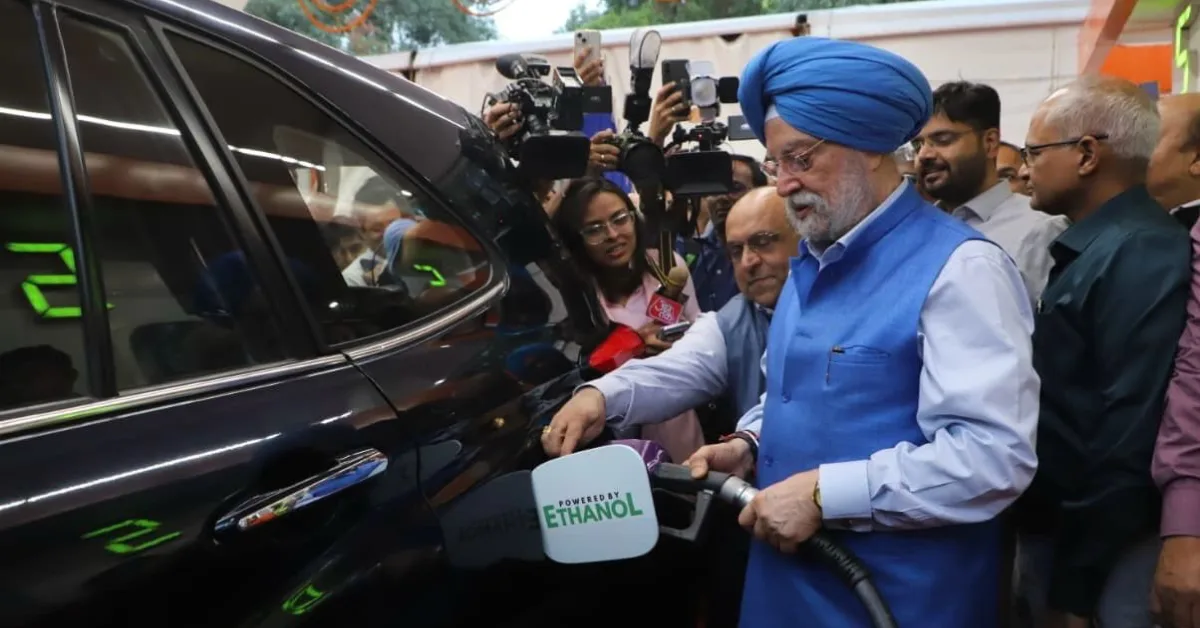
India has begun the rollout of E85 fuel across 48 retail outlets of public sector oil marketing companies, marking a new step in the country’s shift towards higher ethanol blending and flex-fuel mobility, according to a statement by the Ministry of Petroleum and Natural Gas.
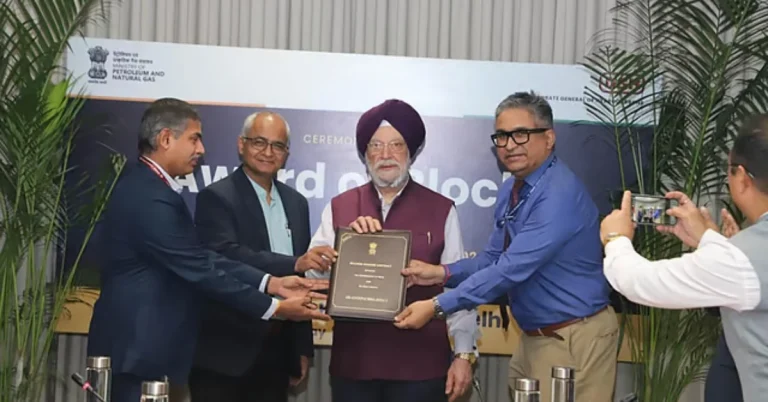
Union Minister for Petroleum and Natural Gas Hardeep Singh Puri launched the fuel at an IndianOil retail outlet in New Delhi on Friday, 5 June, on the occasion of World Environment Day.
Senior officials of the Ministry of Petroleum and Natural Gas and chairmen and managing directors of public sector oil marketing companies were present at the event.
E85 is a high-ethanol blended fuel comprising 80-85% ethanol and 14-19% petrol. It is meant for flex-fuel vehicles, which can operate on ethanol blends ranging from E20 to E100.
The ministry said the rollout has started across 48 public sector OMC retail outlets.
The network is planned to be expanded to 500 outlets by December 2026 and about 5,000 outlets by December 2027.
The expansion is expected to help raise India’s aggregate ethanol blending level to nearly 26% by 2030-31.
E85 has been priced nearly ₹20 per litre lower than conventional petrol to pass on the economic benefit of domestically produced ethanol to consumers.
Speaking on the Occasion, Puri said India has been able to balance the “Energy Trilemma” of energy availability, affordability and sustainability, while ensuring stable fuel supplies and protecting consumers from global energy volatility to the maximum possible extent.
The minister said ethanol blending in India has risen from 1.53% in 2014 to 20% at present, achieving the target five years ahead of schedule.
He added that the shift has helped save more than ₹1.84 lakh crore in foreign exchange and substituted nearly 302 lakh metric tonnes of crude oil imports.
According to the ministry, flex-fuel vehicles running on E85 can reduce lifecycle greenhouse gas emissions by around 61% compared to conventional petrol vehicles.
Ethanol also has a Research Octane Number of about 108, offering higher knock resistance and allowing engines to operate at higher compression ratios and optimised ignition timing.
Higher ethanol blends promote cleaner and more complete combustion, resulting in near-zero particulate matter emissions and contributing to improved urban air quality.
Puri said that if 50% of new two-wheelers and four-wheelers transition to flex-fuel vehicles, it could generate demand for over 312 crore litres of ethanol. Such a shift could result in nearly ₹12,403 crore flowing directly to farmers, annual foreign exchange savings of nearly ₹15,151 crore and a reduction of 66.4 lakh metric tonnes of CO2 emissions.
The minister said India’s flex-fuel journey draws from global experience while being tailored to domestic strengths.
He cited Brazil’s experience, noting that more than 80% of its light vehicle fleet currently operates on flex-fuel technology.
Addressing the misconceptions surrounding ethanol-blended fuels, the minister clarified that E85 fuel is meant only for specially designed flex-fuel vehicles and not for normal petrol vehicles.
He also said that since E20 became the standard fuel across the country, there has not been a single reported case of engine failure or vehicle breakdown attributable to ethanol blending.
The ministerfurther said E20-compatible vehicles deliver improved acceleration and better ride quality, particularly in city driving conditions, and that using E20 fuel has no impact on the validity of vehicle insurance in India.
Puri said flex-fuel vehicles remain competitive with electric vehicles due to lower acquisition costs and their ability to use existing fuel infrastructure.
He added that while electric vehicle technologies depend significantly on imported batteries and critical minerals, E85-powered vehicles run on domestically produced ethanol from Indian farmers.
Read also: PM Surya Ghar records strongest month with 3.16 lakh rooftop solar installations in May