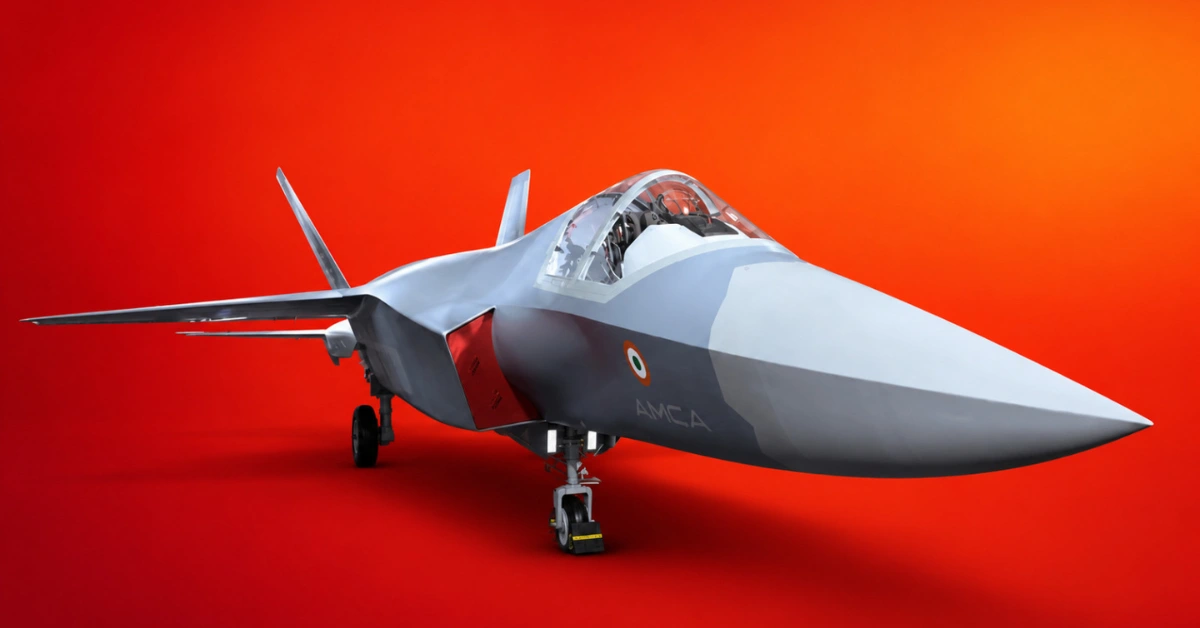
The Defence Ministry on Wednesday, 27 May, issued the Request for Proposal for India’s indigenous fifth-generation Advanced Medium Combat Aircraft project to three shortlisted bidders, marking a fresh step in the country’s effort to develop a next-generation combat aircraft through wider industry participation.
Defence officials told news agency ANI that the RFP has been issued to Larsen and Toubro-Bharat Electronics Limited, Tata Advanced Systems and Bharat Forge-BEML for the mega AMCA project.
The AMCA programme is being taken forward as one of India’s most ambitious indigenous military aviation projects, aimed at developing a fifth-generation fighter aircraft for the Indian Air Force.
The aircraft is proposed as a twin-engine, stealth, multi-role fighter that can operate in contested airspace where survivability, sensor advantage and low detectability are critical.
Unlike conventional fighters that carry weapons visibly under the wings, the AMCA is being designed with an internal weapons bay so that it can carry selected weapons in a stealthier configuration during high-risk missions.
The aircraft is also expected to feature advanced avionics, smart weapons, top-end mission computers, sensor fusion and modern electronic warfare capability, allowing the pilot to combine radar, sensors and combat data into a clearer battlefield picture.
The AMCA is planned as a 25-tonne class fighter with stealth shaping, reduced radar visibility and internal carriage of weapons among its key design features.
Read also: IAF opens Technical Branch officer entry through GATE scores, AFCAT route to continue
The aircraft is expected to carry around 1.5 tonnes of weapons in its internal bay, while additional weapons can be mounted externally for missions where stealth is not the main requirement.
Its intended roles include air superiority, deep strike and precision attack missions, giving the Indian Air Force a future platform designed for both air-to-air and air-to-ground operations.
The AMCA is planned in two broad variants. The initial Mk-1 version is expected to be powered by GE F414-class engines, while a more advanced Mk-2 version is planned with a more powerful engine to be developed with foreign collaboration.
These proposed capabilities make the AMCA important not only as another fighter acquisition, but as a technology leap for India’s aerospace ecosystem.
If the programme succeeds, India would move from assembling and upgrading imported combat platforms to designing, testing and producing a stealth fighter around its own operational needs.
The latest RFP stage follows the approval of the AMCA Programme Execution Model by Defence Minister Rajnath Singh in 2025.
Under that execution model, the Aeronautical Development Agency (ADA), an affiliate organisation of the Defence Research and Development Organisation (DRDO), is implementing the programme through industry partnership.
The model opened the process to both private and public sector companies on a competitive basis, allowing eligible Indian companies to bid independently, as joint ventures or as consortia.
According to the Defence Ministry, the bidder is required to be an Indian company compliant with Indian laws and regulations.
The ministry had described the model as an important step towards using indigenous expertise, capability and capacity to develop the AMCA prototype.
The bidding process gained pace after ADA invited industry participation in 2025 to identify Indian companies capable of taking part in prototype development, flight testing and certification of the AMCA.
The RFP to the three shortlisted bidders is therefore a major follow-up to that earlier expression-of-interest process and moves the project closer to selection of an industry partner for the development phase.
The programme has also been backed by fresh infrastructure.
On 15 May 2026, Rajnath Singh and Andhra Pradesh Chief Minister N Chandrababu Naidu laid the foundation stone for the AMCA Core Integration and Flight Testing Centre at Puttaparthi in Sri Sathya Sai district of Andhra Pradesh.
The Defence Ministry said the centre is meant to fast-track the development of the fifth-generation AMCA and other future indigenous platforms.
The total outlay for the AMCA programme is around Rs 15,000 crore, while the Core Integration & Flight Testing Centre is being established at a cost of around Rs 2,000 crore.
At the foundation stone ceremony, Rajnath Singh said Puttaparthi is set to join the exclusive league of global destinations from where a fifth-generation aircraft will take to the skies.
The AMCA project is significant because India has so far depended heavily on imported fighter platforms and licensed production for advanced combat aircraft capabilities.
A successful AMCA programme would strengthen India’s domestic aerospace design, testing and manufacturing ecosystem while giving the Indian Air Force a future stealth fighter platform designed around indigenous requirements.
The decision to involve private-sector-led bidders also reflects a wider shift in India’s defence manufacturing policy, where large private companies, public sector units, MSMEs and specialised technology firms are increasingly being brought into major military programmes.
The RFP stage will now allow the shortlisted bidders to submit detailed proposals under the project framework.