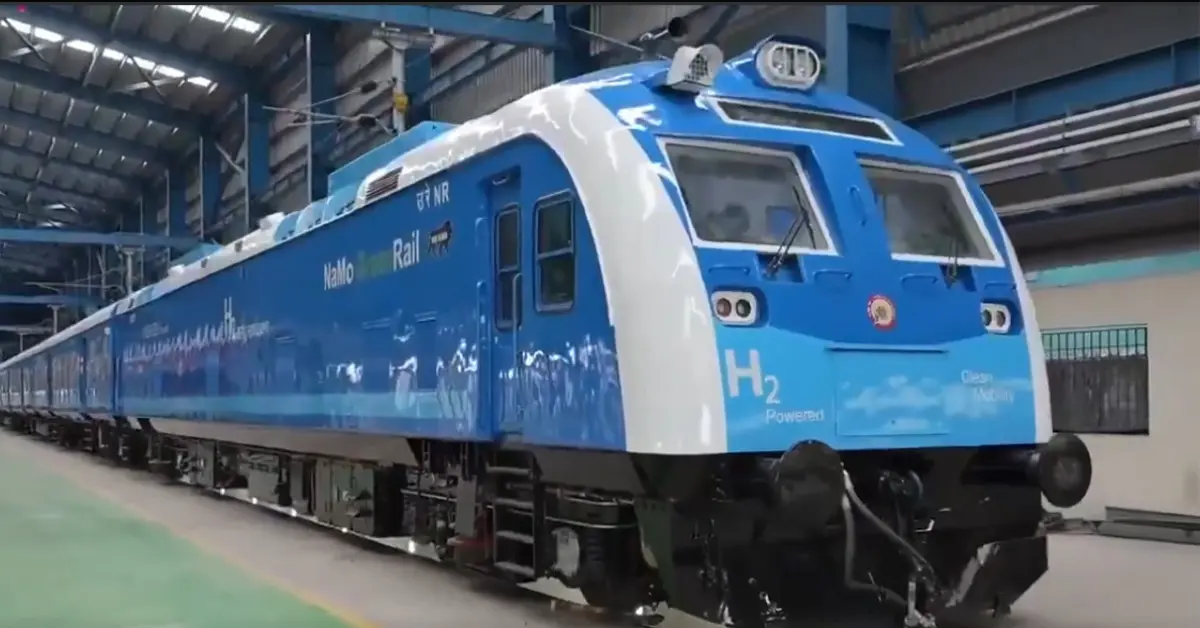
India’s first hydrogen-powered train has received approval to operate on the Jind-Sonipat section in Haryana, marking a major step towards the country’s first passenger service using hydrogen fuel-cell technology.
The train, developed for Indian Railways as a pilot project, is expected to run on the Northern Railway route after the remaining safety, compliance and verification requirements are completed.
The approval brings the project closer to commercial operation, but regular passenger service is not expected to begin immediately.
Railway authorities are required to complete compliance linked to technical and safety conditions before the train is introduced for public use.
The train has been developed as a hydrogen fuel cell-based DEMU train-set.
It is designed to use hydrogen as fuel and emit only water vapour, making it a zero carbon dioxide emission train during operation.
According to official details released earlier by the Ministry of Railways, manufacturing of India’s first hydrogen-powered train-set has been completed.
A green hydrogen production plant based on the electrolysis process is also being established at Jind to support the train’s operations.
The train-set has 10 coaches, including two Driving Power Cars and eight passenger cars.
The two Driving Power Cars have a power rating of 1,200 kW each, taking the total power of the train-set to 2,400 kW.
The ministry also said the train is currently the world’s longest and most powerful hydrogen train-set on the broad-gauge platform.
The latest operational approval is for running the train at a maximum speed of 75 Kmph on the Jind-Sonipat route.
The train is expected to be maintained at Shakurbasti in Delhi, with movement between Jind and Shakurbasti handled separately for maintenance purposes.
Read also: Jammu and Kashmir’s first cherry parcel van of season arrives in Mumbai with 12 tonnes of fruit
The Jind-Sonipat section has been the planned pilot route for the project from the beginning.
Indian Railways had earlier awarded the pilot project for retrofitting hydrogen fuel-cell technology on an existing Diesel Electric Multiple Unit rake, along with ground infrastructure, at a cost of ₹111.83 crore.
The project forms part of Indian Railways’ wider plan to test hydrogen-powered trains as an alternative clean-energy technology, especially for non-electrified, heritage and hill routes.
In 2023, Indian Railways had said it planned to run 35 hydrogen trains under the “Hydrogen for Heritage” initiative.
The estimated cost was ₹80 crore per train, with another ₹70 crore per route for ground infrastructure.
Hydrogen trains are seen as an important option for reducing diesel dependence in rail operations.
Instead of burning diesel, hydrogen fuel cells generate electricity through a chemical reaction between hydrogen and oxygen, with water vapour as the main by-product.
For Indian Railways, the project is also significant because it involves the first-time development of hydrogen traction technology within the railway system.
The ministry had earlier said that direct cost comparison with established traction systems would not be fair at this pilot stage because the technology and related infrastructure are still being developed.
The immediate focus will now be on completing safety and regulatory conditions before the train starts carrying passengers.
These include compliance related to fuel storage, refuelling systems, leak detection, flame detection and operational safety protocols.
Once introduced, the Jind-Sonipat hydrogen train will become India’s first passenger train to run on hydrogen fuel-cell technology, placing the country among the few railway systems globally testing hydrogen as a clean traction option for passenger transport.
Read also: NCRTC invites bids for commercial spaces at 8 Meerut stations on Delhi-Meerut Namo Bharat corridor