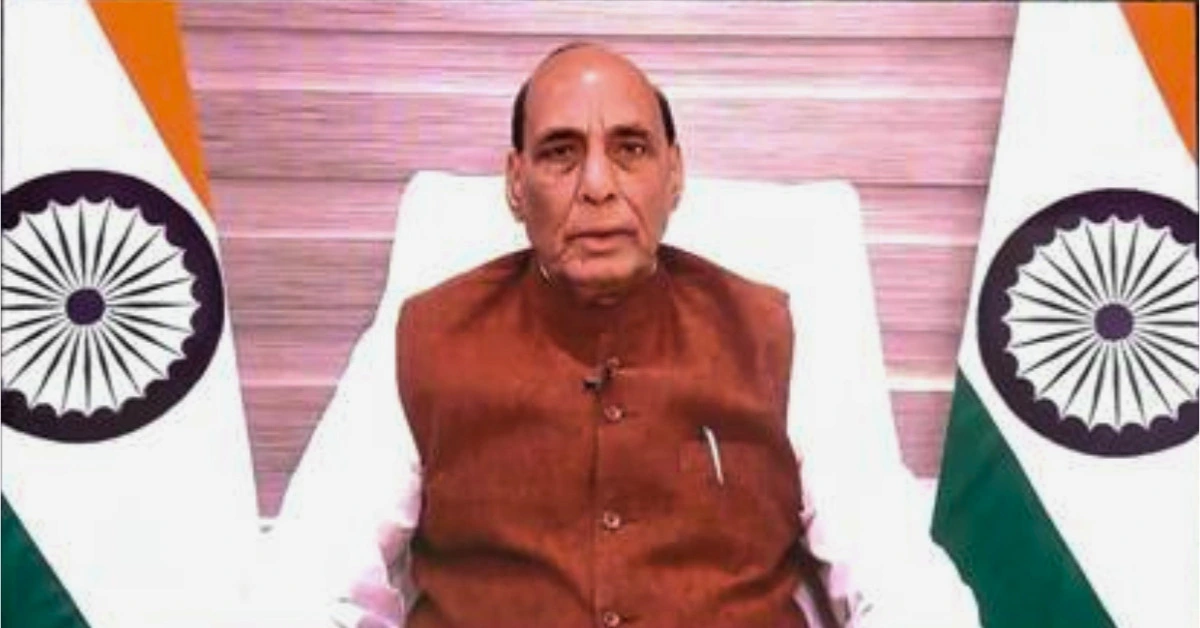
Defence Minister Rajnath Singh on Thursday, 14 May, said India’s strategic autonomy and future military preparedness will depend on how quickly the armed forces, defence laboratories and industry can work together to turn ideas into deployable capability.
Addressing Kalam & Kavach 3.0 through a video message at the Manekshaw Centre in New Delhi, Singh said the battlefield of the future would reward countries that can shorten the time between idea, prototype and operational deployment.
“A nation’s strength will increasingly depend on how quickly its defence forces, laboratories, and industries think & act as one,” Singh said, underlining the need for closer integration between the military, research institutions and the defence industry.
The remarks come at a time when India is pushing to expand indigenous defence production, increase exports and deepen jointness across the armed forces amid a changing security environment marked by cyber threats, hybrid warfare, supply-chain vulnerabilities and fast-moving military technologies.
Singh said national security could no longer rest on old assumptions because of geopolitical tensions, ongoing conflicts and new forms of warfare.
“National security demands our preparedness, resilience, innovation, and strategic confidence,” he said.
The Defence Minister described self-reliance as a strategic necessity, not just an economic objective.
Read also : Indian Coast Guard conducts Girder Laying Ceremony for indigenous Air Cushion Vehicles in Goa
He said a country that depends excessively on others for critical defence capability remains vulnerable during crises.
“We must design, develop, produce, maintain, and upgrade key systems within our own national ecosystem. That is how we will be able to secure our strategic autonomy,” Singh said.
He also stressed that modern warfare does not respect organisational silos.
According to him, operational success will depend on how efficiently India brings together capabilities across land, sea, air, cyber and space domains.
The focus on jointness has become a central part of India’s military reform agenda as the armed forces work towards better integration of planning, logistics, command structures and technology adoption across services.
Kalam & Kavach 3.0 was held under the theme “Taking JAI Forward With I²”.
The dialogue focused on India’s defence and national security landscape, with discussions around Aatmanirbharta, innovation, industrial partnerships, capability development and future-ready technologies.
The event included sessions on AI-enabled warfare, autonomous systems, hypersonic technologies, quantum-enabled C4ISR, defence manufacturing scale-up, aerospace advancements and strategic partnerships.
Senior representatives from the Ministry of Defence, Headquarters Integrated Defence Staff, National Security Advisory Board, armed forces, defence attachés, scientists, industry leaders, start-ups, academia and international partners participated in the conclave.
The conclave also featured an exhibition by Indian private industry, MSMEs and start-ups working in defence innovation.
The message from the event was clear: India’s next phase of defence preparedness will depend not only on higher production numbers, but on faster technology absorption, deeper service integration and a stronger domestic industrial base capable of responding to modern conflict requirements.
Read also : India achieves major hypersonic missile milestone with 1,200-second scramjet combustor test