The Defence Research and Development Organisation (DRDO) has completed hydrodynamic performance assessment and model testing for a new frontline Indian Navy warship project, marking a key step in indigenous naval design capability.
The work was carried out by the Naval Science and Technological Laboratory (NSTL) in collaboration with the Warship Design Bureau (WDB) of the Indian Navy.
According to a statement by DRDO on 29 April, the project involved detailed evaluation of hull hydrodynamics using a combination of computational and experimental methods.
These included Computational Fluid Dynamics (CFD)-based simulations and physical model testing.
The assessment covered critical performance parameters such as resistance, propulsion efficiency, sea-keeping behaviour, and manoeuvrability.
These factors are central to determining a warship’s operational efficiency, fuel consumption, stability in rough seas, and combat readiness.
DRDO stated that the outcomes were benchmarked against leading international standards, achieving parity in accuracy, reliability, and technical depth.
Read also : Indian Navy receives sixth indigenous stealth frigate ‘Mahendragiri’ under Project 17A
This indicates that India’s naval design and testing ecosystem is aligning with global best practices in warship development.
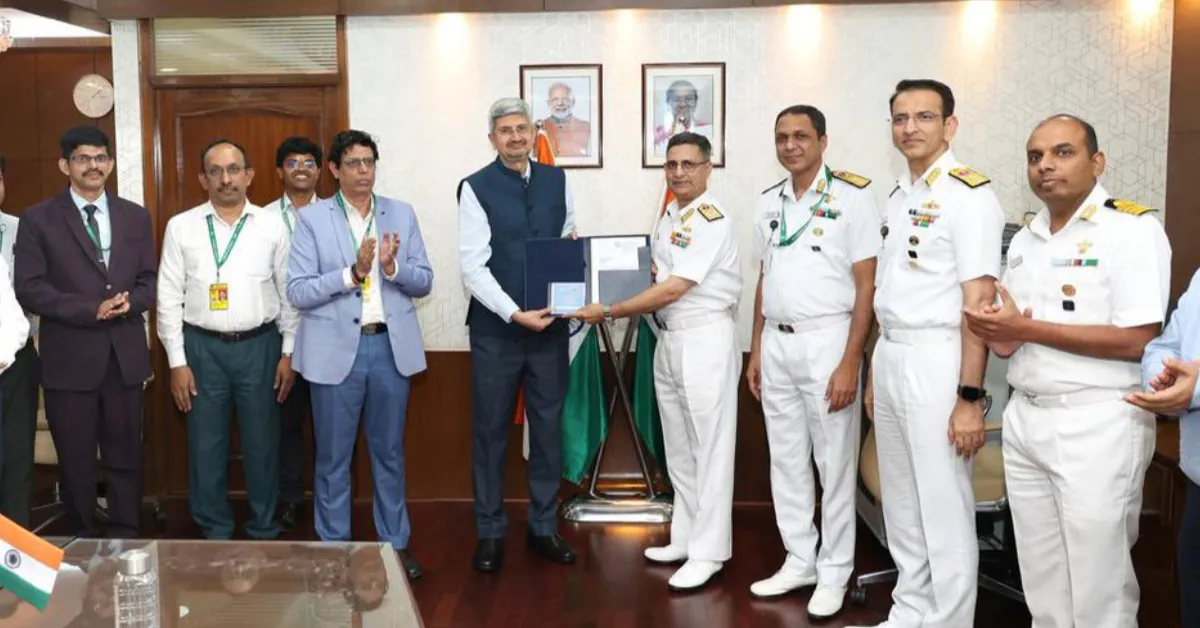
The project deliverables were formally handed over by Dr Samir V Kamat, Secretary, Department of Defence R&D and Chairman, DRDO, to Vice Admiral Sanjay Sadhu, Controller of Warship Production and Acquisition.
Senior officials from DRDO and the Indian Navy were present during the handover.
The development comes amid India’s broader push for defence indigenisation under initiatives such as Aatmanirbhar Bharat, with increasing emphasis on domestic warship design and construction.
The Indian Navy has been steadily expanding its indigenous fleet, including projects such as stealth frigates under Project 17A and next-generation destroyers.
Hydrodynamic testing plays a critical role in these programmes, as it directly influences vessel performance, survivability, and lifecycle costs.
With NSTL and WDB demonstrating advanced simulation and testing capabilities, the milestone is expected to support future indigenous warship projects and reduce reliance on foreign design inputs.
Read also : India conducts maiden salvo launch of naval anti-ship missile from helicopter