An educational institution in Gandhinagar, Gujarat, has demonstrated a scalable model of waste-to-energy utilisation by fully replacing LPG with biogas for its daily cooking needs, according to a statement by the Ministry of Housing and Urban Affairs on Monday, 27 April.
The Shrimati Manekba Vinay Vihar Educational Complex, located near Adalaj and managed by the Vasumati Charitable Trust, now prepares meals for over 500 individuals every day using biogas generated on campus.
This includes approximately 250 hostel students served twice daily, along with 15 staff families residing within the premises.
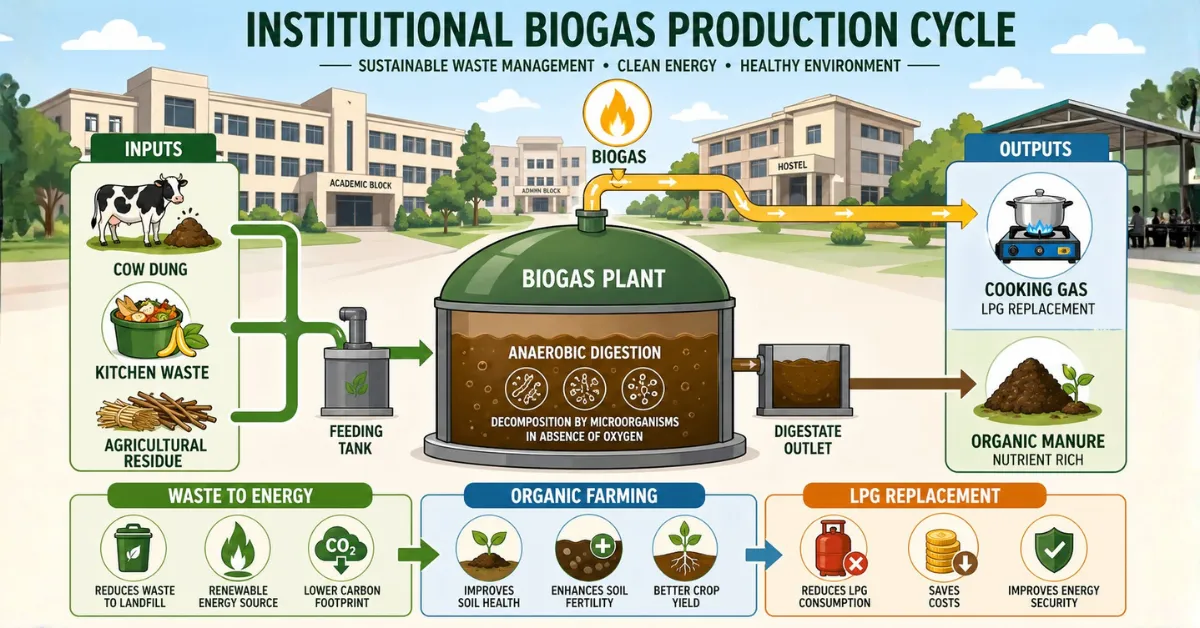
The institution operates two biogas plants with a combined capacity of 90 cubic metres per day.
These plants utilise dung from 222 cows housed in the trust’s cowshed, along with kitchen waste and agricultural residue from nearby fields.
The generated biogas meets the campus’s entire cooking fuel requirement, eliminating the need for conventional LPG cylinders.
“We have become self-reliant in cooking gas under Gujarat government’s Institutional Biogas Plant Scheme. The cows provide sufficient dung, and the slurry produced after gas generation is used as manure in our fields, enabling fully organic farming. Without this plant, we would require around 30 LPG cylinders every month”, officials were quoted as saying in the ministry’s statement.
Read also : PM Modi to launch multiple development projects worth over ₹4,000 crore in Sikkim tomorrow
Biogas, produced through the anaerobic decomposition of organic waste, is among the most viable, economical and environmentally friendly cooking fuels available, the ministry said.
The biogas production process also generates nitrogen-rich slurry as a by-product, which is used as organic manure in agricultural fields.
This supports organic farming practices while reducing dependence on chemical fertilisers, lowering input costs, and maintaining soil fertility.
The Gujarat Energy Development Agency (GEDA) provides financial assistance for such projects, with subsidies of up to 75% available for non-profit institutions.
The scheme supports biogas plants with capacities ranging from 25 to 85 cubic metres, making adoption more financially viable for educational and social institutions.
Over the past five years, approximately 193 institutional biogas plants have been established across Gujarat.
These projects aim to promote sustainable waste management, reduce pollution, and enable energy self-sufficiency through the scientific utilisation of organic waste.
The initiative aligns with the objectives of the Centre’s Swachh Bharat Mission-Urban 2.0, under which cities and institutions are encouraged to adopt circular waste management practices.
Such models demonstrate how organic waste can be converted into a usable energy resource while supporting environmental sustainability and reducing operational costs.
Read also : Mumbai joins expanding Bharat Taxi network as Piyush Goyal launches driver onboarding initiative