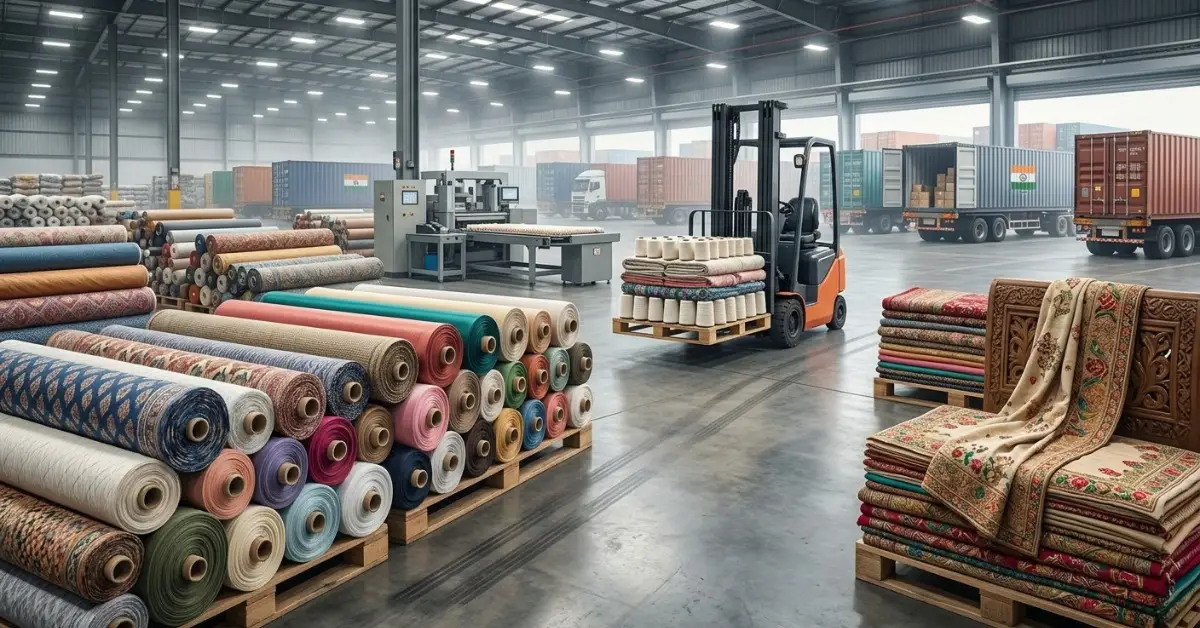
India’s textile sector recorded steady growth in FY 2025-26, with total exports, including handicrafts, rising to ₹3,16,334.9 crore from ₹3,09,859.3 crore in FY 2024-25, marking an increase of 2.1%, according to a statement by the Ministry of Textiles on Wednesday (22 April).
The growth reflects stable global demand and sustained competitiveness of Indian textile products across key categories.
Ready-Made Garments (RMG) continued to be the largest contributor, with exports increasing from ₹1,35,427.6 crore to ₹1,39,349.6 crore, registering a growth of 2.9%.
Cotton yarn, fabrics, made-ups and handloom products saw marginal growth of 0.4%, reaching ₹1,02,399.7 crore in FY26 compared to ₹1,02,002.8 crore in the previous year.
Meanwhile, man-made yarn, fabrics and made-ups recorded a stronger increase of 3.6%, rising to ₹42,687.8 crore from ₹41,196.0 crore.
Among value-added segments, handicrafts excluding handmade carpets emerged as the fastest-growing category, expanding by 6.1% to ₹15,855.1 crore.
India’s textile exports also witnessed broad-based geographical expansion, with growth recorded in more than 120 destinations between April 2025 and February 2026.
Key markets showing strong growth included UAE at 22.3%, UK at 7.8%, Germany at 9.9%, Spain at 15.5%, Japan at 20.6%, Egypt at 38.3%, Nigeria at 21.4%, Senegal at 54.4%, and Sudan at 205.6%.
Policy support continued to play a key role in sustaining export momentum.
The government extended export facilitation schemes such as the Rebate of State and Central Taxes and Levies (RoSCTL) Scheme and the RoDTEP Scheme beyond 31 March 2026.
At the same time, progress on trade agreements is expected to further support the sector.
The India-EFTA Trade and Economic Partnership Agreement came into force on 1 October 2025, while agreements with the UK, Oman and New Zealand were signed or announced during the year.
The India-EU Free Trade Agreement was concluded on 27 January 2026.
These developments are expected to improve market access, reduce tariff barriers and support integration into global value chains, creating new opportunities for textiles, apparel, handicrafts and technical textiles.