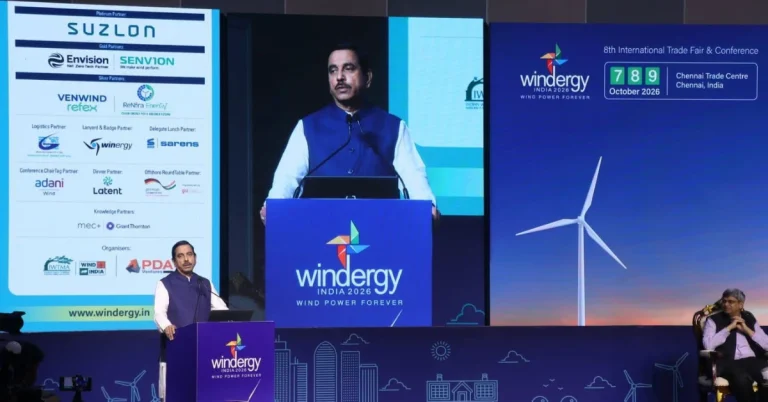
India has installed a total of 283.46 GW of capacity from non-fossil fuel sources as on 31 March 2026, Union Minister for New and Renewable Energy Pralhad Joshi said on Wednesday, 8 April, as capacity addition accelerated sharply during FY 2025-26.
Addressing the media, Joshi said the country added 55.3 GW of non-fossil capacity during the financial year, marking the highest annual increase recorded so far.
The installed non-fossil base comprises 274.68 GW of renewable energy and 8.78 GW of nuclear capacity.
Within renewables, solar remains the dominant contributor at 150.26 GW, followed by wind at 56.09 GW, with the balance coming from bioenergy (11.75 GW), small hydro (5.17 GW) and large hydro (51.41 GW) segments.
The acceleration in capacity addition is being driven by a combination of utility-scale solar projects, distributed renewable energy expansion, and increasing participation from commercial and industrial consumers.
India has also moved to the third position globally in renewable energy installed capacity, surpassing Brazil, according to Renewable Energy Statistics 2026 released by the International Renewable Energy Agency.
In generation terms, non-fossil sources accounted for 29.2 per cent of total electricity generation during 2025-26, with output from these sources reaching 538.97 BU out of total generation of 1,845.921 BU.
Read also: Union Cabinet approves revised cost of ₹79,459 crore for 9 MMTPA HPCL Rajasthan Refinery project
The capacity milestone builds on an earlier achievement in June 2025, when India crossed 50 per cent of cumulative installed electricity capacity from non-fossil sources, five years ahead of its 2030 target under its Nationally Determined Contributions.
The government is targeting 500 GW of installed electricity capacity from non-fossil sources by 2030, with policy support focused on manufacturing scale-up, grid integration and storage deployment.
Solar capacity has expanded to 150.26 GW as of March 2026, reflecting sustained additions across utility-scale and rooftop segments, while wind capacity has reached 56.09 GW, supported by improved tendering activity and manufacturing capacity.
Manufacturing capacity has also scaled up, with solar module capacity rising to around 172 GW and wind turbine manufacturing capacity reaching about 24 GW, indicating strengthening domestic supply chains.
Policy interventions during the year included reduction in GST on renewable energy equipment from 12 per cent to 5 per cent, extension of customs duty exemptions for battery manufacturing inputs, and rollout of monitoring systems to track equipment imports and ensure supply chain transparency.
The Ministry of New and Renewable Energy is also advancing grid-side reforms, including transmission planning under the Green Energy Corridor programme, to support evacuation of growing renewable capacity.
The next phase of capacity growth is expected to be driven by hybrid projects, storage integration and green hydrogen-linked demand, as India moves towards its 2030 non-fossil capacity target.
Read also: Government approves 500 MW renewable energy pilot under CfD model for non-solar hour supply