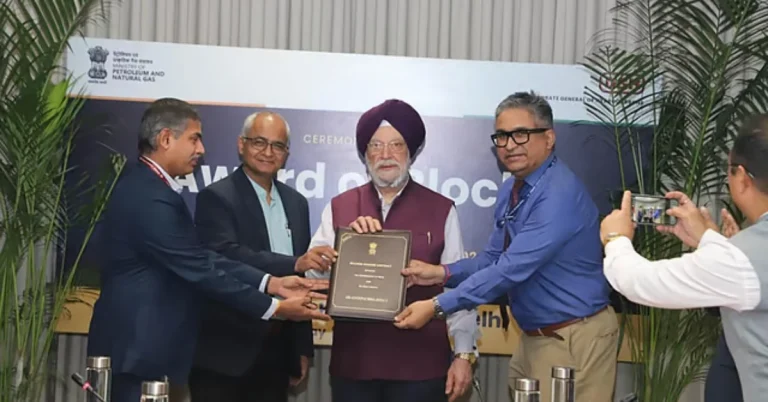
Petroleum and Natural Gas Minister Hardeep Singh Puri on Thursday, 12 March informed Parliament that India has taken multiple measures to safeguard petrol, diesel and cooking gas supplies amid the global energy disruption triggered by the ongoing West Asia conflict.
Making a statement in the Lok Sabha, the minister briefed the House on the government’s response to the situation and the steps taken to ensure continued availability of petroleum products across the country.
Puri described the situation as unprecedented, telling Parliament that “the world has not faced a moment like this in modern energy history.”
He pointed out that the Strait of Hormuz — through which about 20 per cent of the world’s crude oil, natural gas and LPG flows — has been effectively disrupted following the escalation in the region.
Despite the disruption, Puri said India has secured sufficient crude supplies.
“India’s crude supply position is secure, and volumes secured exceed what Hormuz would have delivered in the same period,” he told the House.
Before the crisis, roughly 45 per cent of India’s crude imports transited the Hormuz route.
The minister said alternative sourcing arrangements have since increased non-Hormuz crude imports to about 70 per cent, up from 55 per cent before the conflict began.
India now sources crude from 40 countries compared with 27 countries in 2006-07.
Domestic refineries are also operating at very high capacity utilisation to maintain fuel availability, with several facilities running in excess of 100 per cent throughput.
“There is no shortage of petrol, diesel, kerosene, ATF or fuel oil,” Puri said, adding that retail outlets across the country remain stocked and supply chains are functioning normally.
Alongside petroleum fuels, the government has prioritised the supply of domestic cooking gas (LPG) for households, according to the minister.
“Modi Govt’s foremost priority is that the kitchens of India’s 33+ crore families, especially the poor and the underprivileged, do not face any shortage,” the minister said.
To strengthen availability, refineries have been directed to maximise LPG output by routing propane and butane streams toward domestic cooking gas production.
The minister said these directives have increased LPG production by 28 per cent in the past five days.
LPG cargoes are also being secured from countries including the United States, Norway, Canada, Algeria and Russia, alongside supplies from available Gulf sources, he added.
Addressing reports of panic buying in some areas, Puri said “the rush-booking pressure in some localities reflects a demand distortion, not a production or supply failure.”
He added that demand-management measures have been introduced, including a minimum booking gap of 25 days in urban areas and 45 days in rural and remote regions.
Delivery Authentication Code coverage for LPG consumers is also being expanded from 50 per cent to 90 per cent to prevent diversion and hoarding.
Read also : PM Surya Ghar scheme sees 63.26 lakh applications and 25.02 lakh rooftop solar installations so far
The minister also addressed the regulation of commercial LPG, stating that the government has introduced temporary controls to prevent hoarding and diversion in the deregulated market.
Commercial LPG is normally sold over the counter without subsidy, booking requirements or quantity limits, which in normal circumstances allows businesses to purchase cylinders freely.
However, in the present situation the government has moved to regulate this channel to prevent diversion and black marketing.
A three-member committee comprising Executive Directors from IOCL, HPCL and BPCL has been constituted to assess genuine sector-wise demand and coordinate allocation with state governments and industry associations.
Based on these assessments, Oil Marketing Companies will allocate about 20 per cent of the average monthly commercial LPG requirement so that available cylinders are directed to genuine users such as restaurants and commercial establishments while preventing hoarding or resale in the grey market.
The minister also said alternate fuel options are being activated to ease pressure on LPG and natural gas channels. Kerosene is being made available through retail outlets and the public distribution system, while fuel oil is being supplied for industrial and commercial consumers.
The Ministry of Environment, Forest and Climate Change has also advised State Pollution Control Boards to temporarily permit the use of biomass, RDF pellets and kerosene or coal as alternate fuels for the hospitality and restaurant sector for one month so that LPG demand can be prioritised for households.
Puri cautioned against misinformation amid the ongoing crisis, stating that “this is not the moment for rumour-mongering or fake narratives”.
The minister said India is navigating what he described as “the most severe global energy disruption in recorded history”.
“India must stand united behind its energy warriors, behind the institutions managing this crisis, and behind the national interest. The record of preparation and the record of response speak for themselves,” he added.
Read also : India’s electricity supply nearly matches demand as energy deficit shrinks to almost nil in FY26