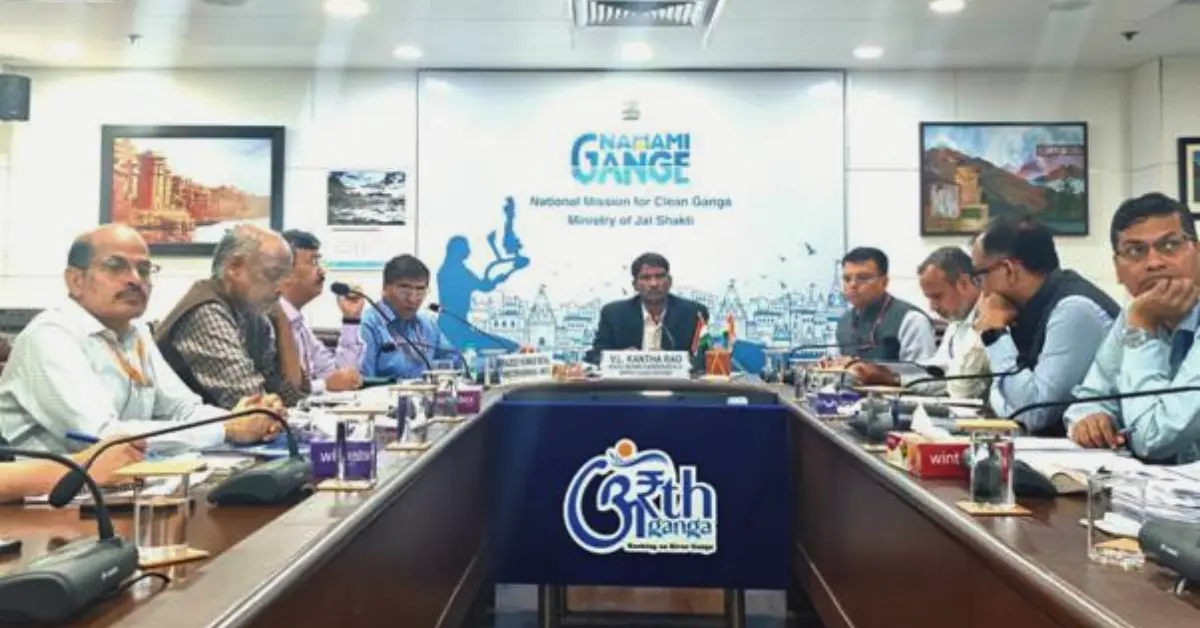
The Centre has asked States to adopt a time-bound, outcome-oriented approach to river rejuvenation, stressing sustained compliance and operational efficiency during the 21st Meeting of the Central Monitoring Committee (CMC) on river rejuvenation.
The meeting was held under the chairpersonship of VL Kantha Rao, Secretary, Department of Water Resources, River Development and Ganga Rejuvenation, Ministry of Jal Shakti.
Senior officials including Rajeev Kumar Mital, Director General, National Mission for Clean Ganga (NMCG), other officials of NMCG, and representatives of State Governments and State Pollution Control Boards attended the review.
The Committee reviewed the latest status of polluted river stretches based on the Central Pollution Control Board’s 2025 report and examined the progress made by States in implementing approved Action Plans.
The Chair underlined that sustainable improvement in river water quality depends not only on the creation of infrastructure but also on its effective utilisation, regulatory compliance, and timely project execution.
Priority areas highlighted included bridging sewage treatment gaps, improving performance of existing Sewage Treatment Plants (STPs), expediting ongoing and tendered STP projects and associated works on developing sewage networks, strengthening industrial pollution control, scaling up reuse of treated wastewater, and accelerating floodplain demarcation.
States were directed to enable real-time monitoring to enhance transparency and accountability in pollution control efforts.
A comparative review of polluted river stretches identified in 2018, 2022, and 2025 showed a continued reduction in the overall number of polluted stretches since 2018.
However, the Committee noted that certain States have reported the addition of new polluted stretches and deterioration in specific river segments, calling for focused corrective action.
The Committee also reviewed progress on sewage treatment plants, capacity utilisation, floodplain zoning, reuse of treated wastewater, and institutional monitoring through River Rejuvenation Committees in respect of Uttarakhand, Uttar Pradesh, Bihar, Jharkhand, West Bengal, Delhi, Haryana, Chhattisgarh, Madhya Pradesh, Rajasthan, Andaman & Nicobar, Lakshadweep, Odisha, Jammu & Kashmir, and Punjab.
The meeting concluded with a call for States to adopt a time-bound, outcome-oriented approach to river rejuvenation, with emphasis on operational efficiency, inter-departmental coordination, and sustained compliance to achieve long-term water quality improvement.