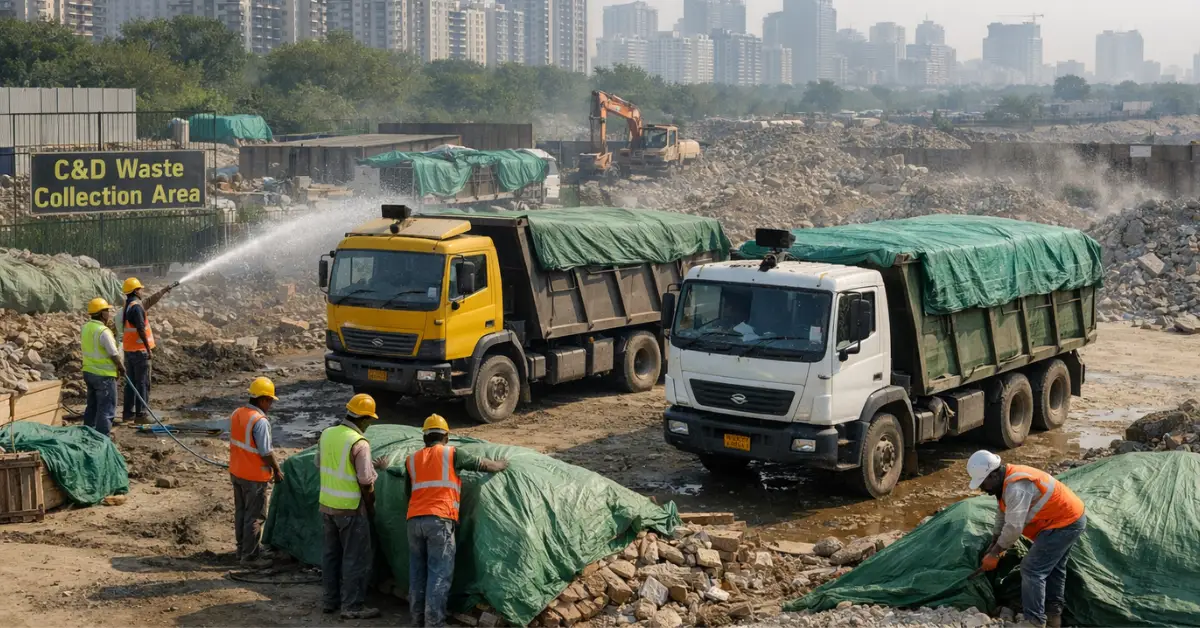
In a decisive move to tackle rising particulate pollution, the Commission for Air Quality Management (CAQM) has issued Statutory Direction No. 97 to tighten dust mitigation measures and strengthen the management of construction and demolition (C&D) waste across the National Capital Region.
The direction, issued by the Ministry of Environment, Forest and Climate Change, aims to curb dust pollution from large-scale construction and demolition activities, which the Commission identified as a consistent contributor to elevated levels of PM10 and PM2.5 in the region.
Despite earlier statutory directions and guidelines, inspections by State Pollution Control Boards, the Delhi Pollution Control Committee, and CAQM flying squads found significant compliance gaps – particularly in the handling and transportation of construction material and demolition debris.
The Commission noted that ongoing large-scale construction activities in major NCR cities are significantly adding to the overall particulate load. In response, the new direction seeks to institutionalise stricter oversight mechanisms and create an accountable waste management framework.
Importantly, the order aligns with the newly notified Environment (Construction and Demolition) Waste Management Rules, 2025, which will come into force from 1 April 2026. These rules emphasise environmentally sound waste management, circular economy principles, extended producer responsibility and stronger compliance systems.
Read also : Delhi’s air quality improves for three consecutive days, GRAP Stage-II curbs lifted across NCR
Mandatory Collection Grid And Waste Declaration
Under the fresh directions, Municipal Corporations and Development Authorities in Delhi-NCR must establish collection points, intermediate storage and processing facilities in line with the 2025 Rules. The Commission has mandated at least one collection point within every 5 Km x 5 Km grid under their jurisdiction.
For projects with a plot area of 200 sq. meters or more – where demolition is required before construction – building plan approving authorities must obtain a declaration of the estimated demolition waste before granting approval.
Further, project proponents must deposit demolition waste at designated collection or processing facilities and obtain a receipt prior to commencing construction or reconstruction. Issuance of Completion Certificates or Occupation Certificates will now require verification of this deposition receipt.
Municipal bodies are also tasked with ensuring environmentally sound transportation and disposal of C&D waste within their jurisdiction in accordance with the extant rules.
Tech-Based Monitoring And Enforcement
To improve transparency and monitoring, NCR State Governments and the Government of NCT of Delhi have been directed to establish an integrated web portal, geo-tag waste collection and processing facilities, and implement GPS tracking of C&D waste transportation.
The new directions will come into force from 1 April 2026.
With construction dust repeatedly flagged as a major urban pollution source, CAQM’s latest statutory intervention signals a sharper regulatory focus on compliance, traceability and accountability in managing demolition waste, placing dust from construction activities firmly under the scanner across Delhi-NCR.
Read also : Mumbai plans 70 Km integrated tunnel grid connecting Coastal Road, airport and bullet train terminal