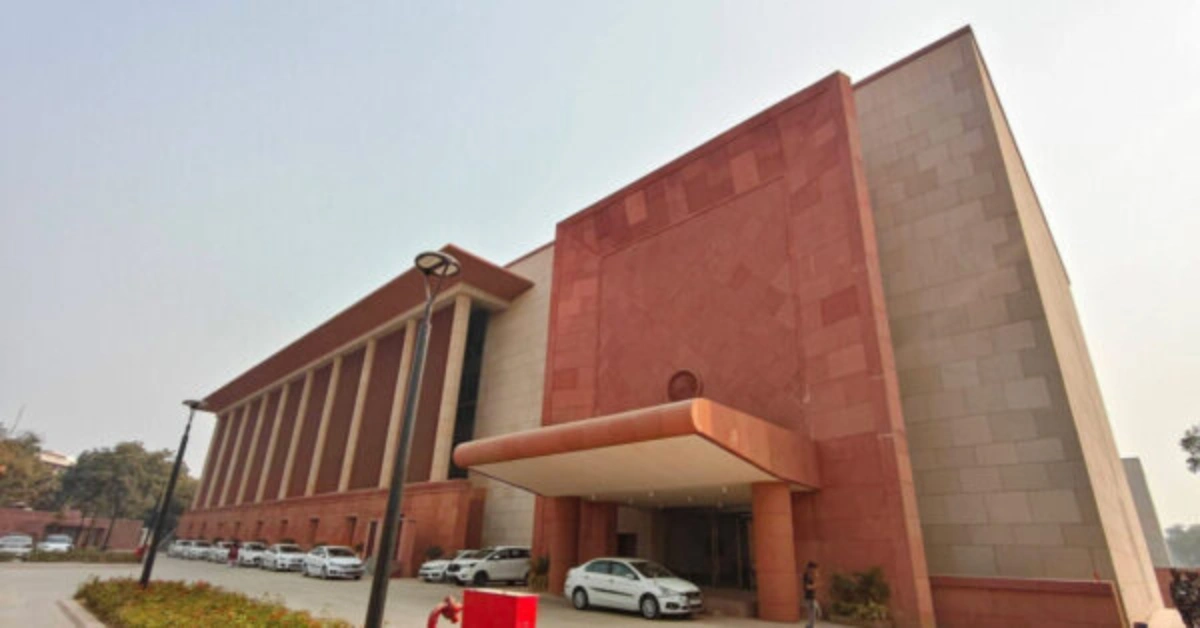
The Union Cabinet has approved the transition of government functions from the historic North and South Blocks to the newly established ‘Seva Teerth’ and ‘Kartavya Bhavans,’ marking a major administrative shift in India’s governance framework.
On 13 February 2026, the Prime Minister dedicated the new Prime Minister’s Office-now named ‘Seva Teerth’-to the nation.
Nearly 95 years after the inauguration of South Block, the Government of India has begun vacating the colonial-era buildings and relocating operations to modern facilities designed to be technological and environmentally friendly.
In a statement, the Prime Minister Narendra Modi-led Cabinet described the move as more than a physical relocation, calling it “a moment of the confluence of history and the future.”
The complex has witnessed key national developments-from the trauma of Partition and periods of war to policy deliberations during peacetime and the evolution from typewriters to digital governance.
Constructed during British rule, the North and South Blocks continued to serve as the centre of administration after Independence, with successive governments functioning from these premises.
Cabinets led by 16 Prime Ministers, from Jawaharlal Nehru to Narendra Modi, have taken major policy decisions within these buildings.
According to the Cabinet resolution, the transition symbolises India’s movement “from the past of slavery towards the future of Developed India,” while reinforcing a governance culture centred on service rather than power.
The new workspace is intended to enhance productivity and support officials in their public service responsibilities.
Over the past decade, South Block served as the hub for several major reforms and initiatives, including Direct Benefit Transfer, Swachh Bharat Abhiyan, Digital India, and the rollout of the Goods and Services Tax.
Decisions related to social justice measures such as the abrogation of Article 370 and legislation against triple talaq were also taken from this complex, alongside key national security actions.
The Cabinet has also resolved to convert the North and South Blocks into the “Yuge Yugeen Bharat National Museum.”
The proposed museum is expected to showcase India’s civilisational legacy, celebrate its cultural heritage, and connect the country’s historical journey with its future aspirations.