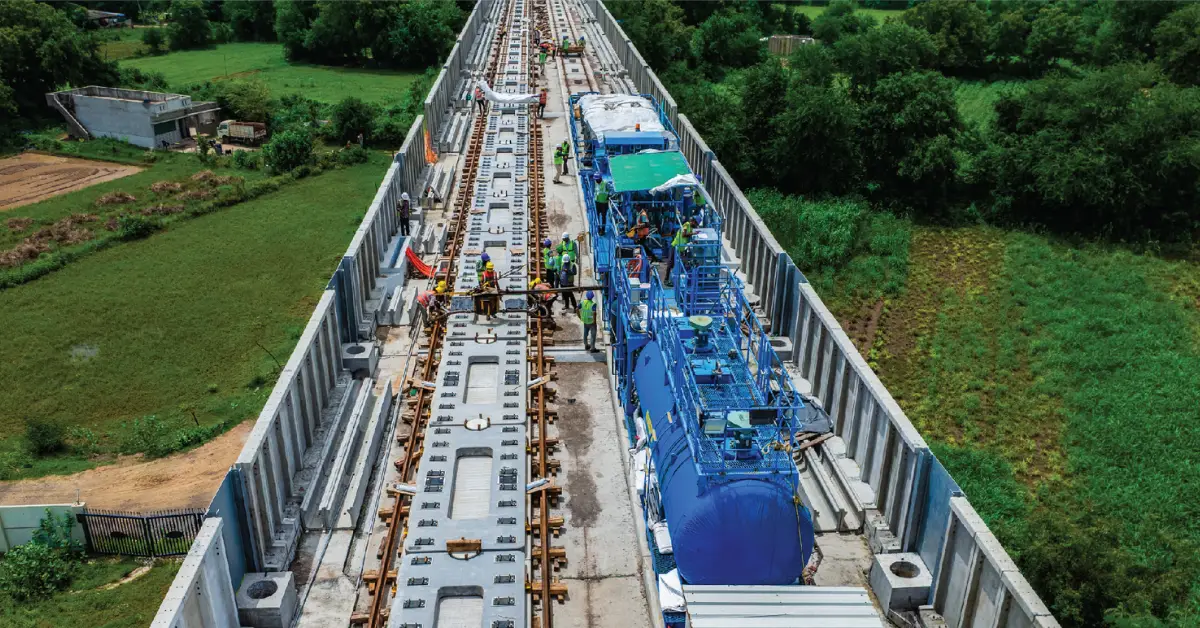
India is preparing to expand its high-speed rail footprint beyond the Mumbai-Ahmedabad bullet train project, with the Union Budget positioning rail investment as a driver of regional integration, passenger convenience, and economic opportunity across states.
The Union Budget 2025-26 has proposed seven high-speed rail corridors: Mumbai-Pune, Pune-Hyderabad, Hyderabad-Bengaluru, Hyderabad-Chennai, Chennai-Bengaluru, Delhi-Varanasi, and Varanasi-Siliguri.
The plan reflects a broader push to scale up India’s bullet train network and reshape long-distance mobility between major economic regions.
The proposed Delhi-Varanasi bullet train is projected to complete the journey in around 3 hours 50 minutes, strengthening connectivity between the national capital and one of India’s key cultural and economic centres.
The Varanasi-Siliguri corridor is expected to bring travel time down to about 2 hours 55 minutes, while connecting important religious, educational and medical centres across Uttar Pradesh, Bihar and West Bengal.
The route is also expected to create a new economic corridor spanning these states and support regional development.
In western India, the Mumbai-Pune high-speed rail corridor will reduce travel time to nearly 48 minutes, effectively integrating the two urban centres and supporting heavy passenger movement on a critical economic route.
Further southward connectivity from Pune to Hyderabad is expected in around 1 hour 55 minutes, forming part of a continuous high-speed spine designed to improve inter-city travel and benefit regional economies.
The Chennai-Bengaluru corridor is projected to bring travel time down to roughly 1 hour 13 minutes, strengthening mobility between two of India’s largest technology and manufacturing hubs.
Meanwhile, Bengaluru-Hyderabad is expected to take around 2 hours, and Chennai-Hyderabad about 2 hours 55 minutes, enabling faster movement across southern India’s major economic centres.
A key strategic priority is also the planned 40 Km underground rail corridor connecting the Northeast with the rest of the country.
The project is intended to create additional capacity and ensure uninterrupted, resilient rail movement for both passengers and freight across the strategic corridor.
Read also : In major safety push, Indian Railways fixes over 8,600 bridges in last three years