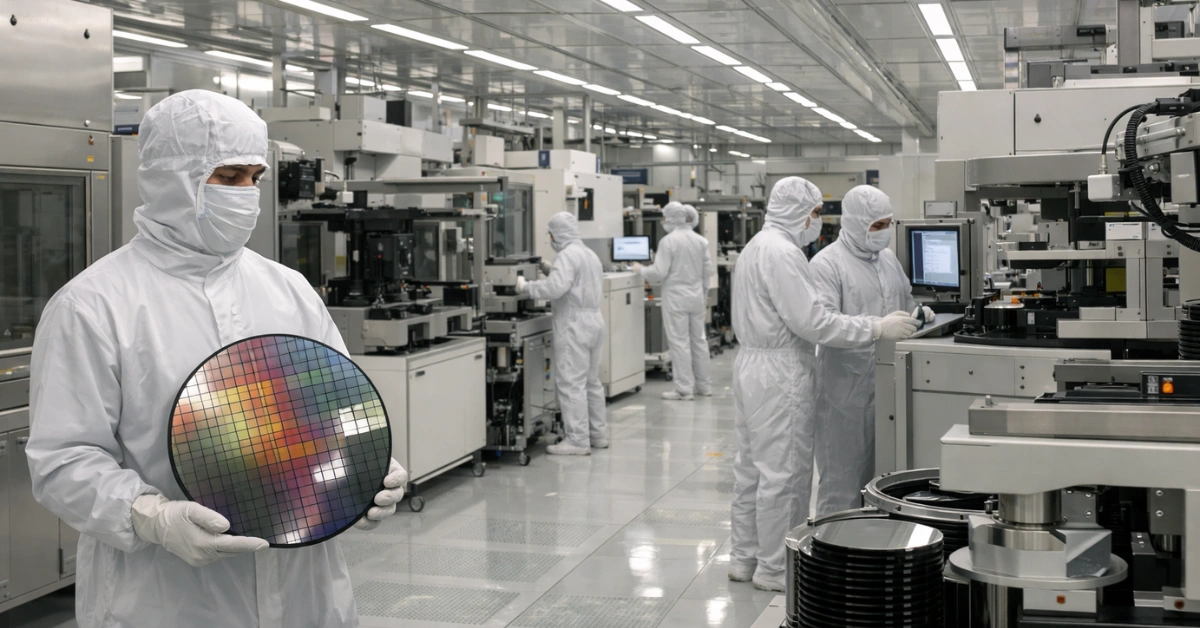
India has unveiled the next phase of its semiconductor strategy with the announcement of India Semiconductor Mission (ISM) 2.0 in the Union Budget 2026-27, signalling a stronger policy push to build domestic chip capabilities and reduce external dependence.
A provision of ₹1,000 crore has been allocated for FY 2026-27, with emphasis on producing semiconductor equipment and materials within the country, designing full-stack Indian semiconductor intellectual property, and strengthening both domestic and global supply chains.
The programme prioritises industry-led research and training centres to accelerate technology development and create a future-ready skilled workforce, reflecting India’s transition from policy formulation to production readiness in the semiconductor sector.
Semiconductors power critical systems ranging from telecommunications and automobiles to defence and artificial intelligence, making them essential for modern economies.
Building on progress under ISM 1.0, the new phase aims to consolidate India’s position as a reliable participant in the global semiconductor network.
India’s semiconductor market is projected to expand sharply from about $38 billion in 2023 to $45-50 billion in 2024-25, and further to $100-110 billion by 2030, anchored in the national vision of Make in India and Make for the World.
The foundation of this growth was laid with ISM 1.0, backed by an incentive framework of ₹76,000 crore offering fiscal support of up to 50 per cent for fabrication, packaging, testing, and chip design facilities.
As of December 2025, 10 projects worth ₹1.60 lakh crore had been approved across six states, covering silicon fabrication units, advanced packaging facilities, and specialised assembly infrastructure.
Looking ahead, India is expected to gain the capability by 2029 to design and manufacture chips required for nearly 70-75 per cent of domestic applications.
The roadmap under ISM 2.0 also targets advanced manufacturing nodes such as 3-nanometre and 2-nanometre technologies, with the broader ambition of placing India among the world’s top semiconductor nations by 2035.
For 2026-27, the Modified Programme for Development of Semiconductor and Display Manufacturing Ecosystem carries a total financial outlay of ₹8,000 crore.
The initiative is designed to accelerate capital investment, generate high-quality employment, and expand domestic capabilities across fabrication, packaging, and chip design.
Projected targets include ₹4,000 crore in investment and employment for 1,500 persons under the semiconductor fabs scheme.
Additional support for compound semiconductor and packaging units is expected to drive ₹11,000 crore in investments and create 3,000 jobs, while the Design Linked Incentive scheme aims to support 30 design companies, develop 10 semiconductor IP cores, and employ 200 design professionals.
The mission also places strong emphasis on design innovation.
The Design Linked Incentive programme currently supports 24 semiconductor design startups that have attracted nearly ₹430 crore in venture capital funding.
Advanced design tools have logged approximately 2.25 crore tool hours, with around 67,000 students and over 1,000 startup engineers actively engaged in chip development.
India has simultaneously invested in indigenous processor development, including the launch of DHRUV64, a fully domestic 64-bit microprocessor designed for deployment across sectors such as 5G infrastructure, automotive electronics, industrial automation, and IoT.
The processor strengthens India’s long-term technological sovereignty by reducing reliance on imported chips.
Talent development remains another pillar of ISM 2.0.
The semiconductor programme has been recalibrated in response to global supply-chain vulnerabilities exposed during the Covid-19 pandemic, when shortages affected more than 169 industries worldwide.
With production concentrated among a few countries, Taiwan alone accounts for over 60 per cent of global semiconductors and nearly 90 per cent of advanced chip, India is positioning itself as a trusted and diversified manufacturing partner.
India Semiconductor Mission 2.0 marks a shift from ecosystem creation to consolidation and global integration.
By deepening support for manufacturing, design, and advanced skills, the mission positions semiconductors as a strategic national capability central to economic resilience, digital infrastructure, and technological sovereignty.