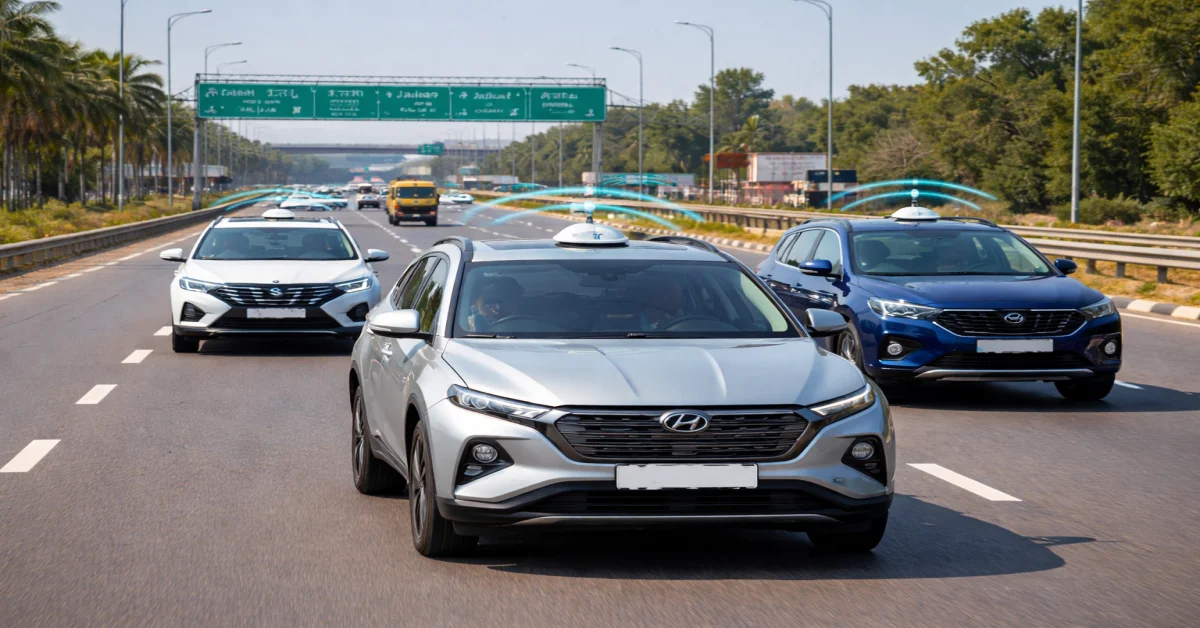
The government has allocated 30 GHz of radio spectrum to develop and deploy Vehicle-to-Vehicle (V2V) communication technology aimed at enhancing road safety and reducing collisions by enabling vehicles to exchange real-time safety data without relying on mobile or internet networks.
Union Road Transport and Highways Minister Nitin Gadkari informed a consultative committee of Parliament that the Department of Telecommunications has earmarked the radio frequency specifically for V2V communication systems that can transmit critical information such as speed, location, direction and braking status directly between vehicles.
The announcement comes against the backdrop of India’s ongoing efforts to curb road accidents, which remain among the highest globally. The V2V technology will work across the front, rear and sides of vehicles to send safety alerts even when hazards are outside the driver’s direct line of sight, enhancing existing Advanced Driver Assistance Systems (ADAS) and helping drivers react faster to dangerous situations.
According to industry reports, this radio spectrum infrastructure could cost around ₹ 5,000 to ₹ 7,000 per vehicle as manufacturers integrate the necessary systems into onboard units. Early deployment is expected in new vehicles this calendar year, with plans to later mandate retrofitting for older vehicles as standards and regulations are finalised with automobile manufacturers.
Experts say V2V communication is part of a broader category of intelligent transport technologies that includes vehicle-to-everything (V2X) systems, which can link vehicles with infrastructure and other road users to improve traffic flow and safety. Traditionally, global implementations of such technologies use dedicated short-range communications in frequency bands like 5.9 GHz under international standards such as IEEE 802.11p and Cellular V2X, enabling direct wireless messaging between vehicles and roadside systems.
In India, standards specific to the 30 GHz allocation are being developed in consultation with industry stakeholders, with the government aiming for a phased rollout that could significantly reduce road fatalities and advance connected mobility.