V.O. Chidambaranar Port in Tuticorin is set for a major transformation after projects worth more than ₹1,500 crore were launched on Monday, 23 February, accelerating its shift toward green energy integration, digital modernisation and expanded cargo capacity.
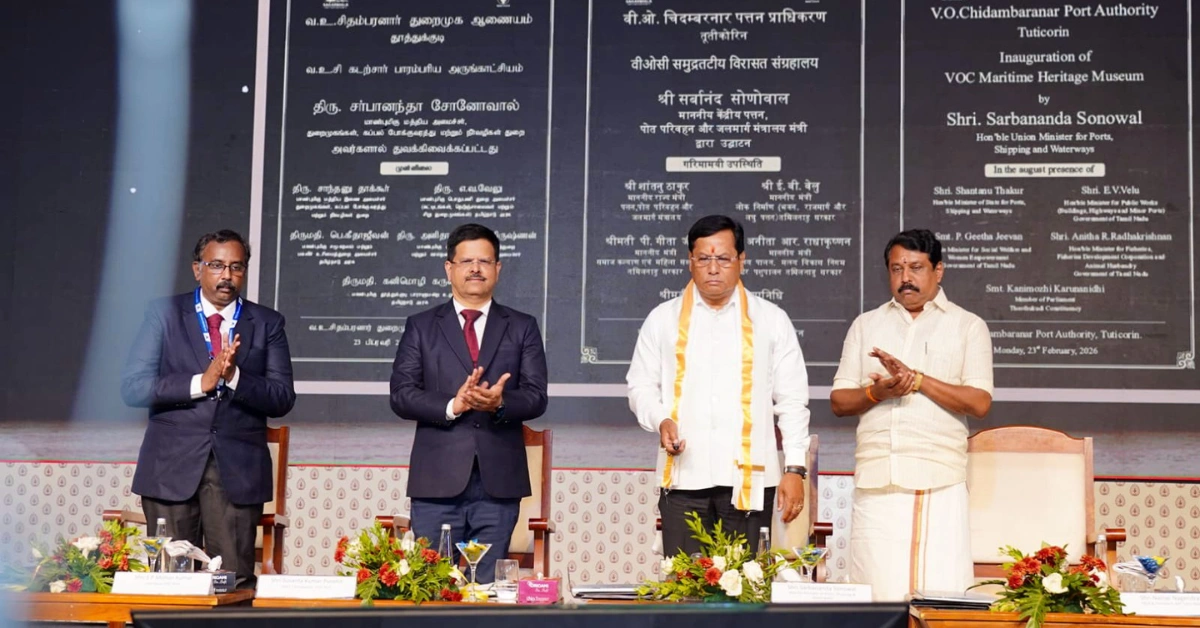
Union Minister for Ports, Shipping and Waterways Sarbananda Sonowal unveiled a series of infrastructure, renewable energy and technology initiatives aimed at strengthening the port’s role under Maritime Vision 2047.
The projects span rail and road connectivity upgrades, enhanced power systems, renewable energy integration including solar, wind and battery storage, green hydrogen production facilities, advanced safety systems and new digital platforms.
A key highlight of the event was the inauguration of the VOC Maritime Heritage Museum, an immersive institution dedicated to India’s maritime legacy and the contribution of freedom fighter V.O. Chidambaranar.
The museum has been conceived as a cultural and educational landmark for southern Tamil Nadu and is expected to promote tourism, community engagement and awareness of the Coromandel Coast’s maritime history.
The port’s expansion builds on recent capacity additions.
Over the past 18 months, three new berths have been commissioned, including the North Cargo Berth-III dedicated in July 2025, which enhanced bulk cargo handling.
Work on the Outer Harbour project is also progressing, a development aimed at accommodating larger vessels and increasing trade volumes.
VOC Port has also emerged as a frontrunner in sustainable maritime operations.
It became the first Indian port to produce and utilise green hydrogen on site, with a pilot project operational since late 2025.
Plans are in place to scale this to commercial production by 2029.
Integrated renewable initiatives, green methanol facilities and partnerships in e-ammonia and carbon capture, utilisation and storage are being pursued to position the port as a green fuel bunkering hub.
On the technology front, the port has deployed India’s first comprehensive Digital Twin platform, enabling real-time monitoring, predictive maintenance and data-driven operational optimisation.
An anti-drone system has also been installed to strengthen protection of critical infrastructure.
According to the Ministry of Ports, Shipping and Waterways, operational performance of the port has improved alongside these developments.
From April 2025 to January 2026, cargo handling rose 6 per cent to 35.97 million tonnes, including a record 4 million tonnes in January alone.
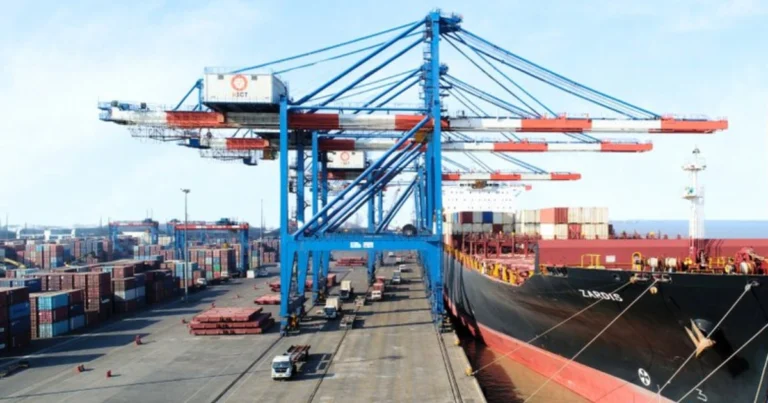
Container volumes increased 9.4 per cent to more than 716,000 TEUs, driven by process reforms, additional equipment and expanded storage capacity.
The ministry expects that the projects will reduce logistics costs, accelerate industrial growth across the Tuticorin, Tirunelveli and Madurai districts, attract new investments and generate significant employment opportunities.
The Maritime Heritage Museum is also expected to enhance tourism and contribute to the overall socio-economic development of the region, Sonowal said.
Officials expect the ongoing investments to reduce logistics costs, support industrial growth across Tuticorin, Tirunelveli and Madurai districts, attract fresh investment and generate employment.
With sustained focus on infrastructure, sustainability and digitisation, VOC Port is consolidating its position as a key maritime gateway on India’s eastern seaboard.
Read also : India’s 13 major ports handle 672.98 MT cargo in April-December 2025, up 8.22 per cent