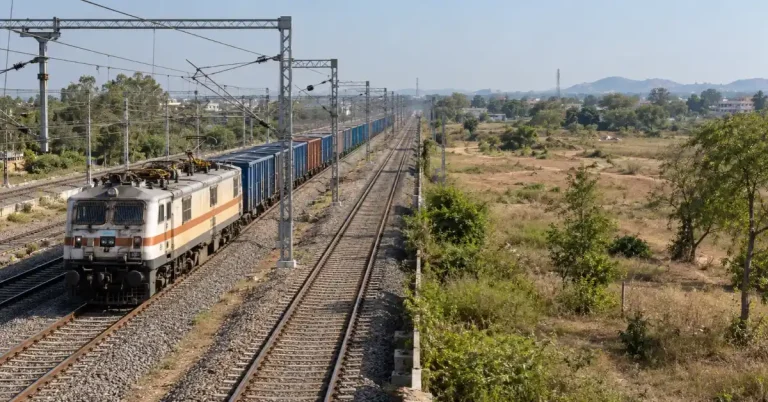
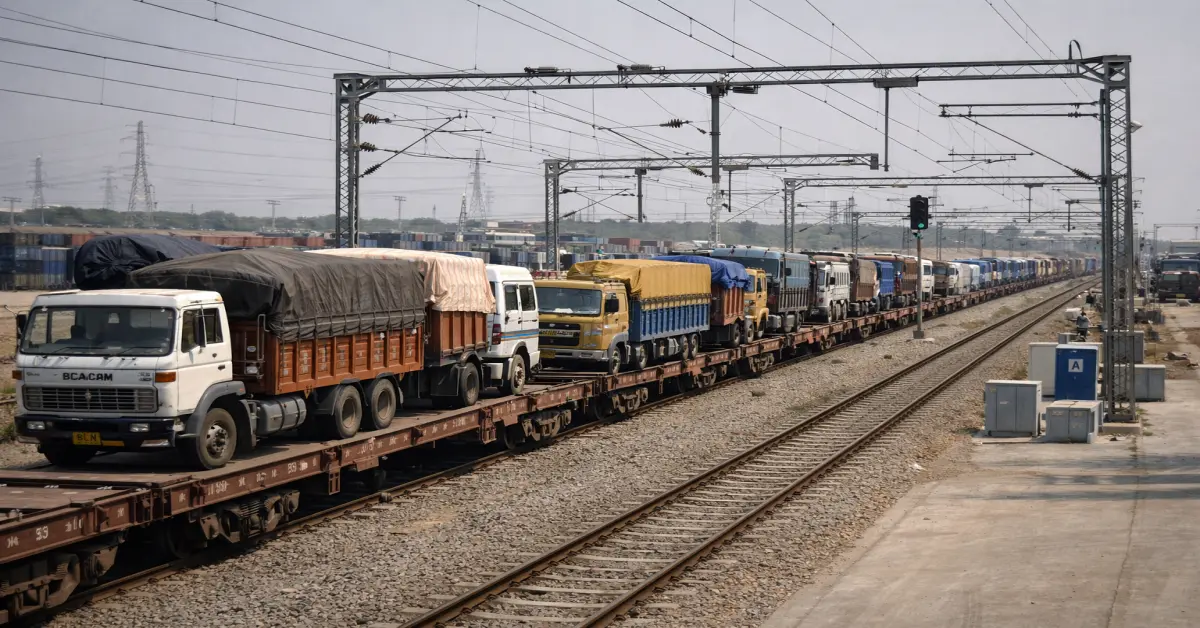
India’s freight landscape is undergoing a structural shift as Indian Railways’ Trucks-on-Trains (ToT) service moves long-haul cargo off highways and onto electrified rail corridors, cutting transit time, fuel consumption and emissions in measurable terms.
The service, operating on the Western Dedicated Freight Corridor between New Palanpur and New Rewari, has moved beyond pilot scale and is now delivering commercial volumes and revenue.
Covering a distance of around 636 kilometres, the ToT service reduces end-to-end transit time from nearly 30 hours by road to about 12 hours by rail, with trucks using highways only for short first- and last-mile movement, according to the rail ministry.
This shift shields freight operators from congestion, toll delays and weather-related disruptions that routinely affect long-distance trucking.
Operational data from the current financial year shows growing adoption. Between April and December of FY 2025, the service handled 545 rakes, moved over 3 lakh tonnes of freight, and generated ₹36.95 crore in revenue. New Palanpur accounted for 273 rakes, carrying more than 2 lakh tonnes and earning ₹20.18 crore, while New Rewari handled 272 rakes, moved about 0.1004 million tonnes, and generated ₹16.76 crore.
Pricing has been positioned to remain competitive for transporters. Freight charges are levied on transparent weight slabs – ₹25,543 per wagon for trucks up to 25 tonnes, ₹29,191 for 25 to 45 tonnes, and ₹32,000 for 45 to 58 tonnes. Empty trucks are carried at ₹21,894 per wagon, while no GST is levied on milk tankers, making the service attractive for dairy and other time-sensitive cargo. Open Indent booking has been available since January 2024, allowing flexible planning for logistics operators.
Beyond commercial performance, the scale of highway decongestion is significant. On the Palanpur–Rewari corridor alone, shifting the long-haul segment to rail effectively removes 48,875 trucks from highways for the core journey. This transition is estimated to save around 88,81,285 litres of diesel and prevent the emission of approximately 2,30,91,343 kilograms of carbon dioxide, highlighting the environmental impact of corridor-based modal shift.
Since inception, the Trucks-on-Trains service has completed over 1,955 trips, handled more than one million tonnes of freight, and generated cumulative revenue exceeding ₹131 crore. Major demand has come from sectors such as dairy, automobiles, FMCG and food processing, with regular volumes anchored after a June 2023 memorandum of understanding with the Gujarat Cooperative Milk Marketing Federation.
Rail-based long-haul movement also improves safety outcomes. By reducing continuous driving hours, the model lowers driver fatigue and accident risk, while reduced truck traffic cuts road wear and public expenditure on highway maintenance. Fully electrified freight corridors further improve reliability during fog, heavy rain and extreme weather, conditions that frequently disrupt highway movement.
With new wagon designs under the Flat Multipurpose platform and additional origin-destination terminals planned across the Dedicated Freight Corridor network, the service is being positioned for wider scale-up. As volumes rise, the data suggests that India’s freight transition is no longer theoretical – trucks are already leaving highways, one train at a time.