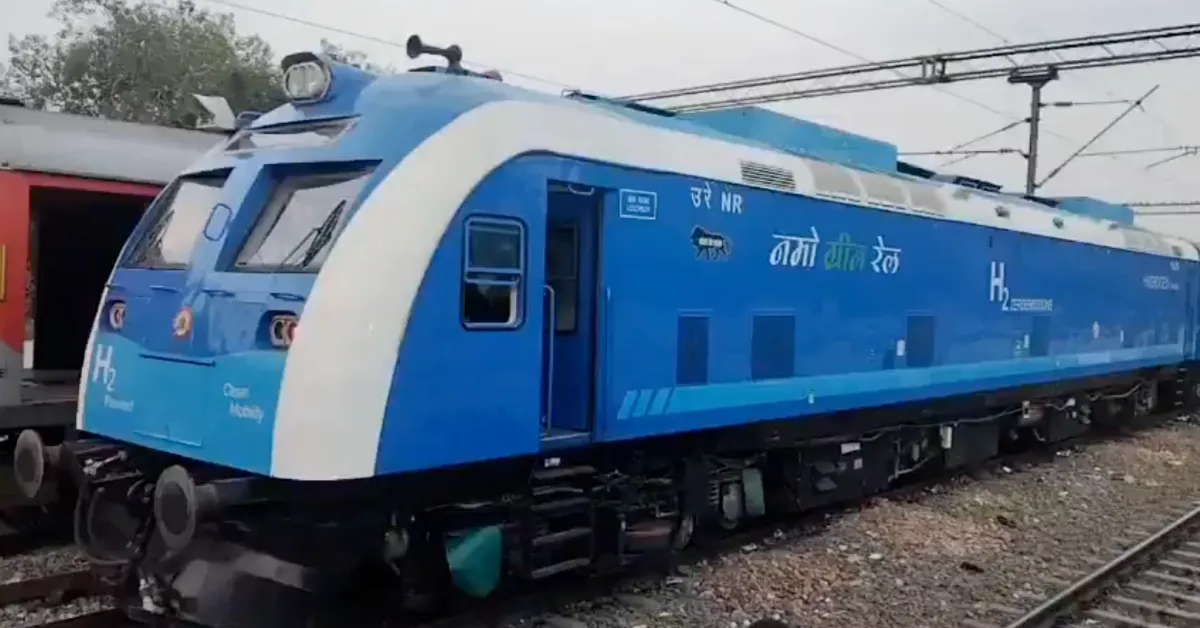
Hydrogen train testing in India has moved from prototype readiness to track validation, with the country’s first hydrogen fuel cell-based train completing a 120 kmph trial on June 26 on the Jind-Sonipat section in Haryana.
The high-speed trial, conducted on Friday, is a key step before Indian Railways can place the train into passenger service on the approved pilot corridor. The Delhi-Jind trial run checked critical operating parameters, including emergency braking distance and oscillation, as railway teams assessed how the new clean-traction system performs under real track conditions.
The latest trial activity comes after earlier testing linked to the Jind, Sonipat and Delhi railway corridor. However, the officially sanctioned passenger section so far remains Jind-Sonipat under the Northern Railway zone.
The train departed from Jind during the trial, with railway officials monitoring its systems and performance. The successful run gives Indian Railways important data before the remaining compliance, safety and operational stages are completed.
The project is significant because it places hydrogen propulsion inside India’s regular passenger railway network, not just inside a laboratory or test facility. The Jind-Sonipat pilot will test the full ecosystem: the trainset, fuel cells, hydrogen storage, refuelling infrastructure, safety sensors, operating crew, maintenance systems and emergency response protocol.
The Ministry of Railways had earlier approved the introduction of a 10-coach hydrogen fuel cell-based DEMU train on the dedicated Jind-Sonipat section. The sanctioned passenger operating speed is 75 kmph, even though the train was tested at 120 kmph during the latest trial phase.
The train has a total power output of 1,200 KW and will function on Distributed Power Rolling Stock technology. Under this model, power is distributed across the trainset instead of being concentrated in a separate locomotive. This improves operational flexibility for short and medium-distance passenger routes where acceleration, braking and turnaround efficiency matter.
Unlike diesel-powered trains, the hydrogen train uses fuel cells to generate electricity through a reaction between hydrogen and oxygen. The direct emission from this process is water vapour, which makes the technology important for Indian Railways’ efforts to reduce fossil-fuel dependence and cut emissions from rail operations.
The train’s fuel supply system is also part of the pilot. A hydrogen production, storage and dispensing facility has been developed at Jind. The Petroleum and Explosives Safety Organisation has granted a licence for filling and storage of Compressed Hydrogen Gas in the Hydrogen Storage System from the Hydrogen Generation Unit for dispensing as automotive fuel at Jind in Haryana.
The Railway Board’s approval comes with strict conditions. Northern Railway must ensure compliance with the Research Designs and Standards Organisation, the Chief Commissioner of Railway Safety, PESO and independent safety assessment requirements before actual passenger operations begin.
Read also : India looks beyond first bullet train, starts groundwork for 350 kmph B35
The sanction letter makes it clear that approval for the train does not mean an immediate public launch. Compliance reports, safety checks, maintenance documentation, crew training and statutory clearances must be completed before the hydrogen train starts regular service.
Safety is central to the rollout. The train and ground infrastructure have hydrogen leak detectors, flame detectors and monitoring systems to identify risks during production, storage, refuelling and train operations.
The Railway Board has also flagged dust accumulation as a possible risk for sensors installed at the hydrogen production, storage and dispensing facility. Regular cleaning schedules have been mandated to ensure fail-safe operation.
“PESO has granted a licence for filling and storage of Compressed Hydrogen Gas (CHG) in Hydrogen Storage System from Hydrogen Generation Unit for dispensing purpose as automotive fuel at Jind, Haryana. Compliance of all the conditions/ stipulations as mentioned therein shall be strictly ensured,” the ministry’s letter said.
“Various sensors (leak detectors, flame detectors, etc) provided on ground hydrogen production, storage and dispensing facility are prone to failure due to dust accumulation. Necessary schedule for regular clearing shall be ensured for failsafe operation,” it added.
The approval also requires 24×7 manning of the control room with access to hydrogen refuelling cycle data. Security arrangements must be maintained across the hydrogen plant and refuelling premises to prevent unauthorised access.
The hydrogen compression system is another area under close watch. Since the initial facility has a single compressor unit, the Railway Board has asked for adequate critical spares and maintenance support. A standby compressor unit must also be provided within the stipulated period.
Maintenance of the trainset is planned at Shakurbasti. Since the approved operating section is Jind-Sonipat, separate authorisation will be required for movement of the trainset between Jind and Shakurbasti in dead condition, hauled by a locomotive.
The Railway Board has also directed that trained technical staff with hydrogen trainset competency accompany the train during the first three months of service to handle any en-route technical issues.
For Indian Railways, the Jind-Sonipat hydrogen train is not just a new train introduction. It is the first full-scale test of whether hydrogen can become a practical clean-traction option for selected passenger routes in India.
If the pilot performs reliably after passenger operations begin, the model could guide future hydrogen train deployments on other routes where clean traction, lower emissions and alternative energy systems are being evaluated.
Read also : Central Secretariat to get Magenta Line link as DMRC begins work on Central Vista Metro corridor