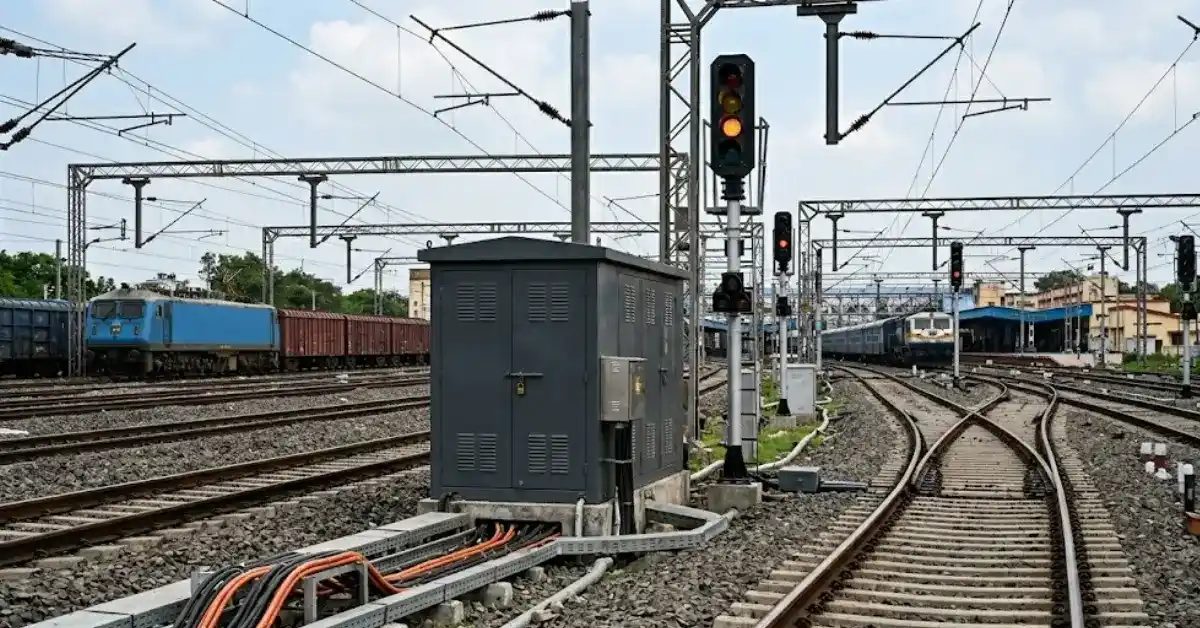
Indian Railways has approved a ₹405 crore signalling modernisation project on Eastern Railway to improve safety, reliability and fault detection on busy routes.
The project will replace old relay-based interlocking systems with Electronic Interlocking at 32 stations and locations.
These include 25 Panel Interlocking and Route Relay Interlocking stations, along with seven Intermediate Block Signalling locations on High Density Network and Highly Utilised Network routes.
The approval comes as part of Indian Railways’ wider plan to modernise signalling systems on critical railway corridors.
These routes carry heavy passenger and freight movement, making signalling reliability an important part of safe and smooth train operations.
Many existing signalling installations on the selected routes are based on older relay technology.
According to the Ministry of Railways, these systems face operational limitations because of ageing infrastructure, outdated power supply arrangements, improper earthing systems and old signalling equipment.
The ministry said issues such as non-segregation of clean and dirty wiring have also increased maintenance requirements and failure risks on these routes.
Electronic Interlocking systems use digital technology to control train movements and signalling operations with greater precision.
Read also : NHAI begins predictive asset management push to improve national highway maintenance across India
Compared with conventional relay-based systems, EI technology reduces the chances of signalling failures, improves system availability and allows quicker restoration when faults occur.
The modernisation is expected to support smoother train operations on some of the busiest railway corridors. It will also help improve safety standards for both passenger and freight services.
The project is also linked to Indian Railways’ future technology roadmap. The upgraded signalling infrastructure will support advanced systems such as Kavach, Automatic Block Signalling and Centralised Traffic Control on high-density routes.
Kavach is India’s indigenous train protection system, while Automatic Block Signalling helps increase line capacity by allowing trains to run at safer and shorter intervals. Centralised Traffic Control allows train operations over a larger section to be managed from a central location.
By moving from relay-based interlocking to Electronic Interlocking, Indian Railways is aiming to reduce failures, improve operational efficiency and prepare critical sections for future capacity expansion.
Read also : Indian Railways approves ₹755 crore Champa–Korba Third Line Project to strengthen coal freight corridor