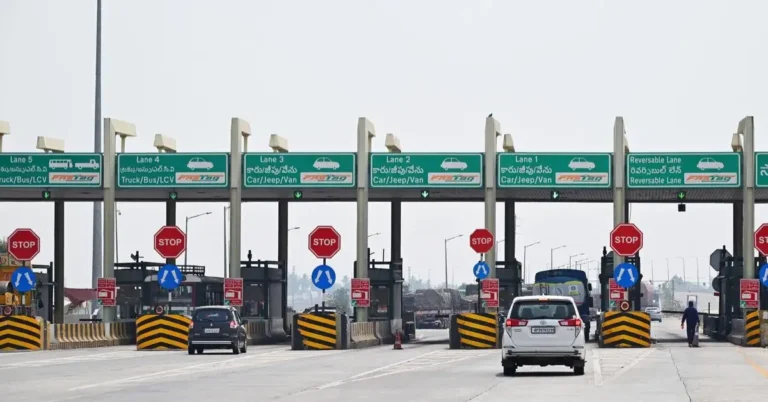

The Indian Highways Management Company Limited (IHMCL), promoted by the National Highways Authority of India (NHAI), has signed a Memorandum of Understanding (MoU) with the National Forensic Sciences University (NFSU) to enhance digital security and data protection across national highway systems.
The agreement focuses on collaboration in research, training, and consultancy, particularly in cyber forensics, digital evidence integrity, and advanced technological applications relevant to highway management.
The MoU was signed by A.R. Chitranshi, Chief Operating Officer of IHMCL, and Dr. S.O. Junare, Campus Director of NFSU Gandhinagar, in the presence of NHAI Chairman Santosh Kumar Yadav and other senior officials.
Under the partnership, NFSU will provide technical guidance for developing laboratories equipped with state-of-the-art technologies such as CCTV systems, multimedia analysis tools, audio-video analysis platforms, and digital as well as cyber forensics facilities.
The university will also support IHMCL in strengthening cyber resilience and evidence integrity through specialised training programmes in cyber and digital forensics and related domains.
Key areas of collaboration include Multi-Lane Free Flow (MLFF), Advanced Traffic Management Systems (ATMS), Automatic Number Plate Recognition (ANPR), Traffic Management Systems (TMS), and Weigh-in-Motion (WIM).
Additional focus areas cover secure camera-based imaging systems, encrypted data storage and retrieval, cybersecurity reviews of critical applications, scientific improvement of imaging accuracy, and the establishment of Security Operations Centre services along with forensic validation laboratories.
Both organisations will undertake joint research, development, and consultancy projects, with coordinators appointed by each side to oversee implementation and periodically review progress. The MoU will remain valid for three years.