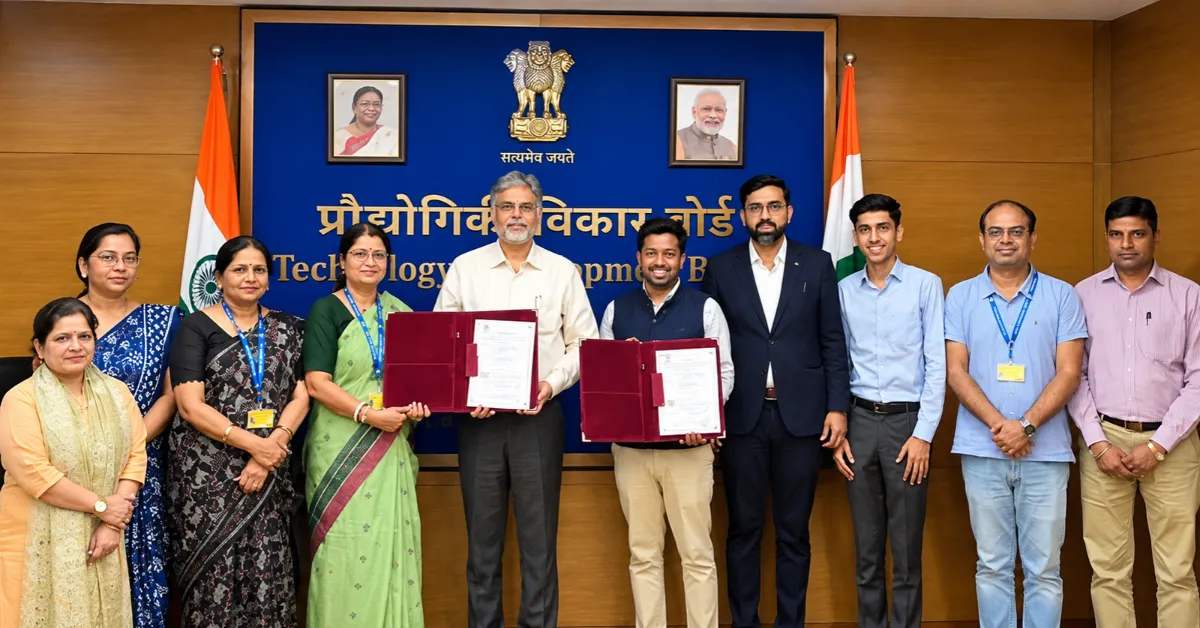
New Delhi, October 27, 2026: The Central Government’s Technology Development Board (TDB) has signed an agreement to provide ₹116 crore in financial support to Navi Mumbai-based Manastu Space Technologies for the development of indigenous green propulsion systems for satellites and launch vehicles. The project, with an estimated total cost of ₹277.63 crore, aims to advance the technology towards commercial deployment.
The agreement was announced by the Ministry of Science and Technology on October 26. The financial support will be provided through optionally convertible debt under the government’s Research, Development and Innovation (RDI) Fund, rather than as a conventional grant.
Manastu Space is developing propulsion systems that use a hydrogen peroxide-based propellant with additives as an alternative to conventional spacecraft propellants. According to the ministry, the technology is intended to improve performance and cost efficiency while addressing operational challenges associated with traditional propellants.
The project covers propulsion systems with thrust levels ranging from 5 millinewtons (mN) to 300 newtons (N), supporting the development of engines for different satellite and launch vehicle applications.
Satellite propulsion systems are used to adjust orbits, maintain orbital positions and perform manoeuvres in space. Systems with different thrust capabilities serve various mission requirements, from small satellite operations to applications requiring higher thrust.
The development programme includes propulsion engines, propellant feed systems and an ultra-high-temperature ceramic catalyst designed to support engine performance under demanding operating conditions.
Manastu Space’s propulsion technology has already been demonstrated in space. However, the newly supported project will focus on further engineering, system integration, testing and validation before the technology reaches its targeted level of operational readiness.
The programme aims to advance the technology from Technology Readiness Level (TRL) 6 to TRL 9.
TRL 6 generally indicates that a technology has been demonstrated in a relevant environment, while TRL 9 represents a system proven through successful operational use. The agreement does not mean that the technology has already achieved TRL 9.
The project is also intended to strengthen India’s domestic capabilities in spacecraft propulsion, a technology critical to satellite operations and launch vehicle development.
TDB Secretary Rajesh Kumar Pathak highlighted the importance of indigenous propulsion technology in strengthening India’s space sector, particularly as demand grows for reliable, safer and more cost-efficient systems.
The company said the financial support would help advance its propulsion technology through additional development and testing, with the objective of establishing a scalable platform for wider space applications.
The ₹116 crore financing commitment forms part of the project’s total estimated cost of ₹277.63 crore. The announcement does not specify how the remaining ₹161.63 crore will be financed or provide a schedule for disbursing the committed funds.
It also does not identify specific satellite operators or launch vehicle manufacturers expected to adopt the technology, nor does it announce a commercial deployment date.
The agreement provides financial backing for the further development of an Indian propulsion technology that has already undergone an in-space demonstration, with the next phase focused on achieving full operational readiness for broader satellite and launch vehicle applications.