
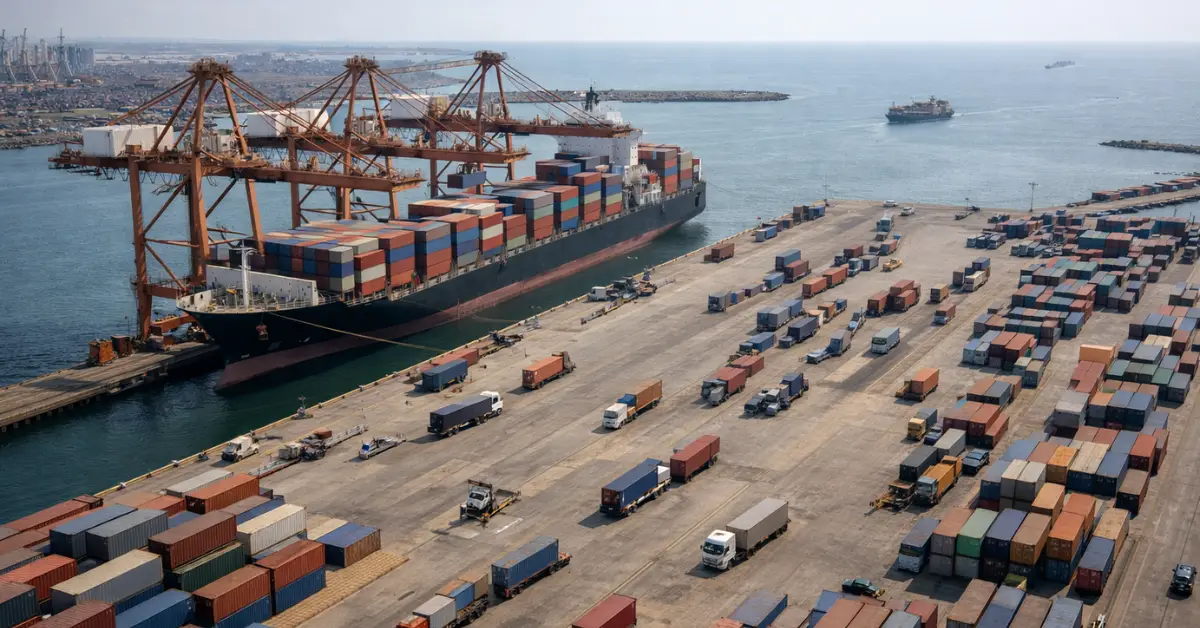
India’s cumulative exports of merchandise and services during April-January 2025-26 are estimated at $720.76 billion, registering a growth of 6.15 per cent compared to $679.02 billion during the same period last year, according to the government.
Total imports during April-January 2025-26 are estimated at $823.41 billion, reflecting a growth of 6.54 per cent.
The overall trade deficit for the period stood at $102.65 billion.
Merchandise exports during April-January 2025-26 reached $366.63 billion, up from $358.75 billion a year earlier, marking a growth of 2.20 per cent.
Non-petroleum exports for the period were valued at $320.94 billion, rising 4.89 per cent from $305.98 billion in April-January 2024-25.
For January 2026, India’s total exports are estimated at $80.45 billion, registering a growth of 13.17 per cent compared with January 2025.
Total imports for the month are estimated at $90.83 billion, reflecting an increase of 18.76 per cent, while the trade balance stood at negative $10.38 billion.
Merchandise exports in January 2026 were recorded at $36.56 billion compared to $36.34 billion in January 2025.
Merchandise imports rose to $71.24 billion from $59.77 billion in the corresponding month last year.
Services exports are estimated at $43.90 billion in January 2026, up from $34.75 billion a year earlier, while services imports are estimated at $19.60 billion compared with $16.71 billion in January 2025.
The services sector recorded a trade surplus of $180.58 billion during April-January 2025-26, significantly higher than the surplus of $153.56 billion reported during the same period in the previous year.
Services exports for the period are estimated at $354.13 billion, compared to $320.28 billion last year.
Key drivers of merchandise export growth in January 2026 included engineering goods, petroleum products, meat, dairy and poultry products, marine products, and iron ore.
Engineering goods exports increased by 10.37 per cent to $10.40 billion from $9.42 billion in January 2025, while petroleum products rose 8.55 per cent to $3.77 billion from $3.48 billion.
Exports of meat, dairy and poultry products grew 17.92 per cent to $0.61 billion, marine products rose 13.29 per cent to $0.61 billion, and iron ore shipments expanded 31.54 per cent to $0.21 billion.
Several commodity categories recorded positive growth during January 2026, including other cereals (88.49 per cent), coffee (36.03 per cent), fruits and vegetables (1.77 per cent), drugs and pharmaceuticals (0.96 per cent), electronic goods (0.32 per cent), and man-made yarn and fabrics (1.01 per cent).
Non-petroleum and non-gems and jewellery exports stood at $30.47 billion in January 2026 compared with $29.86 billion a year earlier. For April-January FY26, such exports were valued at $297.41 billion, up from $281.59 billion in the previous year.
On the import side, several categories recorded negative growth in January 2026, including pulses, newsprint, chemical materials and products, iron and steel, coal and related products, project goods, wood products, organic and inorganic chemicals, transport equipment, pearls and precious stones, textile yarn and fabrics, and crude petroleum and products.
Among export destinations, the highest growth in January 2026 was recorded for Hong Kong, China, the United Arab Emirates, Italy, and the Netherlands.
For the April-January period, China, the United States, the United Arab Emirates, Spain, and Hong Kong were among the destinations showing strong growth.
Switzerland, the United Arab Emirates, China, the United States, and the United Kingdom were among the top import sources registering growth during January 2026, while China, the United Arab Emirates, the United States, Hong Kong, and Singapore led import growth during April-January FY26.