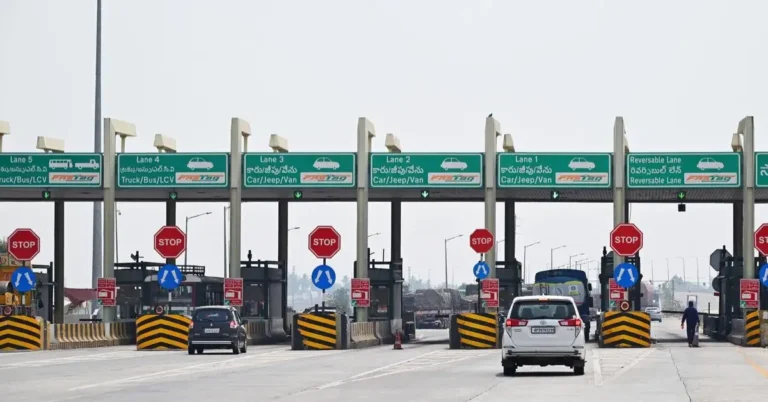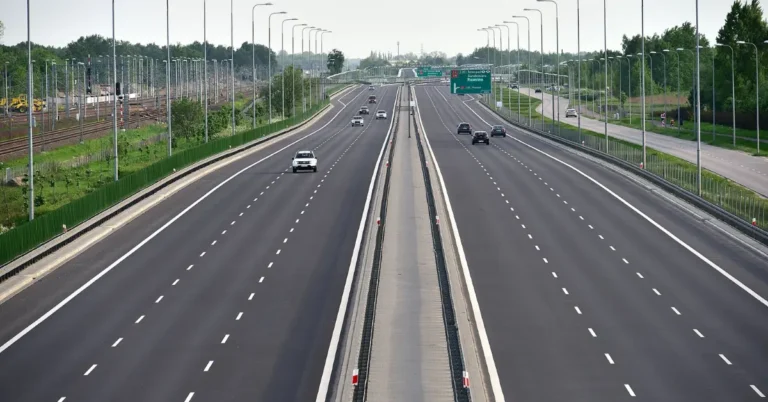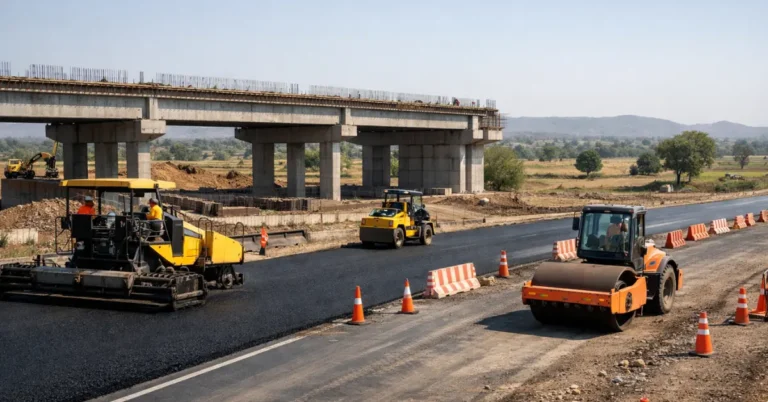
The Government has targeted operationalisation of 18,000 Km of Access Controlled National High Speed Corridors (HSCs) and expressways by 2028-29, Union Minister for Road Transport and Highways Nitin Jairam Gadkari informed the Rajya Sabha in a written reply.
The planned expansion is expected to significantly enhance logistics efficiency and act as a key driver of economic growth.
Gadkari also stated that a total of 26,000 Km of access-controlled highways and expressways are slated for award by 2032-33, signalling the Centre’s long-term infrastructure roadmap.
“Government has targeted to operationalize 18,000 km of Access Controlled National HSCs / Expressways by 2028-29. Also, total 26,000 km of Access Controlled National HSCs / Expressways are targeted for award by 2032-33,” Gadkari said.
Priority is also being given to the development of ring roads and bypasses for cities with populations above five lakh to ease congestion and improve traffic flow, the minister noted.
He added that the government is simultaneously focusing on strengthening port connectivity and linking industrial nodes under the National Industrial Corridor Development Corporation to support trade and manufacturing activity.
Read also : National highways to go digital-secure as NHAI arm IHMCL signs strategic MoU with NFSU
In his reply, Gadkari highlighted that India’s National Highway network has already witnessed substantial growth over the past decade, expanding from 91,287 Km in March 2014 to 1,46,572 Km at present.
Operational access-controlled High Speed Corridors and expressways have increased from 93 Km in 2014 to 3,052 Km currently, he added.
The quality of highways has also improved considerably.
The length of 4-lane and above National Highways has risen 2.6 times from 18,371 Km to 48,568 Km, while highways with less than 2 lanes have declined from 30 per cent of the network in 2014 to 9 per cent, improving accessibility for urban, rural, and industrial regions.
Citing findings from studies by the Indian Institute of Management, Bangalore, the minister noted that every one-rupee expenditure on National Highways leads to a ₹3.2 increase in Gross Domestic Product.
Travel time between factories and suppliers has reduced by 9.19 per cent, transit time to customers by 4.93 per cent, access time to schools by 16.6 per cent, and time taken to reach healthcare services by 9 per cent.
The average time to reach mandis has fallen by 7 per cent, while the number of mandis accessed has increased by 8 per cent.
Referring to a study by the Indian Institute of Technology, Kanpur, Gadkari said construction of 1 lane-Km creates direct employment of 4,478 person-days and indirect employment of 5,297 person-days, with long-term induced employment estimated at 52,393 person-days per lane-Km over a 7-year period.
The minister added that over the last five years alone, 57,125 Km of National Highways have been constructed, averaging 34,215 lane-Km annually and generating about 33 crore person-days of employment each year.
Read also : India’s mega highway development programme: 21,783 km length of Bharatmala projects constructed, says Govt