Indian scientists have developed a sunlight-powered, self-charging energy storage device that can both capture and store solar energy in a single unit, a breakthrough that could significantly advance clean and autonomous power systems for portable and off-grid applications.
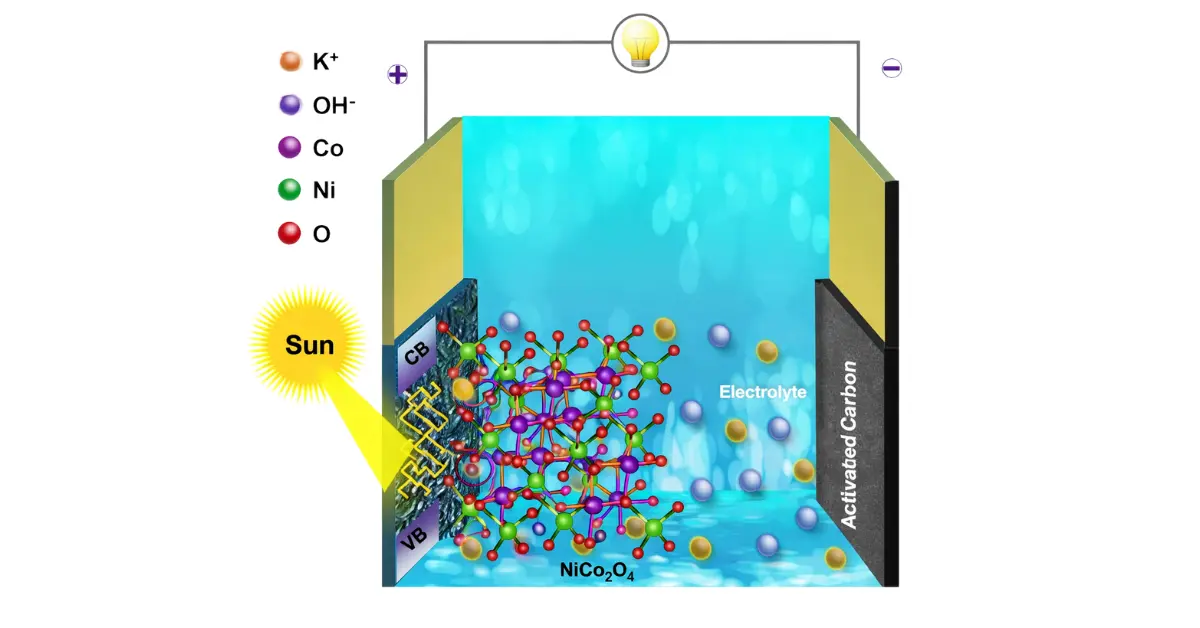
The innovation, described as a photo-rechargeable supercapacitor or “photo-capacitor,” has been developed by researchers at the Centre for Nano and Soft Matter Sciences (CeNS), Bengaluru, an autonomous institute under the Department of Science and Technology (DST). Unlike conventional solar systems that require separate solar panels and batteries, the new device integrates energy harvesting and storage within a single architecture, reducing system complexity, energy losses and physical footprint.
The key innovation lies in the use of binder-free nickel-cobalt oxide (NiCo2O4) nanowires grown directly on nickel foam using an in-situ hydrothermal process. These nanowires, only a few nanometres thick and several micrometres long, form a highly porous three-dimensional conductive network capable of absorbing sunlight while simultaneously storing electrical charge.
Read also : India Energy Week 2026 Commences With Call For Balanced Investment Across Conventional And Clean Energy
During testing, the NiCo2O4 electrode showed a 54 per cent increase in capacitance under illumination, rising from 570 to 880 millifarads per square centimetre at a current density of 15 milliamperes per square centimetre. The electrode retained 85 per cent of its original capacity even after 10,000 charge-discharge cycles, indicating long-term stability.
An asymmetric photo-supercapacitor assembled using activated carbon as the negative electrode delivered a stable output voltage of 1.2 volts and maintained 88 per cent capacitance retention after 1,000 photo-charging cycles, operating efficiently under lighting conditions ranging from indoor illumination to two-sun intensity.
Theoretical studies accompanying the experiments showed that nickel substitution narrows the material’s band gap to about 1.67 electron volts and induces half-metallic behaviour, enabling faster charge transport and higher electrical conductivity.
Published in Sustainable Energy and Fuels, the research introduces a new class of smart energy storage devices that could support India’s clean energy ambitions, particularly for remote regions without access to grid electricity.