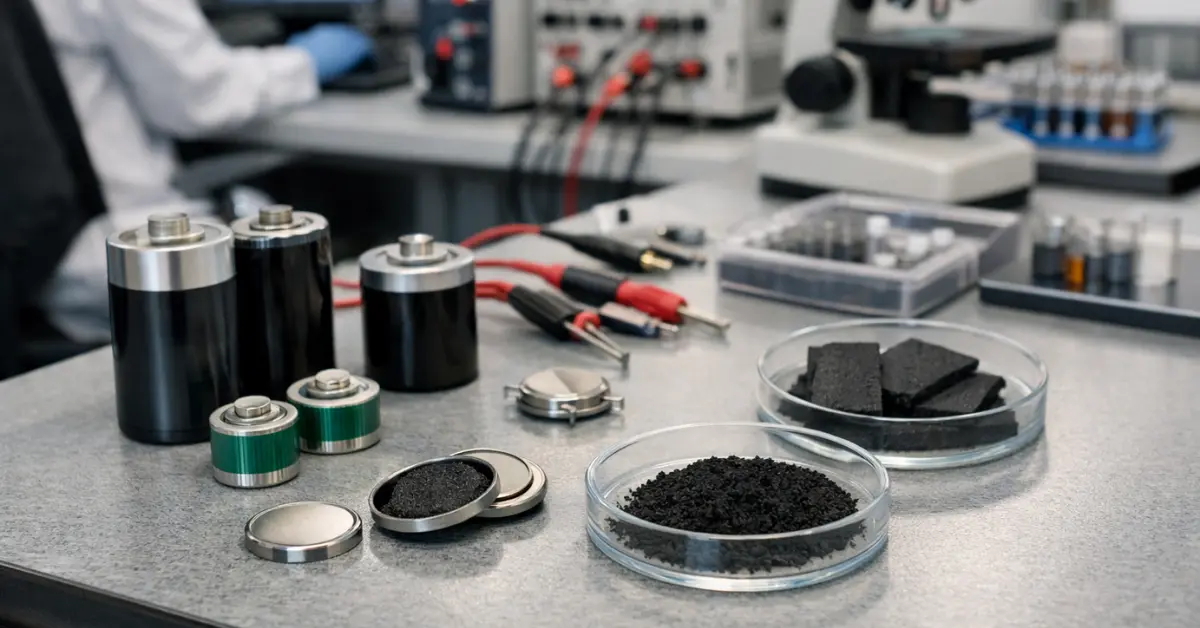
Indian researchers have developed a high-voltage supercapacitor using a dual-functional porous graphene carbon nanocomposite electrode that could significantly improve electric vehicle performance and renewable energy storage systems.
The new supercapacitor, developed at the International Advanced Research Centre for Powder Metallurgy and New Materials, an autonomous institute under the Department of Science and Technology, operates at 3.4 volts. This exceeds the typical 2.5 to 3.0 volt limit of conventional commercial supercapacitors, which often face safety and stability issues at higher voltages.
According to the release, the higher operating voltage helps overcome electrolyte instability and effectively doubles energy density. This allows electric vehicles to achieve increased driving range and faster acceleration, while also reducing the need to stack multiple low-voltage cells, simplifying overall module design.
The performance gains are attributed to the engineered surface of the porous graphene material, which is both water-repellent and highly compatible with organic electrolytes. This dual functionality limits water-induced degradation and enables faster electrolyte penetration into the porous structure, improving ion transport and electrochemical efficiency.
The supercapacitor delivers 33 per cent higher energy storage, high power output, and strong long-term stability. Test results show that the device retains 96 per cent of its performance even after 15,000 charge-discharge cycles, indicating high durability for practical applications.
The electrodes are produced using an eco-friendly hydrothermal carbonisation process at 300 degrees Celsius over 25 hours, achieving yields above 20 per cent and offering scalability from laboratory to industrial production. The resulting structure supports rapid ion transport and power density of up to 17,000 watts per kilogram.
Beyond electric vehicles, the technology is also suitable for grid-scale energy storage, solar power systems, and portable electronics. The research supports India’s clean energy objectives and the Aatma Nirbhar Bharat initiative by strengthening domestic capabilities in advanced energy storage technologies. The study has been published in the Chemical Engineering Journal and was supported by the Department of Science and Technology under the Technical Research Centre initiative.