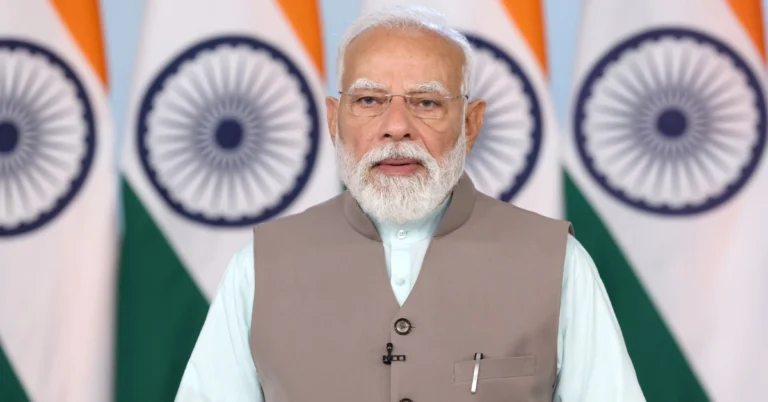

The Union Cabinet chaired by Prime Minister Narendra Modi has approved the launch of the Urban Challenge Fund with a total Central Assistance of Rs 1 lakh crore, aimed at accelerating market-led urban transformation across India.
The Central Assistance will cover 25 per cent of project costs, provided that at least 50 per cent is mobilised from market sources, a structure expected to generate nearly Rs 4 lakh crore in overall investment in the urban sector over the next five years.
According to the Cabinet release, the initiative marks a shift from grant-based financing toward a market-linked, reform-driven and outcome-oriented approach to infrastructure creation, while focusing on resilient, productive, inclusive and climate-responsive cities.
The Fund will remain operational from FY 2025-26 to FY 2030-31, with an extendable implementation window up to FY 2033-34, and aligns with the Budget 2025-26 vision covering Cities as Growth Hubs, Creative Redevelopment of Cities, and Water and Sanitation proposals.
According to the release, projects will be selected through a transparent challenge mode designed to prioritise high-impact and reform-oriented proposals, with funding linked to milestones, reforms and clearly defined outcomes.
A minimum of 50 per cent financing must come from municipal bonds, bank loans and Public-Private Partnerships, while States, Union Territories and Urban Local Bodies may contribute the remaining share.
To improve access to market finance, a dedicated Rs 5,000 crore corpus has been approved to enhance the creditworthiness of 4,223 cities, including Tier-II and Tier-III urban centres.
In addition, a Credit Repayment Guarantee Scheme of Rs 5,000 crore will support first-time borrowers among cities in Northeastern and hilly states, as well as smaller Urban Local Bodies with populations below 1 lakh.
The scheme will provide a Central guarantee of up to Rs 7 crore or 70 per cent of the loan amount for first loans, and Rs 7 crore or 50 per cent for subsequent loans, enabling projects worth at least Rs 20 crore initially and Rs 28 crore thereafter.
The Fund will cover cities with populations of 10 lakh or more, all State and Union Territory capitals not already included, and major industrial cities with populations exceeding 1 lakh.
Smaller cities and ULBs will be eligible through the guarantee mechanism, effectively bringing all cities within the framework in principle.
Funding is anchored to a reform agenda spanning
Governance and digital reforms;
Market and financial reforms to strengthen creditworthiness;
Operational reforms for improved service delivery and utility efficiency;
Urban planning and spatial reforms, including transit-oriented development and green infrastructure; and
Project-specific reforms with defined Key Performance Indicators (KPIs), third-party verification and sustainable Operation and Maintenance mechanisms.
Projects will be evaluated on their ability to deliver economic, social and climate outcomes such as revenue mobilisation, private investment, job creation, improved safety, inclusiveness and service equity.
The government expects the Urban Challenge Fund to catalyse large-scale private investment, strengthen urban governance and accelerate the creation of future-ready cities aligned with national development priorities.