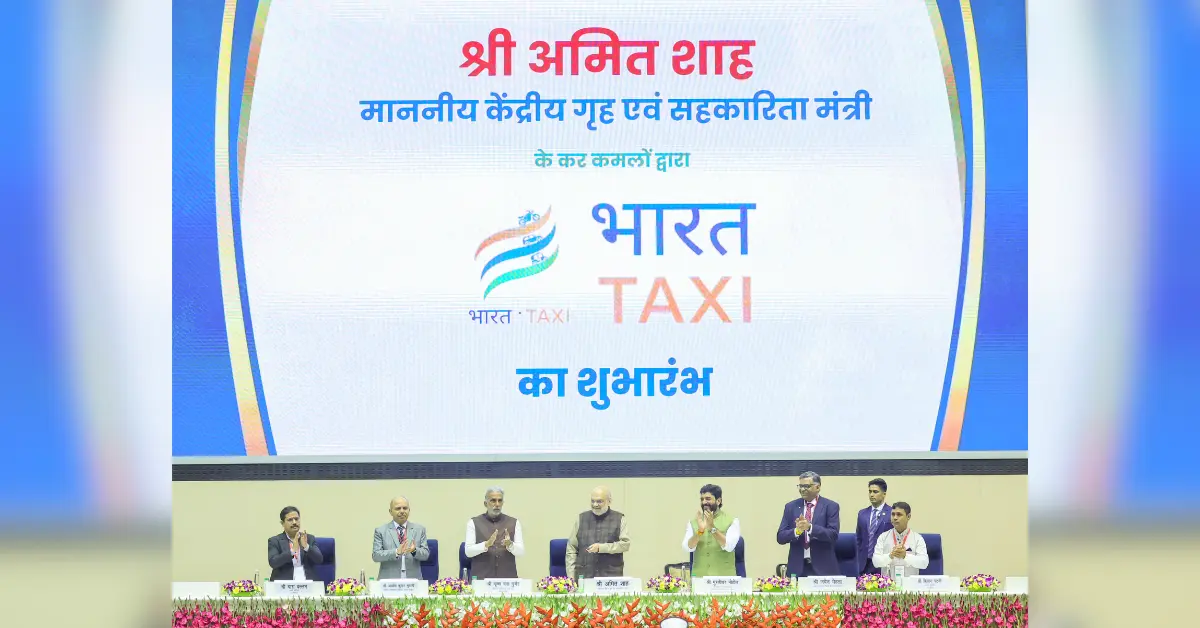
India on Thursday (5 February) unveiled a cooperative-run taxi service that seeks to place drivers at the centre of ownership, marking an unusual attempt to reshape the economics of the country’s rapidly expanding ride-hailing market.
Union Home and Cooperation Minister Amit Shah formally launched ‘Bharat Taxi’, describing it as a model designed for workers in the unorganised sector where the driver – referred to as a “Sarathi” – becomes the owner rather than an earning partner for large platforms.
More than 1,200 drivers from several States attended the launch event, which was preceded by a rally of 100 cars from Indira Gandhi International Airport to Vigyan Bhawan, underscoring the government’s effort to signal scale from the outset.
The service is structured around four principles – ownership, security cover, dignity and equitable distribution of dividends – and has been positioned as an alternative to commission-driven aggregator models.
“The government is not entering the taxi sector; rather, cooperation is entering the taxi sector,” Shah said, seeking to draw a distinction between state control and cooperative ownership.
Perhaps for the first time globally, he added, a taxi company is being created in which neither an individual nor an external firm is the real owner, but the driver who operates the vehicle.
The platform will retain only 20 per cent of total profit, with the remaining earnings credited to drivers, according to the minister.
The service will integrate four-wheelers, three-wheelers and two-wheelers, while a dedicated “Sarathi Didi” feature is expected to provide women passengers the option of being picked up by women drivers, aimed at improving safety and affordability.
The cooperative has signed memorandums of understanding with nine institutions – including the Delhi Traffic Police, Delhi Metro Rail Corporation, Airports Authority of India and State Bank of India – to support financing, airport operations, digital integration and last-mile connectivity.
Drivers associated with the platform will also be eligible for benefits such as free medical treatment up to five lakh rupees under the Pradhan Mantri Jan Arogya Yojana after registering on the e-Shram portal, along with access to loans, subsidies and insurance coverage.
The initiative comes as India seeks to expand ownership-based economic models within the cooperative sector, which has historically powered institutions such as Amul.
Established on 06 June 2025 and now commercially launched, Bharat Taxi is expected to expand nationwide within three years, beginning with operations in parts of Delhi-NCR and Gujarat.
Early participation figures point to more than 2.5 lakh drivers in Delhi-NCR and over 8.5 lakh passengers already associated with the platform, suggesting a rapid initial build-out ahead of the formal rollout.