India plans to achieve 7 nanometre semiconductor manufacturing capability by 2030 and 3 nanometre technology by 2032, as part of a phased roadmap for advanced chip production, Union Minister for Electronics and Information Technology Ashwini Vaishnaw said during interactions on the sidelines of the World Economic Forum Annual Meeting 2026 in Davos.
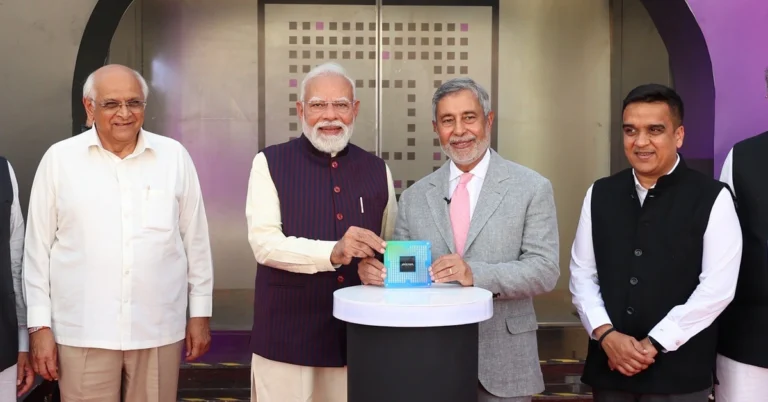
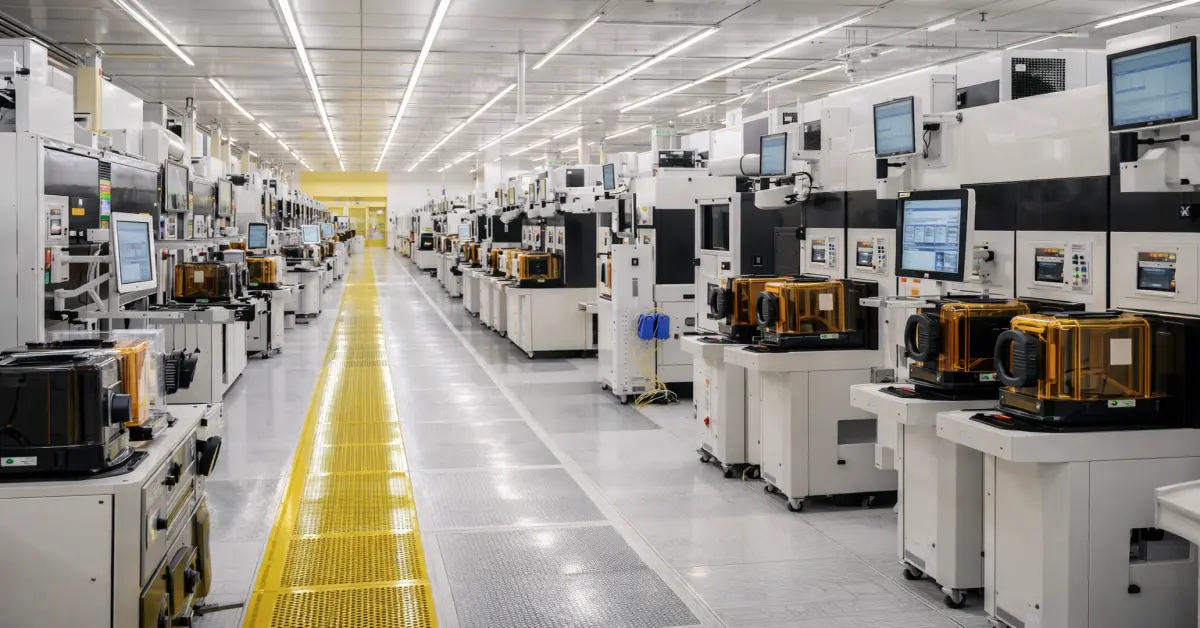
The minister said that four indigenous semiconductor manufacturing units are scheduled to begin high-technology chip production within 2026, marking the start of domestic fabrication at scale. India’s approach is focused on sequentially advancing from mature nodes towards cutting-edge processes, in line with global manufacturing trends.
Vaishnaw said that nearly 75 per cent of global semiconductor volume currently lies in the 28 nm to 90 nm range, which caters to sectors such as electric vehicles, automobiles, railways, defence systems, telecom equipment and consumer electronics. India’s strategy prioritises mastering manufacturing in this segment before transitioning to advanced nodes.
According to the minister, India is working with global technology partners, including IBM, to map a progression from 28 nm to 7 nm by 2030, followed by 3 nm by 2032. The minister said the country is building a complete semiconductor ecosystem covering design, fabrication, packaging, materials, gases and equipment.
The minister also noted that 24 Indian startups are currently engaged in chip design, with 18 having already secured venture capital funding, indicating growing private investment in deep-tech and semiconductor design capabilities.
On the artificial intelligence front, Vaishnaw said India is preparing to showcase its semiconductor and AI capabilities at the upcoming India-AI Impact Summit 2026, which will focus on AI impact, accessibility for the Global South and safety frameworks. He said the summit will feature investment announcements and the rollout of India’s AI models.
The release stated that India is working across the entire AI stack, including applications, models, semiconductors, data centre infrastructure and energy. Around USD 70 billion in AI infrastructure investment has already been confirmed and is under implementation, according to the minister.
Vaishnaw said that India is developing a set of around 12 focused AI models, designed to operate on smaller GPU clusters to deliver services at lower cost. He added that sovereign AI models are being developed to ensure resilience in the event of restricted access to global AI resources.
The minister also said that the government is supporting AI adoption by acting as a demand generator in sectors such as weather forecasting, agriculture and healthcare, while working with industry on skilling and curriculum development to prepare the workforce for semiconductor and AI-driven industries.