India has spent years building the legal map of its inland waterways. The harder part is now beginning: making more of those waterways actually work.
The country has 111 declared National Waterways, stretching 20,187 Km across 23 States and four Union Territories.
On paper, that is a large transport network running through rivers, canals, backwaters and creeks. In practice, only 32 National Waterways were operational as of March 2026, covering 5,155 Km.
That difference is the real story behind the latest push in the Union Budget 2026-27, which proposes to operationalise 20 more National Waterways over the next five years.
The announcement is not just about adding new routes to a list. India already has the list.
What it needs now is usable waterways – stretches where vessels can move regularly, cargo can be handled, and services can run without depending only on natural conditions.
A declared waterway becomes operational only after the basic pieces are in place.
It needs a navigable channel with enough depth and width. It needs terminals for berthing, loading and unloading. It needs navigational aids so vessels can move safely.
Without these, a waterway may exist in law, but not as a dependable transport route.
This is why the target of moving from 32 operational waterways to 52 over the next five years matters. It points to a shift from declaration to activation.
The government’s own case for inland waterways is straightforward.
Water transport can move freight at lower cost, use fuel more efficiently, generate fewer emissions and require less land than other modes.
It can also carry bulk and over-dimensional cargo, while easing pressure on congested roads and railways.
The sector is already showing signs of heavier use.
Cargo movement on National Waterways reached 145.84 million metric tonnes in FY 2024-25, the highest recorded so far.
In FY 2025-26, it had reached 198 million metric tonnes till February 2026.
Passenger traffic has also jumped, rising from 1.61 crore in 2023-24 to 7.6 crore in 2024-25.
As of November 2025, cargo operations were functional on 29 National Waterways, cruise operations on 15 and passenger services on 23.
Eleven National Waterways supported all three – cargo, cruise and passenger movement.
These numbers explain why the government is trying to bring more stretches into operation.
The functional parts of the network are no longer merely experimental. They are carrying cargo, passengers and tourism traffic.
The problem is that much of the declared network is still outside regular use.
The Budget also links inland waterways to a wider shift in freight movement.
A Coastal Cargo Promotion Scheme has been announced to move cargo from road and rail to water transport.
The stated aim is to raise the combined share of inland waterways and coastal shipping from 6% to 12% by 2047.
For inland water transport alone, the target is to raise modal share from 2% to 5%.
Cargo volume is expected to cross 200 million metric tonnes by 2030 and reach 500 million metric tonnes by 2047.
But those targets depend less on declarations and more on infrastructure.
National Waterway-5 in Odisha shows how the next phase is being framed.
The plan is to operationalise the route to connect the mineral-rich regions of Talcher and Angul with industrial centres such as Kalinga Nagar and the ports of Paradip and Dhamra.
That is the kind of corridor where inland water transport can have a clearer role – linking cargo-producing regions with industry and ports.
Along the same stretch, training institutes are proposed as Regional Centres of Excellence to develop skilled manpower and support local youth.
In addition, a dedicated ship repair ecosystem for inland waterways will be set up in Varanasi and Patna. This is important because a transport network does not run only on routes. It also needs vessels, trained people, maintenance facilities and repair capacity.
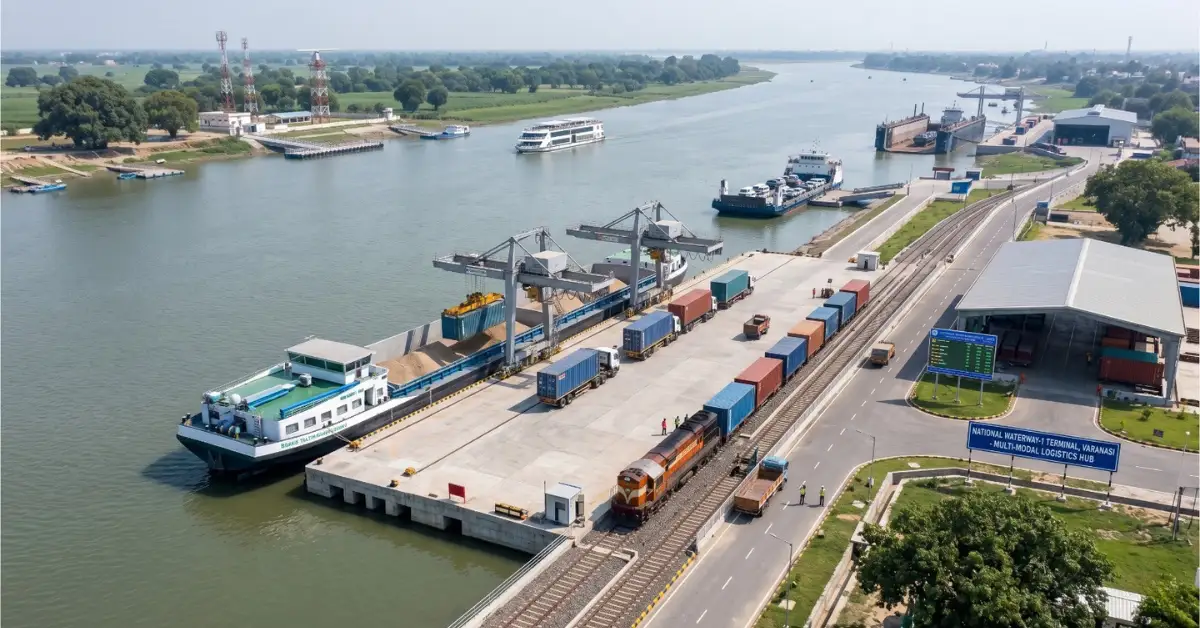
National Waterway-1 offers another example of what operationalisation involves.
The Jal Marg Vikas Project is being implemented on the 1,390 Km Varanasi-Haldia stretch of the Ganga-Bhagirathi-Hooghly river system.
The project aims to maintain an assured water depth of 2.2 to 3.0 metres for at least 330 days a year, allowing larger vessels of 1,500 to 2,000 DWT to move on the route.
A ₹5,061.15 crore project is underway on NW-1, targeted for completion by 30 June 2026.
Cargo movement on this waterway has grown by 220%, from 5.05 million metric tonnes in 2014-15 to 16.38 million metric tonnes in 2024-25.
The same pattern is visible in the North-East.
On National Waterway-2, the Brahmaputra River, development work during 2020-21 to 2024-25 cost ₹498 crore and included terminals at Bogibeel and Jogighopa, tourist jetties at Bogibeel and Pandu, regular fairway development and navigational aids.
On National Waterway-16, the Barak River, development since 2020-21 has cost ₹134.72 crore.
The works include upgraded terminals at Badarpur and Karimganj, fairway development, maintenance of navigational aids and procurement of amphibian dredgers.
The waterways push is not only about freight. River cruise tourism is also part of the plan.
River cruise voyages on National Waterways increased from 371 in 2023-24 to 443 in 2024-25.
Cruise vessels rose from 3 in 2013-14 to 25 in 2024-25, operating across 17 circuits on 13 National Waterways in nine states.
Digital systems are also being added to make operations more reliable.
CAR-D tracks cargo and cruise data. LADIS provides information on least available depth. River Information Services support vessel tracking, weather and water-level updates, and communication between vessels and control centres.
The IWAI Vessel Tracker and PANI Portal provide navigation routes, depth information and real-time vessel tracking.
Such systems matter because inland water transport depends heavily on predictable conditions.
Depth, water levels, weather and route information can decide whether a vessel movement is smooth, delayed or not possible.
The green transition has also been tied to the waterways plan.
The Harit Nauka guidelines aim to reduce carbon intensity of inland waterway-based passenger transport by 30% by 2030 and 70% by 2047.
They also set a roadmap for States to shift 50% of passenger fleets to green fuels by 2033 and 100% by 2045.
It also aims to green at least 1,000 inland vessels over the next 10 years and achieve 100% green vessels across all Indian water bodies by 2047.
Read also : India’s aviation hub push could generate 16 million jobs, add $1.4 trillion to economy by 2047