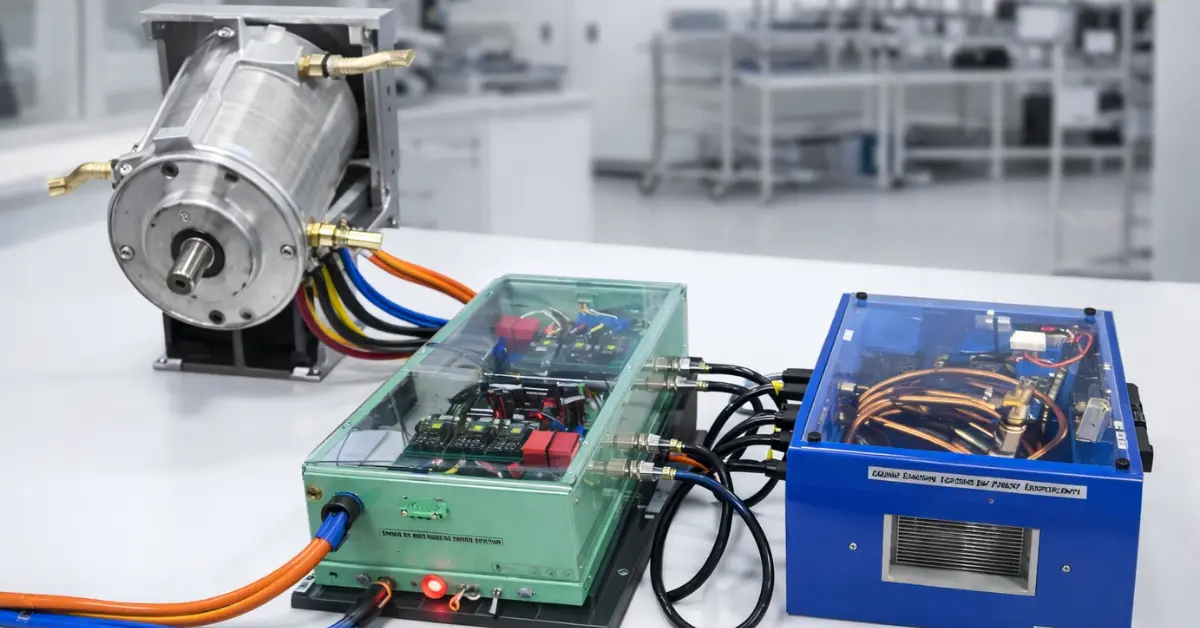
India has launched an indigenously developed 30 kW Wide Band Gap (WBG)-based Integrated Drive System (IDS) for electric vehicle applications, with the system unveiled in Chennai by MeitY Secretary S Krishnan.
The system was developed by the Centre for Development of Advanced Computing (C-DAC), Thiruvananthapuram, in collaboration with the Indian Institute of Technology Madras and Lucas TVS under the National Mission on Power Electronics Technology (NaMPET).
The launch was carried out at IIT Madras.
According to the ministry, the initiative marks a significant step toward strengthening India’s indigenous capabilities in advanced power electronics and supporting the country’s electric mobility transition.
The 30 kW power class is particularly relevant for India’s fast-growing electric passenger vehicle segment, including compact electric cars and fleet mobility platforms.
Indigenous development of integrated drive systems is expected to reduce dependence on imported EV powertrain components, lower system costs through localisation, and support domestic manufacturing aligned with national initiatives such as Production-Linked Incentive schemes.
According to MeitY, the integrated system combines the electric motor and inverter into a single compact, high power-density unit, replacing conventional separated motor-drive configurations.
The Silicon Carbide (SiC)-based system delivers a continuous power output of 30 kW and operates on a 320 V DC bus, with continuous torque of 110 Nm and a base motor speed of 3,000 rpm, extending up to 12,000 rpm operating speed.
It uses a liquid-cooled SiC MOSFET power module and DSP-based digital controller, enabling higher efficiency, wider speed range, and improved torque performance while reducing battery energy demand and extending vehicle driving range.
This design improves efficiency, enhances performance, and supports scalable manufacturing of electric vehicle components in India.
The technology has been designed, fabricated, and validated in collaboration with Lucas TVS and is now ready for commercialisation and large-scale deployment.
MeitY stated that adoption of such indigenous power electronics technologies can strengthen India’s EV supply chain, create opportunities for MSMEs in power electronics and control systems manufacturing, and enhance the country’s global competitiveness in electric mobility solutions.