
The government has amended the Aviation Turbine Fuel (Regulation of Marketing) Order, 2001, to bring aviation turbine fuel blended with Sustainable Aviation Fuel (SAF) under the ambit of India’s existing ATF regulatory framework.
The amendment, notified on 17 April 2026, expands the regulatory definition of ATF beyond petroleum-based fuel and formally covers SAF-blended aviation fuel.
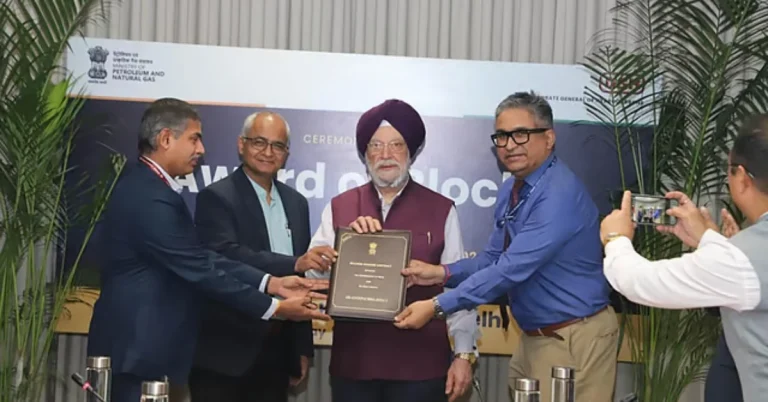
The Ministry of Petroleum and Natural Gas said the change has been issued as an administrative measure to bring ATF blended with SAF under the ATF Control Order.
The move is significant because it gives regulatory recognition to SAF-blended jet fuel at a time when international aviation is preparing for stricter carbon obligations under the International Civil Aviation Organization’s Carbon Offsetting and Reduction Scheme for International Aviation, or CORSIA.
According to the ministry, SAF consists of specially processed aviation-grade hydrocarbons that are chemically similar to conventional ATF and are fully compatible with aircraft engines. It said SAF does not alter the fundamental nature, safety or performance of aviation fuel.
SAF used in aviation undergoes a rigorous testing process recognised by ICAO and ASTM International before it is accepted for use in aircraft engines.
In India’s regulatory framework, the amendment covers SAF co-processed alongside ATF in petroleum refineries as per IS 1571, as well as SAF conforming to IS 17081 blended with ATF and meeting IS 1571.
Before the amendment, ATF was defined only as petroleum-based fuel meeting Bureau of Indian Standards specifications.
The revised framework now removes that regulatory limitation by including SAF-blended fuel within the recognised ATF category.
The amendment does not by itself create a fresh domestic blending mandate for all flights.
Its immediate purpose is to create an enabling regulatory provision so that India can operationalise its already announced indicative SAF blending targets for international flights.
India has announced indicative SAF blending targets of 1% in 2027, 2% in 2028 and 5% in 2030 for international flights.
These targets are linked to the global aviation sector’s carbon compliance requirements, particularly CORSIA.
CORSIA’s mandatory phase begins in 2027 and will require international flights to offset emissions above a baseline level.
SAF can reduce the offsetting burden for airlines, provided the fuel meets CORSIA’s sustainability criteria and qualifies as CORSIA-eligible fuel.
The ministry said SAF can be produced from alternative feedstocks such as crops, biogenic residues and waste materials, and can offer significant reductions in greenhouse gas emissions.
However, for CORSIA purposes, SAF must meet both strict fuel quality standards and sustainability criteria.
Globally, several aviation markets are moving from pilot-stage SAF adoption to formal mandates or incentive-backed programmes.
The European Union has introduced a ReFuelEU Aviation mandate beginning with 2% SAF in 2025, rising to 6% in 2030 and up to 70% by 2050. The United Kingdom’s SAF mandate also begins at 2% in 2025 and is set to rise to 10% in 2030 and 22% in 2040.
Read also : India Records Highest-Ever Wind Capacity Addition Of 6.1 GW In FY26, Total Installed Capacity Crosses 56 GW
Singapore has said flights departing from the country will be required to use SAF from 2026, starting with a 1% target and rising to 3-5% by 2030, subject to wider availability and global developments.
Japan has set a goal of using 10% SAF in aviation fuel consumption by 2030, while the United States is pushing SAF largely through production incentives, including a target of 3 billion gallons of domestic SAF production per year by 2030.
For India, the amendment marks a regulatory step rather than a production breakthrough.
The country still faces the larger challenge of building domestic SAF supply chains, ensuring feedstock availability, creating certification systems and keeping blended fuel commercially viable for airlines.
The cost gap between SAF and conventional jet fuel remains one of the biggest barriers globally.
SAF is typically more expensive because of limited production capacity, feedstock constraints and the still-developing nature of refining pathways.
This means adoption is likely to depend on a mix of regulation, incentives, airline demand and refinery investment.
India’s aviation sector is also expanding rapidly, making fuel policy more consequential.
Any shift towards SAF will have to balance emissions reduction goals with airline operating costs, passenger demand, refinery readiness and international compliance requirements.
The amendment, therefore, should be read as a foundational regulatory change.
It brings SAF-blended ATF into India’s formal fuel marketing framework, aligns domestic rules with emerging international aviation fuel standards and prepares the ground for future blending under global carbon compliance requirements.
With CORSIA’s mandatory phase approaching in 2027, the change gives India a legal and regulatory basis to integrate cleaner jet fuel into aviation supply chains without treating SAF-blended ATF as a separate or legally ambiguous fuel category.