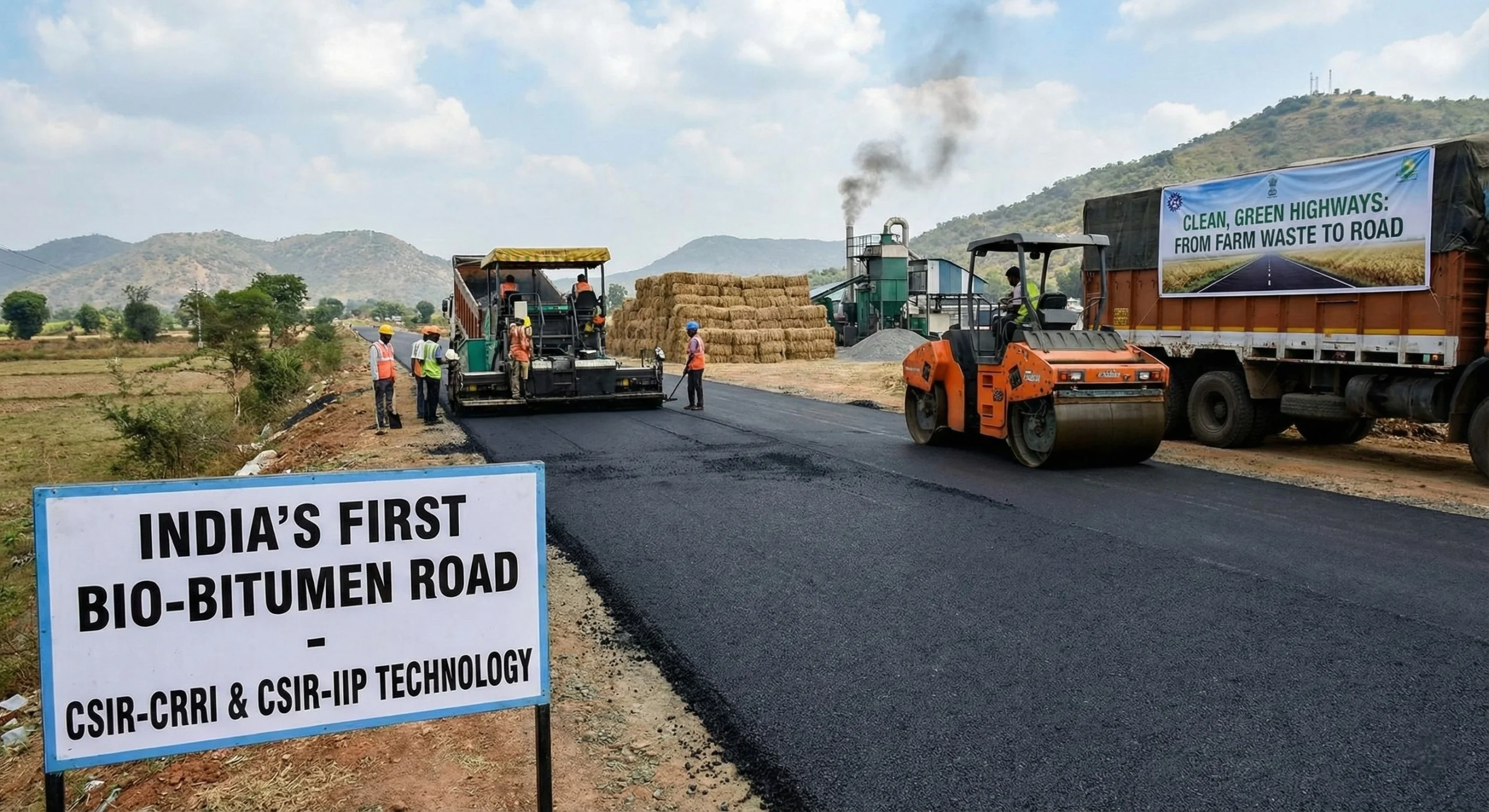
India has taken a major step towards sustainable road infrastructure with the successful technology transfer of an indigenous bio-bitumen process developed by CSIR-Central Road Research Institute and CSIR-Indian Institute of Petroleum, the Union government announced on December 7.
Speaking at the technology transfer event in New Delhi, Union Minister of State for Science and Technology Dr Jitendra Singh said the development marks a shift towards clean and green highways, with road construction moving away from fossil-fuel dependence and adopting bio-driven and circular economy solutions.
Bio-bitumen is produced through the pyrolysis of agricultural residue, particularly post-harvest rice straw, converting farm waste into a usable road construction material. The process involves collection of crop residue, pelletisation, pyrolysis to generate bio-oil, and blending with conventional bitumen.
India currently imports nearly 50 per cent of its bitumen requirement. The adoption of bio-bitumen is expected to reduce import dependence while strengthening domestic road construction capabilities and addressing environmental challenges such as stubble burning.
The technology has undergone extensive laboratory evaluation, including physical, rheological, chemical, and mechanical characterisation. Performance tests have covered parameters such as rutting, cracking resistance, moisture damage, and resilient modulus.
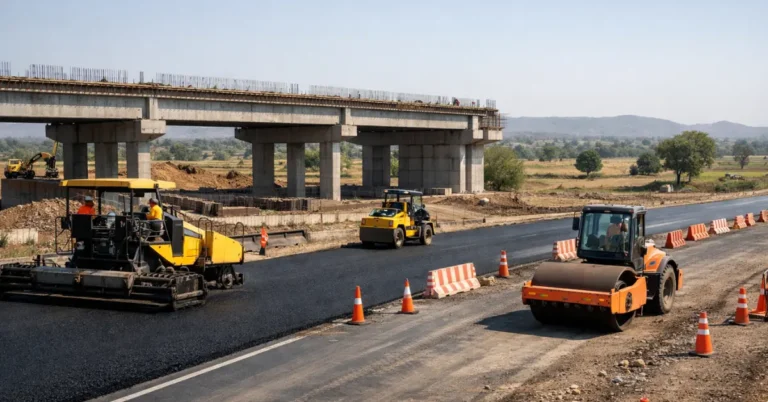
Field-level feasibility has been demonstrated through a 100-metre trial stretch laid on the Jorabat–Shillong Expressway (NH-40) in Meghalaya, validating the technology under real-world conditions.
According to the Ministry of Science and Technology, a patent has been filed for the process and multiple industries have been onboarded for commercial deployment. Laboratory and field trials indicate that 20 to 30 per cent of conventional bitumen can be replaced with bio-bitumen without compromising performance, resulting in lower costs and reduced environmental impact.
CSIR Director General N Kalaiselvi said India has become the first country globally to take bio-bitumen technology from development to industrial and commercial scale within the same year. She added that the pyrolysis process yields multiple value streams, including bio-binders for roads, gaseous fuel, bio-pesticide fractions, and high-grade carbon suitable for batteries, water purification, and advanced materials.
She also proposed policy-level blending of bio-bitumen to enable pan-India adoption of the technology across national and state highway projects.