India currently has eight nuclear power reactors under construction and twelve reactors at the pre-project stage, together accounting for a total planned capacity of 14,600 MW, the government informed the Parliament earlier this week.
In a written reply to a question on India’s nuclear capacity expansion, Union Minister Jitendra Singh said, “At present, eight nuclear reactors are under construction and twelve rectors are under implementation at the pre-project stage, together accounting for a total capacity of 14600 MW”.
According to the information provided by the minister, the nuclear reactors under construction are spread across Rajasthan, Tamil Nadu, Haryana and Karnataka, while the pre-project activities cover proposed sites in Karnataka, Haryana, Madhya Pradesh, Rajasthan and Tamil Nadu.
These projects form a key part of India’s long-term clean energy and energy security strategy.
Read also : India’s First Locally Built C-295 Aircraft To Roll Out Before September 2026, Says Jaishankar
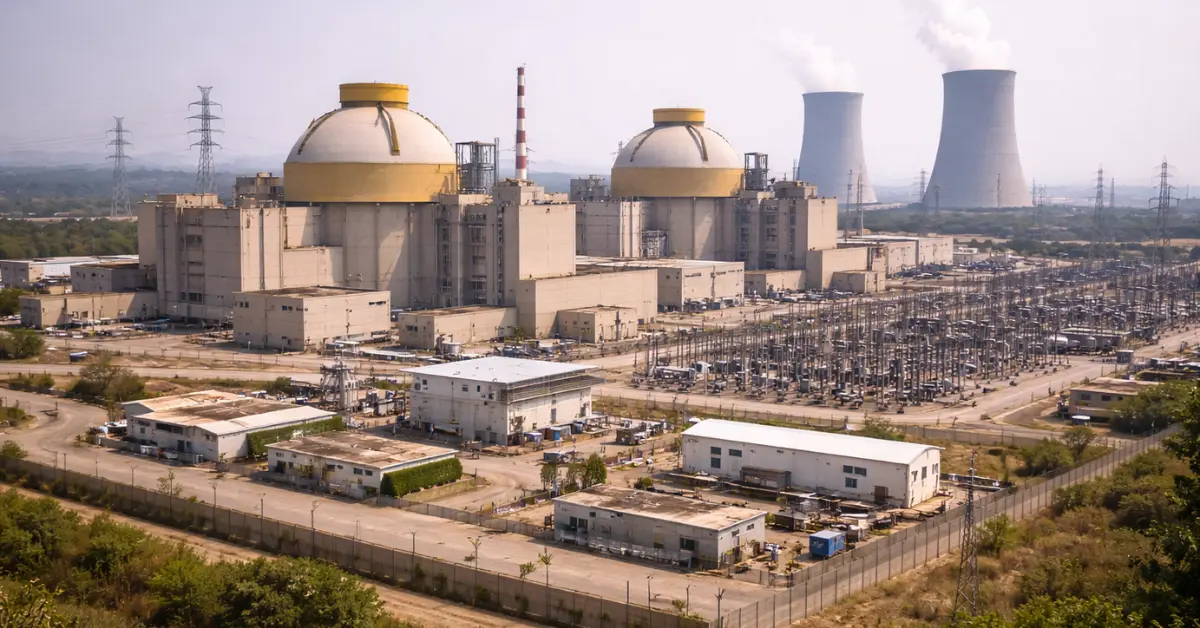
Among the reactors under construction are units at Rawatbhata in Rajasthan, Kudankulam and Kalpakkam in Tamil Nadu, and Gorakhpur in Haryana, with capacities ranging from 500 MW to 1,000 MW per unit.
The Nuclear power projects at pre-project stage include additional units at Kaiga, Gorakhpur, Chutka, Mahi Banswara and Kalpakkam, where preparatory activities such as land acquisition, statutory clearances and project planning are underway.
Several of the ongoing projects involve indigenous Pressurised Heavy Water Reactor technology, while certain units, including those at Kudankulam, are being implemented with technical collaboration from the Russia.
The minister said that nuclear power is a clean and environment friendly, base load source of electricity available 24X7, apart from having a huge potential to ensure the country’s long term energy security.
“The lifecycle emissions of nuclear power are comparable to those of renewables like hydro and wind. Thus, nuclear energy will contribute significantly in India’s clean energy transition towards Net Zero by 2070,” the minister said.
The minister also noted that recent policy changes, including the enactment of the SHANTI Act, 2025, are expected to enable greater private participation in future nuclear projects.
Read also : DRDO likely to create separate wing for high-risk, high-impact research