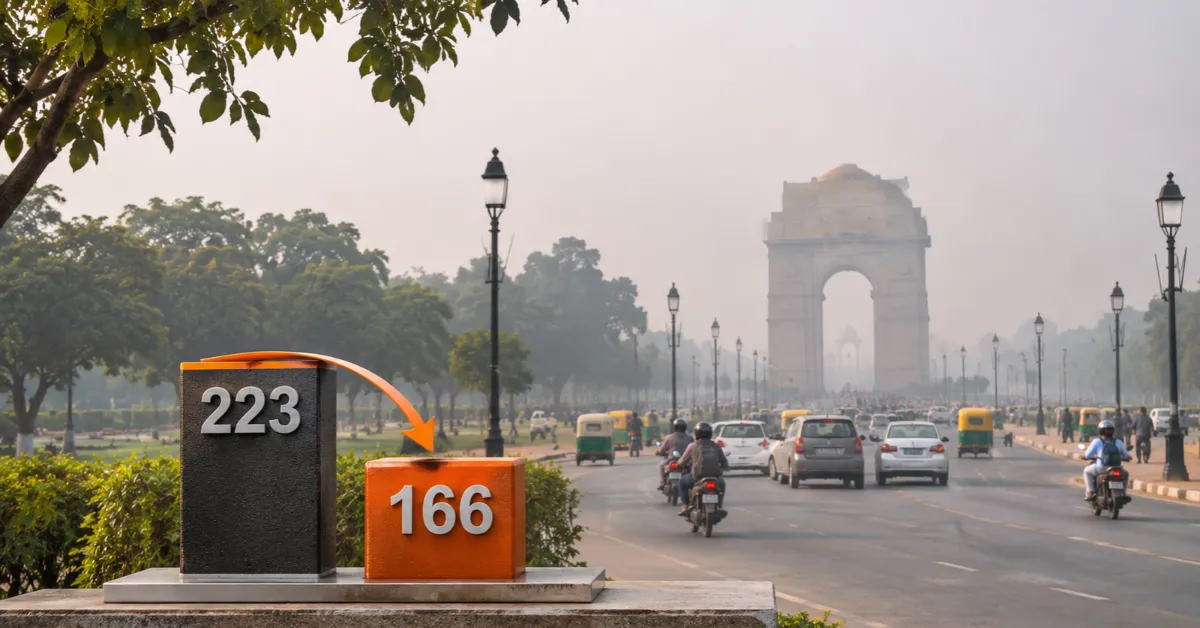
New Delhi, November 1, 2026: Delhi recorded its lowest average October Air Quality Index (AQI) since 2018, with the reading falling to 166 in 2026 from 223 in October 2025, a decline of approximately 26%, according to figures released by the Ministry of Environment, Forest and Climate Change on October 31.
The improvement brought the city’s average October AQI into the ‘Moderate’ category, compared with the ‘Poor’ category recorded during the same month last year. However, an AQI of 166 still indicates air pollution and does not mean the capital’s air is free from health risks.
The ministry’s figures show that Delhi’s average October AQI was 234 in 2024, 219 in 2023, 210 in 2022, 173 in 2021, 265 in 2020, 234 in 2019 and 269 in 2018.
However, differences in the timing of Diwali complicate direct year-on-year comparisons. The festival fell on October 20 in 2025 but falls on November 8 in 2026, meaning that festival-related pollution occurred in different months in the two years.
An independent analysis of daily pollution data found that October 2026 still recorded the lowest average AQI after excluding Diwali and the following three days from the comparison, although the improvement over 2025 was smaller.
Delhi also recorded 220 days with a daily average AQI below 200 between January 1 and October 31, compared with 200 days during the corresponding period in 2025.
This was the highest number of such days since 2018, excluding 2020, when the capital recorded 224 days with an AQI below 200.
The number of days with an AQI above 200 declined to 84 during January–October 2026 from 104 in the same period last year, indicating fewer days in the ‘Poor’ and more severe air-quality categories.
For the first ten months of 2026, Delhi’s average AQI stood at 167, compared with 170 during the corresponding period in 2025. However, it remained higher than the average of 156 recorded in 2020.
The ministry also reported a decline in fine particulate pollution. The average PM2.5 concentration between January 1 and October 29 fell to 69 micrograms per cubic metre from 72 during the same period in 2025.
PM2.5 consists of tiny airborne particles that can penetrate deep into the lungs and pose health risks, particularly to children, older people and those with respiratory conditions.
However, the improvement was not consistent across all pollution indicators. The average PM10 concentration increased to 171 micrograms per cubic metre between January 1 and October 29, 2026, compared with 166 during the corresponding period last year.
PM10 includes larger inhalable particles, such as dust, indicating that particulate pollution remains a concern despite improvements in overall AQI and PM2.5 levels.
The Commission for Air Quality Management (CAQM) said it was continuing to work with the relevant authorities to prevent and control pollution across Delhi-NCR and would intensify its efforts in the coming days.
The latest figures indicate an improvement in Delhi’s air quality, particularly during October, but they do not establish that pollution levels will remain lower during November and December.
As winter approaches and particulate pollution remains elevated, the capital’s air quality continues to be a concern despite the improvement recorded in October.
Read also: Mayors could get five-year terms and more control over city budgets as Urban Conclave calls for municipal reforms