New Delhi, October 27, 2026: The central government has amended vehicle emission certification rules to facilitate the introduction of flex-fuel vehicles capable of running on high-ethanol fuels, including E85 and E100. The changes will enable manufacturers to certify compatible vehicles under the revised framework without requiring owners of existing petrol vehicles to switch fuels or modify their engines.
The Ministry of Road Transport and Highways (MoRTH) announced the amendments to the Central Motor Vehicles Rules, 1989, on October 26, expanding the regulatory provisions for vehicles designed to operate on higher ethanol blends.
The amendments expressly include E100 alongside E85 in the relevant emission certification requirements. Vehicles designed to use these fuels must comply with the applicable standards for their respective categories.
E85 is a petrol-ethanol blend containing up to 85% ethanol by volume, while E100 consists predominantly of ethanol. Both fuels require vehicles specifically designed and certified to operate on high-ethanol blends.
Flex-fuel vehicles are engineered to use different combinations of petrol and ethanol within the range approved by their manufacturers. Unlike conventional petrol vehicles, they incorporate fuel-system components compatible with the specified blends and engine management systems that automatically adjust to changes in fuel composition.
This allows compatible vehicles to operate on different approved fuel blends without separate fuel tanks or manual adjustments to their engine settings.
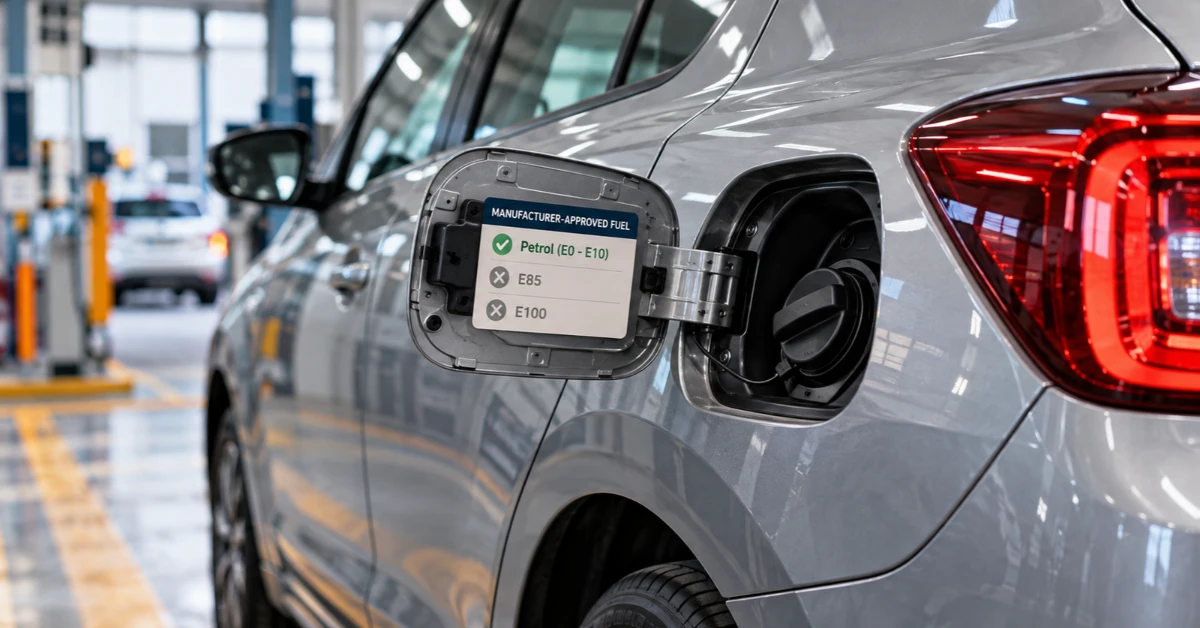
However, the ministry clarified that vehicles currently compatible with E10 or E20 cannot automatically be considered suitable for E85 or E100.
Motorists must follow the fuel specifications declared by their vehicle manufacturers. Compatibility with lower ethanol blends does not necessarily mean that a vehicle can safely operate on fuels containing substantially higher ethanol concentrations.
The government also stated that the amendments do not require owners of existing petrol vehicles to convert them to flex-fuel technology, either immediately or in the future.
Vehicle owners have been advised to check their fuel-compatibility stickers and owner’s manuals before selecting fuel at a filling station.
The regulatory changes are intended to support the development and certification of vehicles capable of using higher ethanol blends rather than impose new fuel requirements on vehicles already in use.
According to the ministry, increased use of domestically produced ethanol could help reduce India’s dependence on imported crude oil.
The use of ethanol in appropriately designed vehicles may also reduce certain exhaust pollutants and greenhouse gas emissions. However, the environmental benefits depend on factors such as the ethanol feedstock, production process and vehicle technology.
Flex-fuel technology is already used in countries such as Brazil and the United States, where compatible vehicles operate on different petrol-ethanol blends.
Alongside the provisions concerning E85 and E100, the government has updated biodiesel-related requirements and made technical corrections to the motor vehicle rules.
The amendments will take effect on the date of their publication in the Official Gazette.
The ministry has not announced a nationwide rollout date for E85 or E100 at fuel stations, identified manufacturers planning to launch compatible vehicles or introduced any requirement for existing motorists to replace their vehicles.
The changes establish a regulatory pathway for vehicles capable of using higher ethanol blends, while fuel compatibility for existing vehicles remains subject to manufacturers’ approved specifications.
Read also: SRF approves ₹600 crore aluminium foil plant in Madhya Pradesh, targets EV battery and energy storage markets